
Curious about what’s behind Best Foot Forward? Explore my author notes about the historical details behind the book.
These notes do contain some plot spoilers! Otherwise, they’re as shared at the end of the book, with edits only to share the most useful links and cleaning up some formatting for the web. Posted April 2026.
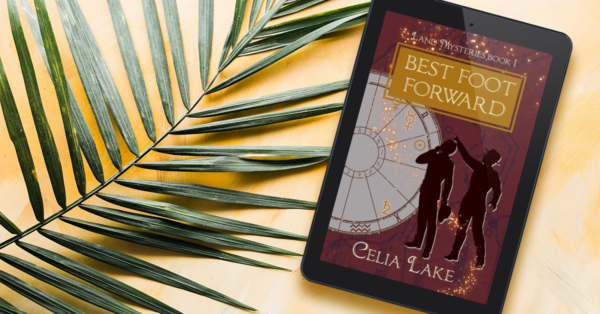
Thank you so much for joining me on this trip from Albion to Austria to Germany, and into an entirely different period of history. Best Foot Forward is the first of a seven book series exploring World War 2, the land magic, and the many kinds of relationships we have in our lives. Keep an eye on my website or sign up for my newsletter for all the details of new and upcoming releases!
My particular thanks to my editor, friend, and other half of my brain, Kiya Nicoll. This book comes from a comment Kiya made while editing Eclipse (in chapter 14), saying: “I now sort of want the buddy cop story in which Alexander and Carillon team up to utterly destroy a munitions smuggler.” Every one of my early readers for Eclipse agreed. I’m so glad I figured out how to write something that has that spirit. Even if a number of details are not quite the same!
Also, an additional thanks to Maren Richter, who kindly provided some corrections to the German in these pages. Much appreciated!
A number of the characters in this book appear in my other books (and will likely continue to appear). My authorial wiki has the most up to date information. Geoffrey Carillon is thus far introduced in Ancient Trust (1922, when he inherits the title from his brother), has his romance with Lizzie in Goblin Fruit, marries her in On The Bias. Alexander is a secondary character in Eclipse.

This book references a tremendous amount of music, thanks to Alexander and Geoffrey both having a longstanding passion for it. Albion (and the magical community) of course have their own composers. For example, Alexander references Reticelle and the Illusionist school of composers in chapter 1. However, for most of the book, it’s the non-magical composers who matter.
There’s also a story about the music in this book. I started music lessons when I was very small, and continued them up through a music major in college (focused on theory and composition, though at various points I’ve sung, and played piano, flute, bassoon, and folk harp). My last semester in college, however, I had a completely destructive class. It was supposed to be a conducting class, but instead, much of our grade depended on repertoire and “drop the needle” tests, where we’d have to identify a given piece we’d studied from 15 seconds of music from anywhere in the work, and give the title, movement, key, instrumentation, and other details.
We had three Beethoven symphonies on every exam as well as eight or so other pieces, so I spent a lot of that semester in 1998 (which was after portable CD players, but before any kind of streaming music access) walking around going “It’s the third movement of Beethoven something, but I have no clue which one.” It destroyed my ability to listen to most classical music for decades (aka between 1750 and 1900 or so, in Western Europe).
Somehow, Alexander and Geoffrey dragged me back into listening to it – into being able to listen to it – in a way I never expected.
And so, I put together a playlist of the music referenced in the book, chapter by chapter, and this page describes the pieces and why they’re in the list in detail. There are also links from the book page for Best Foot Forward and the wiki.
That quite long post includes explanations of the pieces and their implications or why they were chosen. The two particular concerts Alexander and Carillon attend in Vienna and Berlin are both actual performances with some complex and fascinating history behind them. Other pieces reference composers of the day, particular styles of music, or give you a glimpse at the intricate insides of Carillon’s head.
Normally, I listen to instrumental music that sets a mood when writing, but once I started writing Best Foot Forward, I’d listen to whatever segment of the playlist was relevant to what I was writing or editing. So for this book, you can listen to exactly what I was listening to! Check out the music post for all the details about specific pieces, though I’ll mention a couple of the concerts here as well.
With the music sorted, let me work through the book in chronological sequence. It’s really the only way to keep anything in order here.
Chapter 1 : The book opens with a gala fundraising performance at the Trellech Opera House, the main large orchestral and choral performance space in Trellech, the largest magical city of Albion. Lizzie and Carillon deliberately lured Alexander by means of music, including a piece they had reason to suspect he’d find intriguing, Hector Berlioz’s Les Troyens, an epic French opera completed in 1863, but only performed in full for the first time at the 1890 performance that Alexander attended. Luise Reuss-Belce was a famous soprano of the period who sang Cassandre’s role in that performance, and had recently retired in 1933 after a long career first as a singer and then as a voice teacher and opera director.
Chapter 2 : My background research for this book included reading up on the state of research into gasses and chemical warfare in the 1930s. Not at all cheerful reading! I found A Higher Form of Killing: The Secret History of Chemical and Biological Warfare by Robert Harris and Jeremy Paxman particularly helpful in putting a lot of different pieces into context. Especially helpful was learning that in the 1920s and 1930s, British and German research in these fields was rather more advanced than American research.
Chapter 3: Carillon references Debussy’s music, and the way it uses different scales and tonal centers, including pentatonic scales, whole tone scales, and modes not commonly used in classical music of the period.
Chapter 4: I loved the chance to revisit some other characters. Alysoun and Richard have their romance in Pastiche, while Gabe and Rathna find theirs in The Fossil Door. Kate and Giles meet and fall in love in Wards of the Roses. Giles’ guide dog is quite new to him – they only started being introduced in English-speaking countries in the early 1930s.
Chapter 6 : Carillon has spent a pleasant season in Vienna in the past, including a delightful interlude with an operatic soprano. Der Rosenkavelier had the advantage of being recent enough, first performed in 1911, that he’d not seen it on his extended stay in the city on his nominal Grand Tour in 1908. (While Carillon tended to prefer men for dalliance, the women he spent time with before Lizzie tended to be musicians dedicated to their art.)
The concert that Bruno Walter conducts is from March 10th, 1935. Comments on the playing style of the orchestra and Walter’s conducting come from various reviews of the orchestra and online bios of Walter himself.
I couldn’t resist a brief reference to Roderick Sterling-Wise here. The other artists are largely real people, but you can learn more about Sterling-Wise and his art in Fool’s Gold.
Chapter 7 : First, setting any of this in Vienna is a nod to my maternal grandparents, who were living in a flat in Vienna in 1935. They’d been married about 9 months when the book takes place, and my mother was born in late 1936.
Naturally, I couldn’t set a book in Vienna and not spend a little time in the Prater. It is one of the city’s great parks, originally a hunting park for the emperor, then a public park with amusements ranging from cafes to performances to carnival rides. The Ferris wheel there is magnificent, and indeed built by Englishmen. Obviously, the perfect place for an entirely private conversation.
Alexander and Carillon both agree that Dufay’s Nuper rosarum flores is a gem. It was written for the consecration of the duomo of Florence, and for many years it was thought to represent the architecture of the building in the structure of the music. (More recent research had looked at this and said, approximately, “Can you people even count?” because the numbers don’t add up.)
Chapter 9 : Starting around 1846 (and the discovery of Neptune), there were a lot of theories about a Planet X, out beyond Neptune’s orbit. X in this case stands for “unknown”, not the Roman numeral ten. Pluto was discovered in 1930, and people thought it might be the Planet X. These days, Pluto is not considered a planet, and we still wonder about some massive planet out around the Kuiper Belt that affects orbits of objects we can see, even if we can’t see that planet itself.
For a discussion of the Schola houses and how they play out for people, see Eclipse for more. In brief, Alexander was sorted into Fox, and as Carillon says late in the book, it might have been meant as a favour, but that doesn’t mean it was. Alexander, by innate preference, is much better suited for Owl, or arguably for Seal. (Seal is the most liminal of the houses, and the one that tends to get people who don’t fit societal assumptions in some ways).
Chapter 10 : I was delighted both to find historical records of the weather in Berlin in 1935, and that the weather was as awful as I wanted it to be for narrative purposes. Namely, several weeks of rain with bits of hail and downpour and other misery, keeping Alexander and Carillon indoors and around other people.
The Berlin Zoo is as described, thanks to surviving detailed maps. The “human zoo” was also an unfortunate reality, mostly made up of imported individuals from Africa and other far away countries put on display. The comment Carillon makes about a polar bear living in the Tower of London and being taken to fish in the Thames is entirely true. (And one of these days, I hope to write something that makes more of the history of the Tower of London menagerie.)
The music post linked earlier has more detail on the famous Furtwängler concert on April 25th, a particular political statement where Furtwängler agreed to conduct, and the German government wanted to make a point. He was in fact called back on stage seventeen times. In a later concert that spring, there’s quite some chaos when he arranges to be unable to shake Hitler’s hand (or to salute).
Chapter 11 : Goethe, Shiller, and Schubert are some of the foremost German creative minds of the 18th and 19th centuries. A nod, here without getting in too deep.
Chapter 12 : Having gone to a concert featuring Beethoven’s Sixth and Fifth symphonies, played in that order, it’s a natural starting point for the discussion here. And, as it turns out, the Fifth provides an excellent metaphor for the rest of that scene.
Chapter 14 : In the return to England, we have a bit of joyous expansive music (Mozart’s Jupiter symphony, the 41st). Carillon got to know Hippolyta FitzRanulf in Ancient Trust (a free novella). She also appears in In The Cards.
Chapter 15 : Excavations in Memphis (the city in Egypt, once a capital city) had been done by the University of Pennsylvania. Memphis, like all Egyptian cities, had particular gods that it honoured above others, but the gods vary city to city. The Memphite Triad is Ptah, a crafting god, as well as Sehkmet and either Nefertem or the deified mortal Imhotep as their child. You can see more of Ibis in Magician’s Hoard and Chasing Legends.
Chapter 16 : I have known for a very long time that Carillon had trained and hunted with an eagle-owl (Theodora), and had to give up flying her after the injury to his shoulder during the Great War. But I had not, exactly, articulated bits of this to myself until Kiya and I were chatting in February of 2022 as I was writing this. It honestly hadn’t occurred to Kiya that I hadn’t entirely twigged to the fact that Carillon kept walking into hunting parties carrying an eagle-owl, rubbing everyone’s noses in the fact he’s sorted into Owl House and not Fox House (as most people of his background are likely to be). Over and over. Repeatedly.
Brains are very odd things, is what I’m saying here. And so I had to give the joke and the resulting ‘rolling on the floor laughing now’ moment to Alexander.
Anyway, by the time of Best Foot Forward he has retired the merlin he began flying in 1922, named Helena, and now flies another merlin named for an empress, Hildegard. (In this case, named for one of Charlemagne’s wives.) Merlins are absolutely tiny birds, and as noted, they are often considered a lady’s bird.
Lady Juliana Berners is as described. Her Boke of St Albans was published in 1486, just after the Pact and also in the very early days of the printing press, making it of interest to Alexander and Carillon for a variety of reasons. She also wrote what is considered to be the first work on fly fishing. (According to a friend, quite useful for the purpose, if you adapt for modern materials and restrictions on feathers from migratory birds.)
Chapter 17 : Richard Haliburton was a famous adventurer, widely considered to be gay – and certainly quite libertine and scandalous. Carillon’s comments about not being a hypocrite in the nursery are rather telling about his and Lizzie’s priorities as parents.
Enid Nesbit is a famous author of children’s books that intertwine ordinary childhood adventures with magic.
Oxford University is of course itself. One of these days, I will write a book focusing on the Academy, the magical college tucked in among Oxford’s many colleges. Those from Albion are part of one of the known colleges, but are part of additional tutorials in the Academy, attend lectures, and so on. (Giles Lefton is part of the Academy, from the teaching and research side, at this point in his life.)
Why Exeter College? It was my father’s college – he did his Master’s degree at Oxford, though not his BA or PhD. However, when I was looking for Exeter’s reputation when Carillon was there (in the very early 1900s), I was delighted to discover it was the perfect fit. As mentioned later, Exeter undergraduates had a reputation for doing their work but also having an active life outside of academics. Perfect for scooting off to do some ritual magic or alchemy or what have you.
Chapter 18 : The Scottish Play is of course a reference to Shakespeare’s Macbeth, called that by people who are a tad superstitious about that play’s reputation. (And by most actors.) Carillon spends enough time moving in non-magical circles to have internalised that one.
The state of laws about homosexuality in Germany at this point is very much in flux in the spring of 1935. Up until the Nazis took power in 1933, gay communities and networks were flourishing in Germany, particularly in bigger cities. (And Berlin, in particular.) There was significant research on various related topics, and a significant number of fairly public organisations, social groups, and cultural events. Starting in 1933, Germany began to prosecute homosexual behaviour (and particularly gay men) under Paragraph 175, the part of the German criminal code that banned sexual relations between men.
This began ramping up even more after the arrest and execution of Ernst Röhm and others in June of 1934. This was partly about politics and power – Hitler saw Röhm as a threat. But it was also a chance for the more homophobic wing of the Nazi party to act. In late 1934 there were increasing arrests in gay bars and other gathering spots in Berlin and Munich, and by early 1935, 80 percent of the prisoners in concentration camps were there for alleged homosexuality. In June of 1935 (just after Alexander and Geoffrey leave Berlin), Paragraph 175 was amended to include two men looking at each other with lust or desire, or even fairly innocent physical conduct in some cases.
Chapter 19 : Neu Venedig or “New Venice” is a series of canals southeast of Berlin, designed as a spot for recreation and getting away from the city. The canals are more or less as described in the text, a network that sprawls out, with periodic docks.
Chapter 24 : This is me being incredibly geeky about a truly obscure bit of history. Phillips Academy Andover and Phillips Academy Exeter are two of the earliest boarding (private, in the US sense) schools in the United States. In fact, they predate the United States, since Andover was founded in 1778 and Exeter in 1781, both before the end of the American Revolutionary War in 1783. (They were founded by cousins, hence the similarity in names.)
Andover did indeed have secret societies beginning in the 1870s, complete with their own society houses. They continued up into the 1940s, when secret societies were banned first at Exeter and other peer schools, and then at Andover. (Exeter’s societies never had their own houses, though.) The physical houses were later given over to other uses for the school.
Chapter 25 : One of the fascinating pieces about this book is looking at the different context Alexander comes from. In Egyptian theology, Set is a necessary part of the world, challenging the established order and destroying what is no longer working so it can be rebuilt. The uninvoked serpent Alexander references is the ultimate face of evil, threatening the ordered cosmos at its most fundamental level, eater of souls. He is sometimes called Apep or Apophis, and depicted as a serpent or sometimes crocodile.
Chapter 26 : The line about “Like one of the birds of prey – beware the talons, the beaks, the wings.” comes out of a video from a wildlife rehab vet that was circulating on Twitter as I was writing this. The vet is putting an owl coming out of anaesthesia (with plaster casts on its legs and talons) in a cage. He casually comments that you want to avoid the dangerous parts of the bird, the beak, the wings, the talons. On watching it, Kiya and I both went “So, well, the whole bird?” and started laughing a lot.
The line about “hand to hand is holy palmers’ kiss” comes from Shakespeare’s Romeo and Juliet, early in the play.
Chapter 27 : Kiya designed the prayers Alexander says for Perry for me, based on various sources. The ancient Egyptians believed that keeping the name alive mattered a great deal, and so prayers and monuments are key parts of both funeral practices, and day to day religious life.
Chapter 28 : The wyrm dripping fire and ice is a reference to one of the Norse creation myths, and quite suitable for their current geographical location.
You can learn more about Rufus in Outcrossing. He comes into his own under Carillon’s wings, and he appears briefly in Old As The Hills, the second full-length novel in the Land Mysteries series (out in May of 2023).
The Thomas Tallis motet Spem in alium is written for 40 voices, and is a very complex piece. The details of Carillon inheriting that he refers to here are found in Ancient Trust.
Chapter 29 : Alexander mentions being in Washington, he was there for the Washington Naval Treaty. You can see more of his connections and adventures in the United States in the next book in the series, Nocturnal Quarry, a novella set in 1938. (It will be out in early 2023.)
This is also where we get into some obscure astrological magical theory, also reflected in the chart on the cover. Both Carillon and Alexander are working on a theory of planetary influences, framing the structure of the ritual that’s being planned to take advantage of the magical energies of the moment, and of the focus – Berthold, in this case.
The cover shows the chart as it was for that evening. (Keep an eye on my blog for more about the covers for this series.) Saturn is associated with limitations and boundaries, so useful for releasing Berthold from what binds him. Mars, as Carillon notes, is often very competitive if not outright aggressive. These are considered the two malefic or harsher planets in astrology, while Jupiter and Venus are benefics or blessings (so anchoring a rite that draws on those relationships might be helpful) especially when they’re in the angle called a trine. A square, in astrological terms, is a challenging aspect but one that can also be illuminating about what’s going on in a situation.
Carillon’s investigation of the goldwasser – and his romance with Lizzie – are in Goblin Fruit.
Chapter 32 : Alraunes are just one piece of the mandrake lore. Mandrakes – as you may know from other fantasy works – are thought to scream when you pull them out of the ground. There’s a lot of traditions about someone stuffing cotton wool in their ears, tying a dog to the mandrake, and luring the dog to pull the mandrake out. (This is not healthy for the dog.)
Because mandrakes are often shaped more or less like a person – head, two arms, two legs – they were often associated magically with all sorts of things. I drew on existing lore about alraunes in particular, which were thought to amplify magic to an extreme. The comments Alexander makes about what a skilled alchemist could do with one are in keeping with the lore. (A gas that would let people walk through fire, put an entire stretch of army to sleep or deeath, or hundreds of thousands of super soldiers who were impossible to injure or defeat.) Fortunately, alraunes and mandrakes suitable for that kind of magic are exceedingly rare.
Chapter 38 : Aset – also called Isis – is often depicted wearing a cloak of feathers. She is the queen of life and mother of magic, as Alexander says, with many images of her magic sweeping out from her and blessing the land.
Chapter 41 : My endless thanks to Kiya for Egyptian religious consulting throughout this book. Horus and Set have a tremendously complicated relationship throughout Egyptian myth and story. Sometimes they are very much allies, sometimes they are very much opposed. However, there is an understanding of the need for Set’s difference, for the way he stands outside the structure and sees where it is weak or needs attention, that isn’t present in nearly the same way in the Roman myth that Albion’s upper classes favour in particular. Future books and stories will be getting into this a bit more (Nocturnal Quarry among them.)
Bawy is the name of the god formed when these two gods combine into one. It’s a concept that goes badly into English, but is all about the way the two in this particular pairing are each other’s souls, each other’s mirrors, and how that makes many magics possible.
If you’re curious about that house party when Geoffrey was injured, it is part of Bound for Perdition, out in February 2023.
Intimacies of the Seasons
I started writing Intimacies of the Seasons expecting it was going to be an extra that goes out to the mailing list. I didn’t get very far in before I was certain it had to be part of the book itself, an extended epilogue following Alexander and Geoffrey through the next year of their lives.
(There are additional extras for Best Foot Forward though! I’ll be sharing them over the winter as we move from 2022 into 2023, and they’ll be available thereafter. They include Thesan and Isembard’s side of the puzzle, as well as Benton deciding what he thinks about Alexander and his lordship’s choices in the matter.)
Epithets are a common method of referring to the Egyptian gods or netjeru. Names have an incredible amount of power and magic in ancient Egypt, and using multiple epithets is a way to best describe the aspects of the deity you are addressing. Alexander takes great delight in the various epithets for Horus he applies to Geoffrey, and Geoffrey gets his own back eventually.
Dweller in his House is, in fact, referring not to Horus or to Set, but to Hetheru or Hathor, whose name literally means “House of Horus.” She embodies joy, feminine love, and motherhood – though also sometimes very protectively. Obviously, it applies here to Lizzie, rather than Geoffrey.
1870 was in fact a particularly notable year for wines. It has to do with both a tremendous challenge and then weather blessing and challenging the wine. The challenge was phylloxera, insects that eat the roots and leaves, killing the vines. They were first discovered in the Rhone region in the 1860s, and by 1870 had destroyed about three-quarters of Europe’s vines. The weather was a mixed blessing. An icy frost led to low yields, but the summer had very hot conditions, allowing the grapes to fully ripen.
Lady Martin-Baddock is the same person as Nora Martin from The Hare and the Oak. (She chose to add the familial surname to her own when she took on the title.)
Made for afflicting the comfortable is a perfect description of Alexander, and it comes from an old saying, “comfort the afflicted, afflict the comfortable”. It has its origins in a humour piece (quite critical of the press) by Finley Peter Dunne in 1902, but it was picked up by newspapers as a goal in the following years.
The Marriage of Figaro is the root of an old set of apocryphal comments – seen in the Peter Shaffer script for Amadeus – about having too many notes. The counter-argument, however, is that opera has space for many voices at once, without automatically becoming cacophony.
Thank you again for joining me on this trip through Alexander and Geoffrey’s lives. Again, if you’d like to read their earlier adventures, the current books about them include Ancient Trust (Carillon inherits the title in 1922), Goblin Fruit (Carillon and Lizzie’s romance in 1924), On The Bias (Benton and Cassie’s romance, with Carillon and Lizzie as secondary characters, in 1925), and Eclipse (Alexander as a secondary character, in the 1924-1925 school year at Schola).
My authorial wiki has pages, timelines, and maps that connect characters, places, and events in various ways. Please let me know if there’s additional information that would be helpful to you.
Finally, let me leave you with a bit of a teaser about what’s coming next! The Land Mysteries series has five novels and two novellas. The next book is a novella featuring Alexander in America in 1938, Nocturnal Quarry. It will be out in early 2023. The next novel, featuring Gabe and Rathna (previously seen in The Fossil Door) is set in 1939 and 1940. It’s called Old As The Hills and will be out in May of 2023.
The first book in the Mysterious Arts series, Bound for Perdition, set in 1917, will be out in February of 2023, and it features Temple Carillon as a secondary character (with a brief appearance by Geoffrey). This series is exploring various art forms and magic during the Great War and into the 1920s.
The newsletter and my social media accounts will have all the details about new and upcoming releases, and I hope to see you one of those places! Until then, happiest of reading to you.