Curious about what’s behind Silent Circuit? Explore my author notes about the historical details behind the book.
These notes do contain some plot spoilers! Otherwise, they’re as shared at the end of the book, with edits only to share the most useful links and cleaning up some formatting for the web. Posted May 2026.
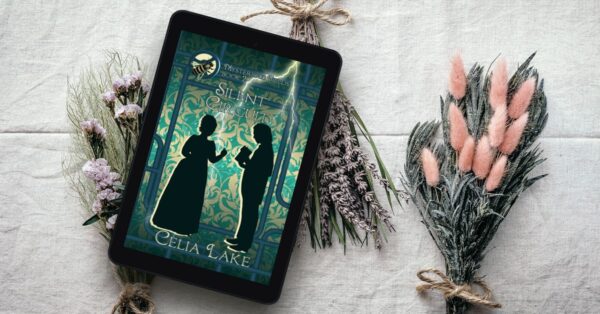
Thank you so much for coming and joining me for the second book in the Mysterious Fields trilogy, Silent Circuit! Don’t worry, Thessaly and Vitus are going to get their happily-ever-after in the third book, Elemental Truth.
I owe so much thanks to my editor, Kiya Nicoll, who has as always vastly improved the plot. Particular thanks to Elise Matthesen for a number of detail points on various stones (as well as the sources I talk about below.) My early readers have also been fantastic at helping make sure the trilogy ties together well.

I won’t repeat the notes about the trilogy as a whole from Enchanted Net (we’ll recap them in Elemental Truth, book 3). I continued to draw heavily on a couple of particular titles for the talisman work that Vitus and Niobe do. Two key titles are A Lapidary of Sacred Stones: Their Magical and Medicinal Powers Based on the Earliest Sources, Includes More than 800 Gems and Stones by Claude Leconteux as well as Stars and Stones: An Astro-Magical Lapidary by Peter Stockinger.
In this book, we get to see a wider range of talismanic work in the pieces Vitus makes for Theo Carrington, and in the stones the Council has on hand in case of need. I really enjoyed getting to explore more of the lore around specific stones, and the ways that Vitus thinks about them in particular. (I am particularly fond of his metaphor about the poetry inherent in alluvial sapphires, honestly.)
On to the chapter notes!
Chapter 10, of course, has a number of stone references. Amber was known originally as electron in Greek, and it’s where we get the word electricity from in English. However, while it can produce static electricity sparks (rub it on some wool!), it is not pizeoelectric. That’s a different quality of stones, produced by high pressure. That sort of pressure would destroy amber. For a fun fact, bone is also pizeoelectric, but this wasn’t discovered until 1957.
Burma rubies are indeed known for their particular colour, pigeon blood. They’re also unfortunately one of the mines that have a long history of being conflict stones. In 1889, as this chapter takes place, the Burma mines had only been taken over under British control within the last two or so years, and so Burma rubies were becoming more common.
Aquamarines and emeralds are both beryls (along with a number of other kinds of stone) but they’re interestingly treated as distinct types, for reasons that aren’t always very clear. They do have distinct colouration, though, which does help. Emeralds have a great deal of lore associated with them related to chastity and faithfulness.
The lore that Vitus refers to here is that if an emerald is given as a wedding or engagement ring (or similar) and the recipient cheats, the stone will turn brown. In Albion’s customs (especially in the upper classes), this would mean going outside the marriage agreements, which do often allow for extramarital liaisons in specific circumstances.
If you’re interested in a more narrative look at the history of stones, both Victoria Finlays Jewels and Aja Raden’s Stoned have a number of stories about the histories of particular stones, mines, and more.
Chapter 18 has a brief reference to something that used to be fairly common. In library collections that had (or in a few cases, still have) loan cards tucked in the back of the item, it becomes possible to trace someone’s interests across different books or music. In my younger days, I certainly did that and discovered some amazing music. (If a couple of particular people in my music classes had checked something out, it was worth my time to listen to, basically.)
These days, the combination of digital circulation systems and a much greater attention to library patron privacy means this isn’t possible in most libraries. The research library I work in as my day job still has cards in books (we have a web-based catalog but our books aren’t barcoded, so we enter loans manually in a notes field). However, our stacks are closed, so the only people who look at the cards are library staff, when we’re checking something out or returning it to the collection.
I was delighted to discover that a British classic humour book came out in August of 1889 and could thus appear as a new release in this chapter. That book is Jerome K. Jerome’s Three Men in a Boat (To Say Nothing of the Dog)which follows three men and a dog in a journey down the Thames and back. A lot of the places they stop are still open as pubs and inns. While critics panned it, it was immensely popular with readers, and remains so.
Chapter 34 : On a more serious note, we end with the Fortier mourning customs. The majority are drawn from French Victorian customs at the time. These include the sitting in solitary silence, keeping a constant vigil with the body, the women sewing the shroud and covers for the mirrors, and the general arrangement of the processions. They also have the same customs around mourning dress, the length of time it should be worn, and so on that Victorian British society does (and that Albion also follows).
The Fortiers, of course, add their own customs. Childeric I (for whom Childeric here is named) was a Merovingian emperor who died around 480 CE. If you’re unclear on Merovingian history – most people are – they were followed by the Carolingians. Charlemagne (crowned in Rome in 800 CE ) is by far the best known Carolingian.
Childeric I’s grave, found in 1653, had over 300 gold and garnet bees in it. Unfortunately, many of them were stole in the 1830s, but a few survive and they are stunning works of metal and stone.
Bees were a general symbol of the Merovingians, and the Fortiers (descended from the Merovingians) have kept the symbology. As part of their rites, they throw a bee (gold for men, silver for women, copper for everyone else) in the grave. Unless, of course, you’re Henut Landry who makes her own rules.
Elemental Truth (the last book, with the happily-ever-after) will be out on December 13th, 2024. We’ll be following it with some extras, but Grown Wise (which takes place in 1947, with Laudine and Dagobert’s granddaughter, Ursula, at the centre) will explore some pieces of this story and the lasting legacy of the Fortier choices as well. That will be out in May 2025.
My newsletter has all my updates and news, as well as additional information about where I am and what I’m doing online. Until next book, happy reading!