
Curious about what’s behind Nocturnal Quarry? Explore my author notes about the historical details behind the book.
These notes do contain some plot spoilers! Otherwise, they’re as shared at the end of the book, with edits only to share the most useful links and cleaning up some formatting for the web. Posted April 2026.
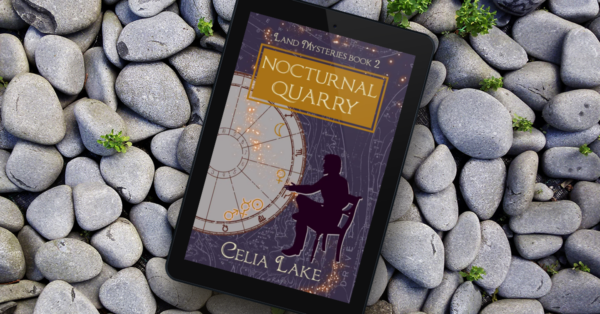
Thank you so much for coming along with me – and with Alexander – on this journey. I’ve been saying about this novella that really, it’s five times Alexander didn’t kill anyone or “Did you want some more Alexander? Here you go.”
It was interesting writing a novella that doesn’t have a relationship developing at the centre of it. Though of course, it’s also all about relationships, and how Alexander’s approach to other people is changed because of Best Foot Forward and the aftermath of those events. There is also more of Alexander to come in the Land Mysteries books (he’s also a point of view character in Upon A Summer’s Day, out in June 2023).
Before we get into the many details of this book, a note on one particular character name. Magistra Marianne, mentioned as a key contact at Oxford’s Academy, is a Tuckerization for Marianne Hicks, an avid reader, teacher, and former academic and university administrator, with a particular love of Oxford. This is the first time I’ve done a Tuckerization (the term for someone getting to pick a name to appear in the book), but I hope to offer the opportunity every so often, either for charitable causes or to celebrate a particular anniversary. Keep an eye on my newsletter for opportunities!
There are two other sets of character arcs worth noting. Medea Aylett first appears briefly in Bound for Perdition, is a significant antagonist behind the scenes in On The Bias, is named as a nemesis in Best Foot Forward , and finally has something of a resolution here.
On a less involved level, Vivian Porter, mentioned early on, appears in Goblin Fruit, finds her romance in Seven Sisters, and untangles a particular problem in Fool’s Gold. And on a “coming at some future point” note, I do have some thoughts about some books (probably a trilogy) related to the Fortiers, Alexander’s brother and mother, and various other events around 1889. But I’ll start writing them in 2024, so not quite yet.
The question of what happened to Temple and Delphina Carillon is an ongoing arc, chronologically begun Bound for Perdition. The aftermath of Temple and Delphina’s death is in Ancient Trust (sign up for my newsletter to get that, free), with additional mentions in other books. That arc will have a resolution in Three Graces, later on in the Land Mysteries series.
On to the details of the book!

Stella Wilbur and Gladys Cuthering went to Miss Porter’s School, one of the eminent private girls schools for a certain class of family at the time. Alums are known as Ancients.
William Pelley was one of many esotericists of the period, and like a number of them had some distasteful views and attitudes. He was an antisemite, a fascist who was an active supporter of Hitler from 1933, and arrested and convicted of sedition in 1942. His religious system was a mix of Theosophy, spiritualism, Rosicrucianism, and pyramidism. Alexander has very little patience for all of these. That said, there were a number of figures like Pelley active at the time, with varying degrees of influence in certain circles. All those esoteric and occult groups certainly had a fair bit of traction at the time in different parts of the community.
The friend with strong opinions about gasses that Alexander mentions is Giles Lefton, who was blinded by magical gas in the Great War (though a number of Alexander’s associates find them completely distasteful.) At this point in history, the British have a much more developed research program around chemical and biological weapons than the American do, though that starts changing around 1942 or 1943.
The trains that Alexander takes are as accurate as I could make them. My father was a massive railroad fan (both actual trains and model railroads), and I am fairly sure I’d be haunted in perpetuity if I didn’t put in the time to get it right. The Montrealer was one of the standard overnight trains running up the East Coast from Washington D.C. to Montreal (shockingly, the name actually is relevant here). It ran over tracks maintained by five different railroads, and you did in fact have to change in New Haven to get to Providence (or to get up to Boston, because the route cut through western Massachusetts).
My brother has lived in New Haven for a number of years, so I’m quite familiar with the New Haven train station. The Hotel Garde was a mainstay of the travelling community for many years. New Haven is about an hour and a half out of Manhattan by train (depending on some factors) so it’s served both as a commuting point and as a connection to trains to Providence, Boston, and other points east for many years.
Brown University has long had a highly respected Egyptology department, and the library also has a number of notable collections. Alexander mentions Lysander Dickerman, an archaeologist working in Egypt in the tail end of the 1800s. Pleyte’s “Set dans la barque du soleil” was published in 1865.
Set is often associated with an animal known as the Set animal or sha. There’s a total lack of agreement on what animal this actually is, if it’s mythic or an animal that exists or existed. It’s more or less canid, with a stiff tail, erect ears, and a long muzzle that sometimes turns down at the end, something like a greyhound or a jackal in shape. The canid part is Alexander making jokes about old dogs learning new tricks.
Theodore Adams first appeared in Best Foot Forward. This novella more or less outlines what happened, but, well, he’s very lucky that Alexander and Geoffrey were focusing on other things. As mentioned, Phillips Academy Andover has (in this period) secret societies with their own individual buildings (rather like Schola, actually), while Phillips Academy Exeter had the societies but not the buildings. Alexander references a conversation in his varied past with Henry Riggs Rathbone, an Andover alum of 1888.
My notes now say: “A précis on the state of the chaos of American intelligence agencies”. Up until the creation of the Office of Strategic Services (OSS) in June 1942, basically every different department – State, Treasury, Navy, and War – managed their own intelligence needs, with no overall coordination. Which meant, as you might guess, that they often got in each other’s way. Theodore and his higher-ups are with State (as he points out, he’s not a military man, which leaves those options out). So yes, you can imagine the chaos, the territorial squabbling, and the fact that having any kind of direct contact with any of those agencies might be useful to Albion. And for Alexander’s purposes, State is probably the most useful.
The Wheel in Boston was previously referenced in Sailor’s Jewel. It’s the best of the magical hotels in Boston, tucked into a small magical street on Beacon Hill, not far from the State House. (As a native Bostonian, I do like to get the city in here and there…)
The details of Boston geology are all reasonably accurate. Much of eastern New England, southern Ireland, England, and Wales were all originally part of Avalonia (along with some bits of eastern Canada including New Brunswick, Newfoundland, Nova Scotia, and Prince Edward Island) and some parts of continental Europe. It does give Alexander a certain fluency with the geology. As he mentions, Trimountain – originally three hills on the peninsula that Boston was originally built on – was levelled off to fill in what is now the Back Bay.
Of course, once Alexander gets to New York City, I had to spend a little time in two favourite museums. The Metropolitan Museum of Art, besides having a vast collection, also has a great deal of information about its collections online. That meant I was able to browse through the Egyptian collections and pull out specific items. Check out my blog post “The Art of Nocturnal Quarry” for images of the art Alexander’s looking at – and one piece he doesn’t get to see.
Alexander references the scent of kyphi, an incense that was used for both religious and medicinal purposes in Egypt. It’s one of those things where there are a number of recipes, many people (or as in Alexander’s case, families) have specific variants. Common ingredients include honey, wine, raisins, myrrh, juniper berries, cyperus, pine or terebinth resin, and then a variety of others depending on taste and preference. As Alexander mentions, his family likes mint in there, but cinnamon, cassia, saffron, cardamom, and spikenard are among others you might know and like.
Tant Amunet’s form of address, first. The word ‘tant’ comes from the French ‘tante’, but is more commonly translated without the e in Egyptian Arabic. It’s a common term of respect for older female family members, just also more or less accurate to the relationship.
She lives in the Ansonia. It was originally built as a “residential hotel” with three thousand rooms, a central kitchen and serving kitchens on every floor, as well as a wide range of additional services and luxuries. It did in fact originally have a small farm on the roof, because William Earle Dodge Stokes, who designed the building, wanted it to be as self-sufficient as possible. The bear was in fact also a resident, though it’s not clear how that relates to self-sufficient agriculture.
By the time Amunet settles there, the rooms have been broken up into individual flats or apartments with their own cooking facilities, but it’s still a popular location especially (as she notes) with musicians and opera singers. Residents at various times included Babe Ruth (baseball player), Theodore Dreiser (writer), Arturo Toscanini (conductor), Igor Stravinsky (composer), and tenor Enrico Caruso (singer) as well as fashion designers, religious leaders, and more. Also, a number of the floor plans are available through the historical collections of the New York Public Library, which made it easier for me to figure out how Amunet’s flat was laid out.
The lettuce is – well, theologically load bearing, yes. It comes from a series of stories called the Contendings of Horus and Set, about both of them trying to get the upper hand over the other, and the detail of this one has to do with the fact that the Egyptian variety of lettuce, when cut, produces a milky white liquid very reminiscent of other male fluids. (I mean, this is a romance series, I’m sure you don’t need my help figuring this out.)
While the stories are complex, and have to do with perceptions of power, dominance, and a number of related topics, they also allow for a certain amount of amusement. Anyway, since I knew that story – and knew Amunet had spotted that Alexander is Set’s, blood and bone – I couldn’t resist having a bit of fun with it.
Medea Aylett has been Geoffrey Carillon’s nemesis for quite a long time, but as noted, she’d been entangled with his family rather earlier. She and Margot Williams appear in Bound For Perdition, in 1917, when Medea and her husband were collaborating with Temple Carillon (Geoffrey’s older brother) on various rather nefarious bits of magical research for the War effort. Three Graces, book 6 in the Land Mysteries series, will pick up the remaining loose threads and what Temple was actually up to that led to his downfall.
Mercury, as Medea notes, is extremely dangerous to work with. It’s also long been thought to be very good for swelling, and in a very accurately dosed alchemical or magical potion, might be very good for certain kinds of circulatory or swelling issues.
Finally, we come to the question of the land magic in the United States, or at least touching on the question. Americans who are part of the larger magical community still make an oath not to reveal magic at the age of 12 (as young people in Albion do), but while the Pact still holds up, the United States in general has a very different relationship to the land magic. This is for all the reasons you can probably think of – the implications of colonialism, certainly, but also issues of massive changes in land use, population density, etc.
That means that the land magic is tended more or less as Callie Thorn describes, with people living in an area coming to take a particularly strong interest in their particular places. She names a good number of those tending Manhattan, but there are likely more she doesn’t know about yet.
I also wanted to give a nod to the amazing work of the 135th Street Library in Harlem in this period, which was not only providing library services to everyone from small children to elderly readers, but also at the centre of the Harlem Renaissance. The New York Public Library has done some great blog posts about these librarians. Check out this post about a number of women who helped build that particular branch up, including Regina Andrews, Augusta Braxton Baker, Pura Belpré, and Catherine Allen Latimer.
More about Rathna is in The Fossil Door and in the upcoming Old As The Hills and Upon A Summer’s Day (out in May and June 2023, set in 1939 and 1940). She and Callie would indeed get along very well, yes.
As part of that conversation, Alexander refers to the planetary influences. He’s got a point here about the endless expansion of Jupiter being quite a problem, if it isn’t balanced by other things. Jupiter is the planet associated with that endless expansion and Mercury with wit, cleverness, and technology.
As Alexander and Callie talk about, colonisation is a mess for the local land magic and who deals with it. As she points out, she’s not the right person for some of it, she doesn’t have access to how it was done before colonisation, and connecting with people who do is complicated (especially in the 1930s). But she’s also clear that there are things she and others are responding to on the land as it is now, and tending those needs is also important. In the case of Manhattan in specific, some of the the local Lenape formed what became known as the Delaware Nation and some moved south along the eastern seaboard. These days there are Lenape communities in New Jersey, Oklahoma, and in Ontario, Canada.
Finally, if you’re curious about the reference to the Ones Below, read Sailor’s Jewel, an ocean-crossing romance set in 1901.
Finally, let me leave you with a bit of a teaser about what’s coming next! The Land Mysteries series has five novels and two novellas. The next novel, featuring Gabe and Rathna (previously seen in The Fossil Door) is set in 1939 and 1940. It’s called Old As The Hills and will be out in May of 2023.
The newsletter and my social media accounts will have all the details about new and upcoming releases, and I hope to see you one of those places! Until then, happiest of reading to you.