
Curious about what’s behind Shoemaker’s Wife? Explore my author notes about the historical details behind the book.
These notes do contain some plot spoilers! Otherwise, they’re as shared at the end of the book, with edits only to share the most useful links and cleaning up some formatting for the web. Posted April 2026.
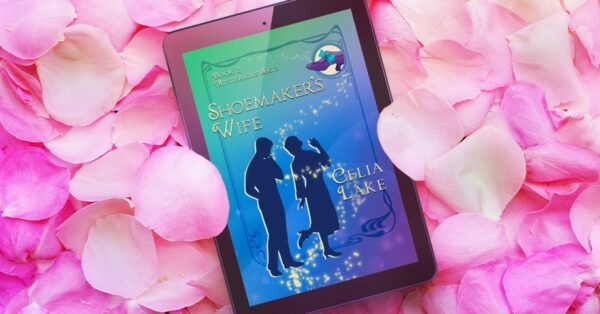
Thank you so much for joining me for Shoemaker’s Wife and a glimpse at life in Trellech! As always, the greatest of thanks to my editor, Kiya Nicoll, for many excellent suggestions (and all the editing), as well as to my early readers. They all helped make this a much better book.
You can find connections to other people, places, and events of my books in my authorial wiki. Several secondary characters who appear here also appear in other books, so let’s start with that before we get into the details of each chapter. You don’t need to know their backstories to make sense of Shoemaker’s Wife, but if you want a bit more of them, here’s where to explore.
Shoemaker’s Wife gives us a look at Golshan, Seth, and Dilly beginning about eight months after the events of Casting Nasturtiums. That novella (found in the Winter’s Charms collection) is a friends-to-lovers polyamorous romance that begins when Seth goes looking for his best friend after Seth is demobbed in the summer of 1919. Seth and Golshan have been friends since they were 13, and Dilly has her own affection for Golshan.
Griffin Pelton appears in Point By Point in a minor role, and he’s getting his own romance later in this series, in a book that will be focusing on the magics of Trellech’s legal system (and Trellech itself) along with jewellery making and jet carving. As I write this, it doesn’t have a title yet, but it should be out around August of 2024.
Edgar Watson appears briefly in Country Manners, another of the novellas in Winter’s Charms. That one takes place about a year after Shoemaker’s Wife, when Edgar has left working for the theatre, on good terms but wanting a bit more of a regular schedule, to take up as valet to Giles Lefton. (I am contemplating whether there’s a romance in the offing for him in that time period, too. Edgar’s a delight, and I do love his particular form of competence.)
On to the book!

First, let’s start with the theatre. My father was a theatre professor, so I grew up around and sometimes tucked into odd places in a university theatre, seeing all kinds of shows from the time I was remotely old enough. It left me with a great amount of respect for the process, as well as far too many opinions about staging, direction, the proper way of doing things, and what makes a scene work than anyone really ought to. At least not anyone who isn’t actually doing theatre regularly. (I had a series of small roles when my father needed a conveniently scheduled child actor for things he was directing. As well as some time playing in the pit orchestra for high school productions and turning my hand to a little bit of stage management.)
All of this meant that when I sat down to write this book, I spent a bit of time poring through a couple of theatre history resources, and trying to figure out what Albion’s cultural divergence from the non-magical community meant for theatre. Albion, frankly, mostly didn’t care about the artistic impact of the Restoration in nearly the same way (and while Shakespeare is obviously in their repertoire, they would not have been focused on the creative output of the Elizabethan court.)
The result is a mix – some plays do very well in Albion, others are rarely or never performed. Albion’s satires and comedies tend to come from Albion playwrights as well, because the beats that are funny (or that are on the nose for the moment) are a bit different than those in London or elsewhere.
For those who aren’t familiar with the British panto (or pantomime) tradition, it is very much its own particular art form. It does owe something to the comedic (and also satirical) works of forms like commedia dell’arte, combined with a lot of topical humour. If you’re curious, YouTube does have a number of performances (of varying levels of professional staging).
It has a number of common traditions. Pantos these days are most usually based on some sort of fairy tale – Puss in Boots, Cinderella, Jack and the Beanstalk and so on. There’s often a Good Fairy who pops onto stage to help and perhaps a Bad Fairy who’s part of the challenge of the plot.
There is also a long tradition of cross-dressing, both by the Dame (traditionally played by a mature man), and a breeches role (traditionally played by a woman). The latter’s often a young man who serves as narrator and/or the hero. In many cases, the character the Dame is playing is his mother. There is, however, a lot of possible variation in terms of the parts assignment here, and I’ve taken some liberties to adapt for Albion’s stage.
There’s a lot of historical reason for all of this, and some of it works better than others in our current conversations of gender, identity, fictional roles, and so on. There’s also a lot of academic, experiential, and other discussion about this in various forms, if you want to explore more about it.
Onto the notes by chapter.
Chapter 2: From 1860 to 1916, soldiers in the British Army were required to have a moustache. This, obviously, causes some complications for men of Albion, who tend to prefer being clean-shaven for reasons of magical contagion concerns. (It’s easier to fully shave, and dispose of the bits in a magically appropriate way, also various of them have thoughts about disease and hygiene.) Anyway, that was lifted in 1916, in part because gas masks in the trenches were complicated when men had facial hair (which had generally become less common among British men by the 1880s.)
Chapter 4: There was an entire process of demobbing. People would be sent back to a camp in Britain, where they’d wait for a period of time (usually somewhere between a week and a month) while the final paperwork was processed, and they made arrangements for whatever they were doing next. Once they were formally demobbed, they were given a train ticket (or money for one), often a civilian suit of clothes, and sent off. They were expected to turn in the great coat local to them once they’d arrived, and would then also (at least in 1920) qualify for thirteen weeks of payment.
If I did my maths right, using inflation calculators, 24 shillings a week at 20 shillings to the pound (so 1.2 pounds) comes out to about 69 pounds or 78 dollars today. (I did the maths during the drafting of the book, so it’s based on November 2022 currency conversions.) Not enough to cover all your expenses, though it’d certainly help with basics. Britain is in the early months of a major inflationary cycle at this point, too.
Chapter 6: Of course Owen paid particular attention to the boots in his uniform. As he mentions, there were a handful of common patterns, and some of them lasted better than others. The issues he mentions are all things that came up repeatedly in commentary from the period.
Chapter 8: As Owen is aware already, beers after the Great War were notably weaker than before. Other beer-drinking habits had also changed, with porter becoming decidedly less popular, and lager and bitter (draught pale ale) were more popular. There were fewer varieties available overall.
Chapter 10 : One of the questions I had to sort out an answer to is “just how big is the theatrical base in Albion?” Trellech is a city of 20,000-25,000 people (depending on how you count: some people work in Trellech and live outside it, some residents are seasonal). But they’re also a central location for all of Albion, with easy transportation for a significant portion of that population via the portals.
The end result was four theatres, plus the Opera House which has a different range of productions, and a number of troupes doing some amount of touring. The touring was extremely common in theatres of the period. There are of course a whole host of amateur theatrical groups, one-off productions done outside a long-term theatre schedule, etc.
Chapter 12 : The vaudeville acts are more or less as Maisery explains them. You can find some period videos (or nearly period) of adagio acts on YouTube if you do a little searching. Adding the term “gymnastic” or “acrobatic” will help you filter out all the other musical uses of the word. British Pathé has a recording from 1933 under the title “The Dance Acrobatic”, for example.
One of my ongoing favourite sorts of humour is people listing all the things that happen in folk songs that you should not do. Don’t be named Margaret or Janet. Don’t go down to the greenwood, or any navigable waterway. There are a lot of iterations of these, but my standby is a post called “Folksongs Are Your Friend” on a blog called Making Light, posted in 2005.
I also had to do some thinking about what themes and stories are popular in Albion’s creative arts. The legend of Brutus is in fact one of the possible origin stories of Britain. Arthuriana (in its many and varied forms) and fairy tales are also regular themes.
Chapter 14 : And of course, which plays are sensitive is a bit different in Albion than in Britain as a whole. You may well be familiar with the theatre folk custom that you never say the name of the Scottish play in a theatre (Macbeth. I’m typing it, and I’m still wincing a little.) Albion doesn’t actually care as much about that one. The play that causes problems is, as noted, Midsummer Night’s Dream, because of how strongly associated it is with fairies and the Fatae, and might get their attention.
Chapter 16 : Aphra Behn is a real person, but she’s also a great example of one of my favourite methods of worldbuilding, aka “wait, this person has dropped out of documented history for a bit, were they doing something magical?” She appears on the scene in very early adulthood during the English Civil War period, becoming one of the first English women to earn her living by her writing. She was a poet, author, translator, and playwright, as well as probably also being a spy. There’s very little known about her early life, and she also disappears from the historical record for a few years as an adult.
Obviously – if you’re me – she had made the Pact, and was part of Albion’s society. There are, obviously, therefore some plays that are performed regularly in Albion not known to non-magical audiences.
Chapter 17 : Laundry is eternal, isn’t it? Households in Albion have a variety of methods of dealing with it, but it’s all fairly labour-demanding. Even with magic. In this period, it’s still quite common to send laundry out, even for working class or middle class households.
Chapter 18 : Theatre has a long history of Guild pageants and mumming plays, telling a fable or morally relevant story or one related to the organisation putting the thing on. They often involve stylised characters or archetypes, and some set and costuming to support the story (but not a lot of elaborate set building, since they’d often be performed outside or in a multi-use space.)
Chapter 19 : I am just noting here that the phrasing given in this chapter for “All work and no play” is in the original punctuation.
Chapter 20 : The reference to the mysterious house is the plot of my Wards of the Roses.
Chapter 21: Agnes Evans, met in this chapter, appears in Point By Point, which has a bit more of the Trellech Moon’s morgue. King Lear is a well-known Shakespearean play, based on a bit of ancient British myth. It’s a cautionary tale about the challenges of age and making good decisions. It is also a classic role for actors who are getting toward the end of their career, and the comments about Randolph here are not entirely kind.
Chapter 22 : I couldn’t have a theatre and not have a theatre ghost. There is a very long and grand tradition of theatre ghosts and other spooky events. As noted, ghosts in Albion are often associated with some sort of hidden treasure (coins specifically hold magical energy in ways that make that more likely, as discussed briefly in Fool’s Gold). I also just wanted a generally friendly theatre ghost, unlike some of the depictions we get in other sources.
Chapter 24 :The Young Visiters is in fact a real book, and it came out in 1919 (though it was written in 1890.) I was introduced to it by my father, and then met one of my lifelong best friends during a session of reading it aloud in the social room of a convention hospitality suite. It is absolutely hilarious in that mode, especially if you swap around who’s reading regularly.
The chapters are short, the spelling is horrendous, and the childhood assumptions about Victorian adult life are also hilarious. The 2003 film version also has some wonderful acting, and is also hilarious though in slightly different modes (since it can rely on visual absurdity). Once I realised it had been published in 1919 – and immensely popular – I couldn’t resist having it appear here.
Chapter 26 : Owen is fairly straightforward when talking about the changes in shoe manufacturing in the period. Some of those changes came about with factory manufacturing, some were due to processes like vulcanisation (a more flexible and waterproof sole, arguably, but with other limitations.)
Chapter 28: Why are turnips funny? They are funny for me because I grew up watching the British comedy series Blackadder, which takes place through multiple periods in history. Turnips feature particularly in the Regency series, and well – as Maisery said – you can get a lot of mileage out of a root vegetable.
Chapter 32: The magical green screening here is intentional. But mostly because Welsh does in fact have a colour word – glas – that is about a quality of shimmering colour as much as it is about the shade of blue or green. It seems a fine background for illusion work.
Chapter 34 : There was a requirement in many Great War units for a certain number of people in the unit to become adept in using semaphore, since it was used extensively for signalling during combat situations. Semaphore and the number of people in the infantry who learned it.
Chapter 36: For those who like to make connections between characters, the Doyle of the solicitor’s office is Lucy Doyle’s father. (The solicitor of that name is referenced a couple of times in other books)
Chapter 37: Captain Donovan appears at the end of Wards of the Roses, and Griffin in Point by Point. Griffin will also be getting his own romance later in the Mysterious Arts series as I mentioned earlier, so we’ll be seeing more of him then.
Thank you again for joining me for this journey and a glimpse into the theatrics of Albion. The next book in the Mysterious Arts series is Perfect Accord, focusing on perfumery and alchemy. It will be out in February of 2024.