
Curious about what’s behind Perfect Accord? Explore my author notes about the historical details behind the book.
These notes do contain some plot spoilers! Otherwise, they’re as shared at the end of the book, with edits only to share the most useful links and cleaning up some formatting for the web. Posted May 2026.
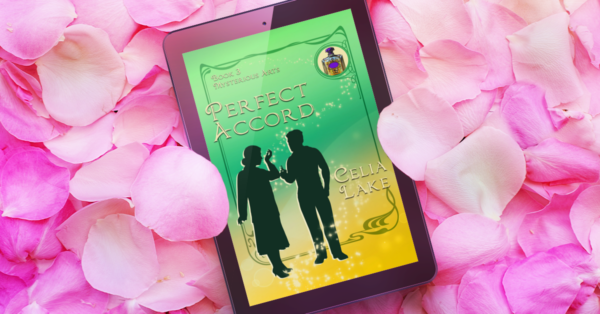
Thank you so much for joining me and Charlotte and Lewis for Perfect Accord I’m delighted to get to share Charlotte’s romance with you, in particular – I’ve known pieces of it for a long while. As always, tremendous thanks to Kiya Nicoll, my friend and editor, and to my early readers, whose comments made this a much better book. (They always do. Especially, in this case, improving how Victor comes across).
Charlotte, of course, has appeared in a number of other books at various stages in her life. Her parents have their arranged marriage to love match romance in Pastiche when Charlotte is 4, and The Fossil Door covers Gabe and Rathna’s romance in 1922. Charlotte also appears in Upon A Summer’s Day in 1940, as Gabe prepares for a new challenge. Fortunately, being Gabe’s sister turns out to be good preparation for understanding Lewis!
You can find all the details about where the Edgartons appear on my authorial wiki. Under “Series and Arcs” on the wiki, you’ll find a page for the Edgarton family.

We have fairly short author notes this time, which could honestly mostly be summed up as many gestures at the long history of natural perfumes, the materials used for them, and the way that plays out. I’m going to start with three general sets of comments, and then get into the chapter details.
The text itself explains enough of how perfume works to get started: a given perfume is made up of a variety of notes, some of which linger in the scent for longer, meaning that a given scent can change over time as it’s worn. Similarly, different perfumes – particularly natural ones – work differently on different people’s biochemistry. Accords are a combination of notes that evoke another, such as amber accord, and can be used as the basis for other scents.
One of the interesting things about setting this book in 1923 is the way that plays with the state of perfume. Up until the 1880s or so, perfumes were made from various natural materials using a variety of techniques. These include distillation, enfleurage, infusion, and many other approaches. Some plants are so delicate that you need tons of material to get a small bottle of oil (roses, for example). Others are so enthusiastic about scent that a little of the plant goes a long way. And of course, sometimes we’re not talking about plants at all: ambergris comes from whales, civet from the glands of civet cats, castoreum from beavers, and musk from musk deer.
However, beginning in the 1880s, there was a surge of interest and development of artificial perfume notes. These had some advantages: in some cases they’re vastly more humane (the ingredients of animal origin), in some cases they’re much less expensive. They’re also more likely to be stable: a given perfume on two different people is likely to smell much the same if it’s using artificial notes. Obviously, that has a lot of commercial benefit, though there are (and have been all along) perfumers who do amazing things with natural perfumes.
In Albion, obviously, there’s a preference for natural perfumes because those natural sources can also carry magical properties that have relevance to the wearer or the purpose. Lewis is thinking about these when he constructs the scent for Charlotte just before they make their way to the manor house at the climax of the book. But he’s also thinking about what represents her, in specific, and what she will find appealing. It’s a fascinating multi-dimensional puzzle.
I’ve been interested in natural perfumes in a low-key way since discovering Black Phoenix Alchemy Lab (often known as BPAL) back around 2004 or 2005. There’s definitely something absolutely magical about a combination of notes and then how they smell when they’re on you, in specific. I did a lot of reading then that’s come in handy for this book, and I went back and reread several as I was getting ready to write.
If you’re interested, I highly recommend any of Mandy Aftel’s work, especially her Essence and Alchemy, which both talks about the history of many perfume ingredients and walks the reader through putting together a scent, including making an amber accord. I got the oils she mentions and have had a great deal of fun experimenting. Her Fragrant is also a great discussion, and focuses more on the role scent plays in our lives.
There are hundreds of other books out there, about specific ingredients, but I liked Celia Lyttleton’s The Scent Trail: How One Woman’s Quest for the Perfect Perfume Took Her Around the World for its rather epic journey to explore the origins of some of the ingredients.
Not all scent has to be complicated, either. I loved thinking about the various scents of the food Charlotte makes, and thinking through what she knew how to cook and what she doesn’t. (Given that she’s always lived in a home with household staff.) But of course her chosen aunts wouldn’t let her get away without being able to cook a few things. The dishes she makes that she learned from Aunt Mason (who is of Dutch, English, and Malaysian background) are modifications as she describes, for ingredients more readily available in Albion. Sometimes you have a coconut available and sometimes you don’t.
The second thread in this book is obviously about cults. The term is hard to define – academics and people with experience in coercive groups have done a lot of conversation about this in recent years (and earlier ones). In this case, though, we have a relatively small group with a charismatic leader (Morgen), an equally charismatic sidekick (Gareth), and some specific desires about shaping the world around them. That includes coercing people for their own benefit, using other people’s magic, and the money and luxury that often comes with that.
There are a profusion of sources about cults (especially in the more modern experiences of them) out these days. There are documentaries (with various motivations and level of quality), there are books, and there are podcasts. I’ve read and watched enough that trying to do a list is impossible. But while writing this book, I have thought a lot about episodes from the podcasts A Little Bit Culty and IndoctriNation. They both focus more on ‘what made this attractive in the first place’, what kinds of behaviours to watch out for, and what happens when you begin to want to get free of them.
We don’t always hear as much about cults in the 1920s – though there are some notable ones out there. But many of the things that make people vulnerable to coercive groups and manipulation were present in abundance in the period. People were struggling with the aftermath of the Great War, whether that had to do with their own losses, changes in options for the rest of their lives, or figuring out what they valued now. Having a place that courted you, that said you were meant for something special, and that gave you a focus could be tremendously compelling then – as it can be now.
There are also a lot of resources out there now if you or someone you know is concerned about a particular group or community. Both the podcasts I mentioned above have more information about these resources and tools on their websites, if that’s helpful.
Arthuriana is such a huge topic I’m not going to attempt any sort of cohesive explanation. That makes sense, given these stories have flourished for well over a millennium, in multiple languages and cultures. As Charlotte and Lewis figure out, Morgen is leaning harder on some of the older and more obscure tales, rather than the central Arthur, Lancelot, and Guinevere (in her many spellings) focus that has become most familiar.
And of course, Morgen is picking and choosing those elements that work for her other goals, rather than being consistent about any particular set of tales. Naturally, that’s easier when the tales themselves have hordes of contradictions in names, in places, in the role of magic, and basically everything else.
All the names I’ve chosen do appear in the Arthurian legends in some form. Over the centuries, people have come up with all sorts of layers of additional information. I drew the heraldry in the scene where two devoted followers get their names and associated items from a list of Arthurian heraldry originally drawn up by a French nobleman in the 1500s. in a treatise called La forme quon tenoit des tournoys et assemblees au temps du roy uterpendragon et du roy artus. This is of course nowhere near a contemporary source for Arthur, whatever historical Arthur there was, but it made a great starting point for some interesting designs and associations.
Onward to information about specific chapters.
Chapter 1: Charlotte briefly mentions both her own family’s wedding customs (such as the yellow veil), which largely draw from Roman custom in varying forms. (These can also be seen in the first chapter of Pastiche, for Alysoun and Richard’s wedding.) She also mentions Rathna’s background in passing. Rathna was born to Hindu parents, but spent her adolescence and young adulthood in a Jewish household. While she isn’t Jewish, she prefers to keep their food customs (as well as not eating beef, in her own right), and of course the wedding feast needs to accommodate that.
As Charlotte notes, both June and Wednesday were considered particularly fortunate days for a wedding. In the period, the kind of event that is described in the book is not that uncommon. They’re hosting a large gathering, but most of the people invited to the more public parts of the wedding can easily take a random Wednesday for a wedding, rather than pushing it to a weekend.
Chapter 3: Priddy is derived from the Welsh “prydydd” meaning “bard”. It’s definitely not Morgen’s legal name. The stones Gabe mentions are all local to the area, but the formal mineralogical names were not entirely established in this period.
Ebbor Gorge is a fascinating geological location, with both the gorge and nearby caves that have been used for a variety of purposes. There are also some interesting legends of the surrounding area, including what Albion would consider some strongly linked to the Fatae or fairies and other magical beings.
Chapter 15: The Unicorn Tapestries are widely known – they’ve been on display at the Cloisters in New York City (part of the Metropolitan Museum of Art), since 1938. John D. Rockefeller Jr. bought them in 1922, and had them hung in his home until the Cloisters were built, something widely discussed at the time (and chronologically well-placed for my use here!)
Made right around 1500, the seven tapestries depict a vivid and detailed world, including the hunt for a unicorn. They may well come from multiple sets, but a monogram indicates they were likely from the same maker. That detail includes over a hundred different plants, with over eighty-five identified by botanists. That’s a rich source for magical associations!
Chapter 24: Charlotte is referencing John Donne’s poem, “The Sun Rising” which begins: “Busy old fool, unruly sun, / Why dost thou thus, / Through windows, and through curtains call on us? / Must to thy motions lovers’ seasons run?”
Chapter 25: Magical and botanical lore often links specific plants with particular planets, elements, or other associations. Juniper here is a herb of the Moon, and cardamom (a particular favourite of mine) with Venus. The latter’s particularly on point for a romance, obviously.
Thank you again for reading. Again, you can get your copy of the two conversations Charlotte and Victor have at the end of the book.
Thank you again for joining me for this journey and a glimpse into the theatrics of Albion. The next book in the Mysterious Arts series is Facets of the Bench, focusing on the courts and legal systems of Albion along with jet carving. It will be out in August of 2024.