
Curious about what’s behind Three Graces? Explore my author notes about the historical details behind the book.
These notes do contain some plot spoilers! Otherwise, they’re as shared at the end of the book, with edits only to share the most useful links and cleaning up some formatting for the web. Posted May 2026.
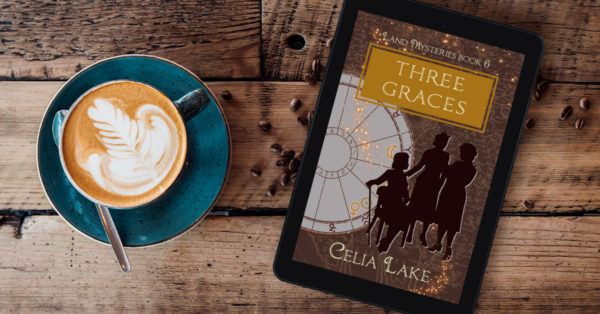
Thank you so much for joining me for Three Graces and for the final resolution of the mystery of what happened to Temple and Delphina Carillon. More on the earlier pieces of that puzzle in a moment. My thanks, as always, to Kiya Nicoll and to my early readers for making this a vastly better book. In particular, for helping me making sure the three threads of skill all balance out sufficiently here.

If you’d like more about the complete arc of the Carillons or the Edgartons or the Fortiers (and Landrys), I keep an up to date list on my authorial wiki.
If you browse the list under “Series and arcs”, you’ll find pages with the arc for each of these families. I do love them, and I keep coming back to them, even while I continue to explore other romances. We do have more coming about all three families: I have eventual plans for a romance for Edmund Carillon, who appears briefly here, for Ursula Fortier, and there will be a trilogy touching on a longstanding mystery related to Alexander Landry’s mother and brother. (Added in 2026: You can find Edmund and Ursula’s respective romances in the Liminal Mysteries series, and the others in Mysterious Fields.)
To give you a brief overview of relevant books about all three women, here’s what you might want to read. The books dealing with the question of Temple and Delphina are, in internal chronology:
1917: Bound for Perdition, which is also Reggie and Lynet’s romance.
1922: Ancient Trust, available for free, right after Temple and Delphina die and Geoffrey inherits.
1924: Goblin Fruit, Lizzie and Geoffrey’s romance.
1925: On The Bias, Benton and Cassie’s romance, which takes place right before Lizzie and Geoffrey marry.
1935: Best Foot Forward, Geoffrey and Alexander tackle a complex problem in Germany and Geoffrey is willing to consider poking this question with a long stick again.
1940: Upon A Summer’s Day, when Geoffrey asks Gabe to investigate the problem and see if he can get some new traction.
Alysoun Edgarton first appears chronologically in Pastiche (her arranged marriage to love match romance with her husband), then notably in The Fossil Door (her son Gabe’s romance), and OId As The Hills and Upon A Summer’s Day. She’s also a more minor character in a number of other books.
Thesan Wain has her romance with Isembard in Eclipse, and also features in Chasing Legends, briefly in Best Foot Forward, and in the upcoming The Magic of Four. (The last one is partly from their son Leo’s point of view in 1946-1947.)
I’m very glad I had a chance to bring this particular mystery to a close. I knew the outline of it way back when I wrote my first book – there are obviously some references to it in Outcrossing, and more in my second, Goblin Fruit. But many of the specific details didn’t get entirely sorted out until I was writing Ancient Trust, as well as Bound for Perdition, where we see Temple, Delphina, and also Margot.
Here are a few further notes. Lighter on the historical side this time, though I have a few of those, but I did want to make it easier to find other parts of past events if you want to read or reread them.
Chapter 1: Lapidoth Manse also appears in Bound for Perdition, which also explains how he knows Reggie. This chapter also overlaps with the aftermath of Illusion of a Boar, around the planning for 1945, as soon as the war in Europe is actually over.
And as a particular bit of trivia, black liquorice can drop blood pressure dangerously low in some people, though not in quantities most people are likely to eat.
Chapter 2: The creation of the magical journals is also a key part of Bound for Perdition. As you’ve probably picked up from context at this point, they allow direct contact between people in a written journal format. By the 1940s, they’re still expensive (so not everyone has them), but more on the order of a mid-range computer than a mid-range car, in terms of cost, though there are some variations.
Chapter 4: Seth, Dilly, and Golshan are the focus of Casting Nasturtiums, a novella collected in the Winter’s Charm volume. Seth and Golshan are both veterans of the Great War, and spend a fair bit of their time (along with Dilly) filling in the gaps around veterans support that the Ministry ignores.
There was in fact a project to build wooden aeroplanes (that could glide and avoid radar). Seth was too old for the initial conscription age during World War 2, but just young enough when the age was raised, and it seemed the perfect place for his skills.
The ATS refers to the Auxiliary Territorial Service, one of the main service options for women during the Second World War. (Cammie and Hypatia, two of the point of view characters in Illusion of a Boar are in the ATS, and that book gets more into that experience.) The Land Girls were the women who went out to do heavy farm labour when men had been conscripted, often living in remote locations and learning a wide range of new skills.
Livia Fortier’s death is part of Old As The Hills, and it has a number of unexpected ripple effects, not least for her husband, Garin. I think at this point, I’m up to four times when I’ve written a bit about Garin, started at it, and gone “I almost like you now.”
Chapter 6: Alexander Landry was initially Isembard Fortier’s mentor and teacher, via family connections. Since Eclipse, when Alexander returned to Albion, they’ve been good friends (and as Lizzie notes later, Alexander is godfather to Thesan and Isembard’s children). The loss of the Paris portals is part of Old As The Hills.
Chapter 7: Clothing rations were part of the British war experience starting in 1941. Each item of clothing was awarded a number of points. Many of my characters here can live quite easily out of their existing closets (or remake things from the family attics). There were Utility Scheme designs, which were created to avoid using excess fabrics – they strictly limited buttons, pleats, pockets, extra fabric in the skirt, and so on. Thesan makes a point of having some of her dresses made in this style, more so than Lizzie and Alysoun, not least because she’s a teacher and feels she ought to model that for her students.
Mainbocher was a real and historical couturier who did in fact leave Paris just before the occupation and spent the war years in New York City. Margot’s frocks are based on several of his specific designs, though I took some liberties with the colour choices.
Chapter 8: The reopening of the Louvre is the historical event – about as soon as the stored and hidden art treasures could be rehung safely. The Bibliotheque de Magie is the magical community’s museum and library, very much in parallel. (It gets a brief visit in Magician’s Hoard, if you want to see a bit more of 1920s Paris.)
Chapter 10: When I started this chapter, I knew I wanted Margot and Lizzie to meet up at an auction. As I often do, I did a little rummaging in the Times of London to see if there were any references. I was delighted when I came upon a huge multi-day auction of the estate of R.M.W. Walker. He was a well known collector of a number of fine art objects. Christie’s hosted a series of auctions, with eight days devoted to English silver, Chinese porcelain, Objects of Vertu and miniatures, Chelsea porcelain, and art and furniture between July 10th and 26th, 1945. The sales also included some books, a couple of which I have referenced. The actual items mentioned (other than the brief book references) are all similar to items in the auction, but I did not extend my research as far as trying to find a detailed sales catalogue.
Chapter 11: The Mabinogion is a collection of Welsh prose tales with a long and fascinating history, dating from (probably) around the 11th or 12th centuries. Here, the Albion translation is fictional (but the sort of thing someone in Albion would do.) Lady Charlotte Guest’s translation was the standing one in English for many years, though she was more delicate with some of the tales than the Welsh is. These days, I very much like Sioned Davies’ recent translation.
Lludd a Llefelys is one of the collected stories in these tales, and Thesan’s summary is basically accurate, though she leaves out the details of the other two dangers and how they’re solved. It’s reasonable to assume that most people who’ve had a good literary education (and many people without a formal literary education, for that matter) have at least a passing familiarity with these tales in Albion, so she just gestures at the relevant part.
A lot of Second World War history is scattered with rumours about or fantastical theories about some sort of secret weapon. In that context, it’s entirely believable that some people during the Great War would have looked for magical options (as well as some of the other awful options like gas and infection that were tried at various points).
Chapter 13: Once I knew the timeline for this book, I sat there staring at August. On one hand, the dropping of the atomic bombs on Hiroshima and Nagasaki is across the world from Albion. On the other hand, the land magic is the land magic. Garin had already been moving toward wanting to retire from the Council, but finding some alchemical method of mitigating any of the damage from atomic warfare is obviously a strong focus for him going forward.
The events of the summer of 1925 are in On The Bias.
And one quick note on the black currant squash. During rationing, citrus fruits weren’t rationed but were often incredibly hard to get (since they take a lot of coaxing and care to grow in Albion’s climate). Instead, black currant became very common as a drink that was full of vitamin C. It’s still popular (the most readily available form is the brand Ribena). It didn’t catch on the same way in the United States, because black currant was considered an invasive plant for various reasons.
Chapter 16: Illusion of a Boar has a lot more about Orion’s journey toward his making a challenge for the Council (and his success at it). We will be seeing a bit more of Claudio and Orion (and Cammie and Hypatia) down the road, Claudio is eventually getting his own romance in 1950.
That’s it for my notes! If you’d like to know about my latest news (and a round up of historically interesting links), my newsletter is the place to be. And again, you can find more details about all these people and where else they appear at my website and via my authorial wiki.