
Curious about what’s behind Four Walls and a Heart? Explore my author notes about the historical details behind the book.
These notes do contain some plot spoilers! Otherwise, they’re as shared at the end of the book, with edits only to share the most useful links and cleaning up some formatting for the web. Posted May 2026.
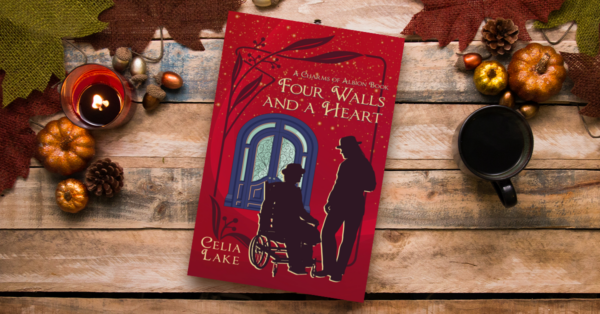
Thank you for joining me for this seaside romance, full of a love of books. I loved getting to spend some time with Gil and Magni. You can see more of them (including how they describe their romance to Richard twenty years later) in Pastiche, which takes place in 1906. The end of this note has more about where else you can find them.
As always, my thanks to Kiya Nicoll for excellent editing. (All remaining errors are entirely my fault.) In this case, along with all the other reasons, I owe Kiya thanks for pointing out that I’d written two other unusual houses. Kiya thought Gil should have a pleasant mystery house, to set him on the path of architectural magic. Thanks as well to my early readers for making hopeful noises about this romance and for useful and helpful comments that make the story better.
Let’s get on to the historical notes!
Chapter 1: The bombs mentioned in conversation are the Fenian bombs that were set around London in May of 1884. Four bombs went off in one night, destroying offices in Scotland Yard, as well as exploding in two other London locations, and an unexploded bomb was found at the foot of Nelson’s column.
As Fillary says, Albion (as a magical community) has some different negotiations with Ireland. I’m glad to finally get a chance to talk a little about that! Fillary and Magni cover the basics, but Ireland’s magical community runs by their own rules, and is not covered by the Pact that governs England, Wales, and Scotland’s magical community. Obviously there’s a lot of interplay and mutual agreements around things like employment and recognising education. (Una, one of the heroines in a short story, “A Dog’s Chance“, available as a free extra, is Irish, and living and working in London in the early 1920s.)
At this point in 1883 and 1884, the Mahdist War is an utter shambles and about to get worse. It’s one of those dreadful colonial wars, running from 1881 to 1899. (Richard, Magni’s eventual apprentice, also briefly serves in that fighting in the Army in 1898 or so.) A lot of it had to do with control over trade and shipping in the region, including the Suez Canal.
About the time Gil was injured and getting shipped home, General Charles Gordon assumed control of the forces moving into the Sudan. By the middle of March, he and much of the Anglo-Egyptian army were besieged in Khartoum. When the siege was finally broken in January of 1885, there were almost no survivors, due to a combination of illness, siege conditions, and the massacre that ended the siege. If Gil hadn’t been injured, he’d likely have been there, and he is well aware of that once the news reaches Albion in 1885.
On a lighter note, the rules around facial hair in the army required a moustache in this period. Men in Albion are more inclined to be clean-shaven (and that was more and more common in this period in general), so Gil shaves it as soon as he can, and also lets his hair grow out longer. Albion has traditions about magic being held in the hair, so many men grow it long and leave it hidden down the back of their shirts, especially if they spend relatively little time in non-magical spaces.
The Temple of Healing is Albion’s main hospital, though there are a variety of other locations (focused on children, long-term care, etc.) You can see more of the inner workings of the Temple of Healing in 1915 in Carry On.
Chapter 2: The Royal Hospital Chelsea has a fascinating history. Founded in London in 1692, it was meant to provide a home for Army pensioners. Historically, in return for turning over their pension, they’d be provided with room and board. They were referred to as ‘in-pensioners’ because the hospital also administered the pensions for pensioners living in communities around Great Britain.
The rooms – up until 2015, when the Long Wards were fully renovated – involved a small room that looked out onto the ward with no window and very little privacy. These spaces were nine foot square with low ceilings, just big enough for a bed and a tiny desk and other essential storage. With the modern renovations, each pensioner now has their own sitting room, wet room, and bedroom (with a window). These renovations also allowed for female in-pensioners for the first time. There are some lovely videos on their website explaining the history and showing shots of the spaces before and after renovation.
As Gil notes, he’d qualify for a pension (as others with similar injuries did), but he’d never be able to do anything magical that might be obvious, nor even have books about it that he couldn’t explain to others. Not the best of all possible trades, though certainly better than his father’s offer.
On that note, I am wondering if I can come up with something that deals with Gil and his brother Michael, later on in their lives. Keep your eyes open!
Edited to add: This now exists! You can read what happens when Gil and Michael meet decades later in 1943 shared on my Patreon in March 2025.
Chapter 4: Agricultural fairs are a key part of many communities. In Albion, the main one is the Midsummer or Solstice Faire, beginning on the day after the summer solstice and running for a week. It has all the things you’d expect of a country faire, with competitions, demonstrations, food and drink, and various other entertainments and activities.
The baked goods that Magni brings to share are all typical offerings. Lardy cake is a tea cake made from dough enriched with lard, and made with currants and raisins, popular in a number of the southern counties of England. Shrewsbury cakes or biscuits come out of Shropshire, and have egg, butter, lemon zest, and often dried fruit. Scones are likely more familiar, they’re lighter and made with baking powder. They’re commonly served with clotted (thicker, spreadable) cream and jam, but there are a great many opinions on how and in which order you apply those!
Chapter 6: Aphra Behn is a historical playwright, author, poet, and quite possibly also spy. At one point she disappears from London entirely for several years, and that always makes me wonder if someone was in the magical community at that time.
Chapter 7: I spent a lot of time trying to figure out the specifics of Brighton in 1884, which turned out to be an interesting problem. I kept finding details that were a couple of years too late for this book.
At this point in time, there are two piers, but the main pier many people associate with Brighton, the Palace Pier, wasn’t built until 1899. The Chain Pier (barely appearing in this book) was built in 1823, but by the 1880s it was decidedly on the way out. The West Pier (that Gil and Magni and Grant go out on) was built in 1866. The spaces on it were expanded significantly around 1893, adding a pavilion that could hold 1,400 people and creating more spaces for concerts and performances.
I also kept researching seaside foods and discovering they became popular just a few years too late for this book. Ice cream cornets date to 1885 (though ice cream itself is fine, obviously). Rock candy dates from 1887. A few other things, I couldn’t track down a year for to my satisfaction.
The tuberculosis bacterium was discovered in 1882, which means that by 1884, there are a lot of changes in play in civil planning to figure out how to manage things better (and also avoid cholera and typhus and so on). The planned improvements for Brighton that Gil and Magni discuss are part of that, and are based on the historical discussions.
The Pelagius liners are a magical shipping line. The ocean voyage in Sailor’s Jewel in 1901 is on one of their ships, as well as another trip in the 1920s. Of course, magic provides some additional options for smuggling.
Chapter 8: The comment about pomades does explain a lot about the profusion of doilies in Victorian living. Gil refers to the philosophical concept of Plato’s cave, posing the question of whether the viewer is seeing what’s actually going on or shadows projected by firelight on the wall. Figuring out what’s real and what’s a reflection is an interesting challenge here.
Chapter 9: Mistress Howell has been mentioned briefly a few times before. Pross Gates apprenticed with her, and Pross talks about her in Magician’s Hoard. I loved getting a chance to see how she manages her shop and figures out what books people might want to read. As noted, Charles Dickens, Wilkie Collins, Jules Verne, and Thomas Hardy are all authors who exist in our world. The discussion includes several writers in Albion. As noted, Hespasius is a woman, but with a similar focus to Hardy.
Chapter 13: Queen Victoria’s mourning for her husband is legendary, leading to a whole rise in the industry of jet and other black jewellery.
Chapter 14: Waterloo’s impact on disability history was substantial, as well as all the other ways it made a deep impression on history. Veterans who’d had one or more limbs amputated became common sights on the street and also much more visible in literature. There were some quite sophisticated prosthetics for the period (notably Lord Uxbridge’s leg). Many others, with fewer resources, had to figure out options that more or less worked for them.
Epilogue: The complexities of 1889 are going to get a lot of time in an upcoming trilogy, but I wanted to gesture at the ongoing implications in Albion here.
Looking forward from the epilogue, Richard meets Gil for the first time in Pastiche, as well as actually hearing Magni and Gil’s summary of how they got together. That takes place mostly in 1906.Grant is still living with them, seeing to the household needs. It brings them closer, as the three (as well as Alysoun, Richard’s wife) form a close friendship.
Gil and Magni become chosen uncles for Richard and Alysoun’s children, Gabe and Charlotte. Gil and Magni are also both point of view characters in a couple of extras related to The Fossil Door in 1922, when Gabe falls in love. (You can find those in 3 Tales of Gabe and Rathna, available through my newsletter, but read The Fossil Door first!)
In the 1930s, Grant retires to live with a nephew, and Gil and Magni move into rooms at Veritas, the Edgarton estate. Knowing that they get the long happiness they both hoped for and thought they wouldn’t get to have makes me terribly happy.
I hope you’ll join me for further books in Albion! My newsletter is the best way to follow all my news and coming releases. However, if that’s not your thing, my website has more about the books, links to additional information, and details on where you can find me on social media.