
Curious about what’s behind Elemental Truth? Explore my author notes about the historical details behind the book.
These notes do contain some plot spoilers! Otherwise, they’re as shared at the end of the book, with edits only to share the most useful links and cleaning up some formatting for the web. Posted May 2026.
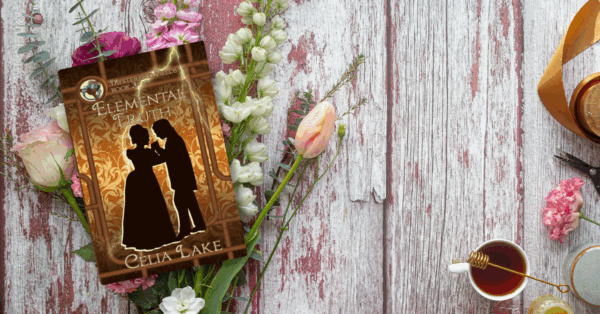
Thank you for following me – and Thessaly and Vitus – through three books of challenges! Now they can build a life together.
My thanks in so many ways to Kiya Nicoll, my editor and friend and other half of my brain, who put up with my having new thoughts about this trilogy at all sorts of points in the process. And my thanks to Elise Matthesen, for ongoing excellent comments about stones and their properties.
I have plans for some extras for this book. Keep an eye on my newsletter and website!

The Fortier and Landry families appear in many other places in my books, later in the timeline.
Grown Wise, Ursula Fortier’s romance in 1947, revisits some of the events of this trilogy and the impact on the family. It’ll be out in May 2025. Ursula is Isembard’s daughter, Laudine and Dagobert’s granddaughter. By 1947 she’s been named Heir to her Uncle Garin.
Otherwise, here are some key titles for the family:
• Eclipse finds both Isembard Fortier (born in this book, in his 30s) and Alexander Landry (in his 50s) as adults, when Alexander comes to teach at Schola in the 1924-1925 school year . It’s a friends to lovers staffroom romance between Isembard and Thesan Wain, Astronomy professor.
• Alexander is the focus of Best Foot Forward in 1935, as well as Nocturnal Quarry in 1938 (a character focused novella that includes a bit more of Alexander’s family.)
• Old As The Hills has a key event in Garin’s life, and some of the aftermath, though he’s not a main character there.
• The Magic of Four includes Isembard’s son Leo as one of the main characters.
You can find Niobe Hall, Vitus’s apprentice mistress in Facets of the Bench, much later in her life in 1927. And Margot Williams, Thessaly’s cousin, appears in Bound for Perdition (in 1917)and Three Graces (in 1945).
You can find more about Cyrus and his sister in Sailor’s Jewel, The Hare and the Oak, and an upcoming book (set in 1928) with his daughter Gemma’s romance.
I’ve also been sharing sequences of extras related to the Fortiers and to Cyrus on my Patreon. The relevant sets include A Fox Hunt (Ursula and Garin going into her romance in 1947), Schola Tales (Leo Fortier and others in 1946-1947), and Ritual Time (following Cyrus year by year after he becomes Head of the Council in 1932).
On to the content notes!
There is a tremendously long history of using specific gemstones and talismans for magical purposes. The primary resources I drew on include A Lapidary of Sacred Stones: Their Magical and Medicinal Powers Based on the Earliest Sources, Includes More than 800 Gems and Stones by Claude Leconteux as well as Stars and Stones: An Astro-Magical Lapidary by Peter Stockinger. The former – as you might guess by the title – is extensive. The latter is more focused, but goes into more detail in some places.
As I noted in the author note for Enchanted Net, lore also has a lot to say about inscriptions for specific purposes. For example, there’s this description (taken from the Laconteaux book): “etched with the moon and sun and hung about the neck with hairs from a synocephalus and feathers from a swallow, it protects one from evil spells. Magical properties are increased if set in gold or silver and if a man on horseback holding a sceptre is carved on it.” If that seems like a lot to put on a gemstone, yes, I thought that too. (A synocephalus has the head of a canid.)
Vitus and Niobe take something of a middle road here when it comes to design: pieces are created at magically relevant time (astrologically/astronomically speaking), using materials that associate in particular ways. They’re also imbued with magic by the creator, enabling them to do the desired function. It’s a little like building a computer and coding with it after building it out of raw materials.
Chapter 3 : Albion – like Britain, historically – has a number of varied guild systems. Some guilds are fairly free-form, or they rely on individual evaluations. The Talisman Maker’s Guild obviously has a specific process for evaluation by members, with Vitus’s final exam here. (As Vitus notes, he’s already met the requirements to be a journeyman member of the Gem Cutter’s Guild, since that’s a precursor for much of the talisman work.)
Chapter 7 : The parson’s cat is a Victorian game (also known in some places as the minister’s cat). In it, you go around the room and give the cat an adjective in alphabetical order. If you hesitate, you lose the round. It can also help you keep your calm during a difficult conversation, as Thessaly demonstrates here.
Chapters 9 and 10 : The All Hallows customs here are drawn from northern Wales, with a mingling of things that might have come into the family over time. The dangers that Thessaly notes – Gwyn ap Nudd with his hounds, voices calling out, dangers at crossroads – are all commonly referenced culturally. (Gwyn ap Nudd is ruler of the Otherworld and associated with the Wild Hunt.)
The traditions around cracking nuts and reading the future in them is also common in various parts of Great Britain.
Chapter 11 : As noted above, Cyrus and his sister also appear in a number of other places. Cyrus eventually becomes head of the Council in 1932, and he has a steady hand there. Andie, his sister, takes on a new name in 1901 (just as Sailor’s Jewel takes place), Rhoe. That’s because she’s taken on a new position in the Temple of Healing, as the senior Healer in charge of the ritual healing baths.
Chapter 27 : I did some research to figure out if I could do a Hound of the Baskervilles trick here with phosphorous. Unfortunately, phosphorous was known, but not in this kind of use, and the related approaches with radioactive substances weren’t figured out until 1896. A little too late for this book!
Thank you again for joining me for this story. Again, if you’d like a bit more about aspects of what happened that Thessaly and Vitus never see, some of those will be explored in Grown Wise, out in May 2025.
My newsletter has all my updates and news, as well as additional information about where I am and what I’m doing online. Until next book, happy reading!