
Curious about what’s behind Weaving Hope? Explore my author notes about the historical details behind the book.
These notes do contain some plot spoilers! Otherwise, they’re as shared at the end of the book, with edits only to share the most useful links and cleaning up some formatting for the web. Posted May 2026.
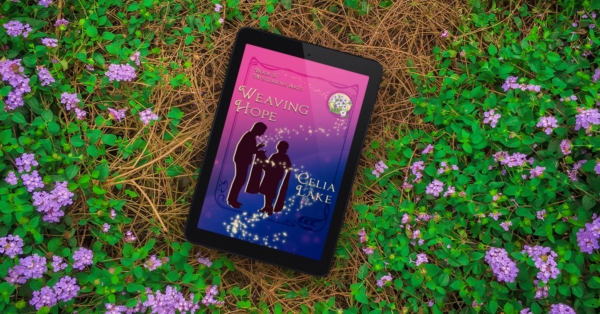
Hello, and thank you so much for this quiet little story of buildings and gardens and tapestries! As always, tremendous thanks to Kiya Nicoll, my editor and friend. And thanks as well to my early readers, for helping me making sure all of the story (and the central puzzle) worked.
First, some chapter notes, and then – if you’re the sort of person who likes having a reference – some additional notes on the tapestries and their original sequence when they appear and the correct sequence.

Weaving in general: There are a great many ways to do weaving, and I’ve gestured at a number of them here – different kinds of looms, different kinds of processes. What you see Eda doing on the small portable loom she brings with her to Oakburgh Hall is a typical setup for a small home loom. As looms get larger, they can do wider fabric, more complex patterns (depending on the design) or work better for certain kinds of weaving, like the complex illustrative designs of a tapestry. As Eda notes, for larger looms, weavers would often work in pairs. Collaboration is a big part of helping keep things moving in a workshop, because the individual steps can be time-consuming or just need more than one pair of hands.
Thanks to my friend Elise Matthesen for sharing her long-developed knowledge about natural dyeing (and a set of samples for me to pet and admire). I didn’t get as much into dye here as I might, but perhaps in some future book we’ll revisit it.
Catholic recusants: There’s a tremendous amount of history here, but if you’re not familiar with the period, the Tudor era under Henry VIII and through Elizabeth I’s reign brings in a great deal of back and forth about religion. Catholic recusants were those who remained Catholic (refusing to attend Church of England services) – laws were on the books from 1558 until they were finally removed in 1888. The term these days is usually applied to members of the aristocracy and their families. Various of these notable families created spaces for mass to be said in their homes, or to provide a secure place to hide itinerant priests (travelling around the country).
Priest holes or priest hides would be the term for those hidden spaces. I’m delighted to have finally written a book that includes some – they’re an architectural aspect of history that’s absolutely fascinating.
More about the history of Baddesley Clinton below, but Oakburgh Hall here is based closely on Oxburgh Hall, a real place (moated and with towers and all). I’ve taken a few liberties with the specific setup of the space, including the inclusion of the priest hole in the chimney, but it’s based on similar spaces in other buildings. The hidden passage in the library, however, comes from some historical renovation discoveries.
Chapter 5 : Castile soap is a particularly good choice when working with fabrics that can pick up oils from your hands. The name comes from the fact it was originally principally made in Castile, Spain. It was probably based on soap and recipes brought back from the Crusades around Aleppo.
Chapter 6: The famous Unicorn Tapestries (now at the Cloisters of the Metropolitan Museum of Art in New York City) were bought by John D. Rockefeller in 1922 and given to the museum in 1938. I’m very grateful to the Met for the extensive information they’ve shared about the tapestries, including things like calculations on how long that weaving would have taken and detailed discussions of plants and animals in the panels.
Chapter 10: One of the more amusing research problems for this book was figuring out the likely edition of the Encyclopaedia Britannica. The 11th edition was published in 1910-1911, in 28 volumes plus an index. That edition is notable because they had solicited significant experts in the field to write the articles, and many of the articles are works of art in themselves. Supplements to this edition came out in 1921 and 1926. Beginning in 1920, Sears Roebuck took over the encyclopaedia, with the next full edition (the 14th) coming out in 1929 and a revised 14th beginning to have rolling revisions starting in 1936.
Chapter 26: First, if you’re at all interested in Harvington Hall, they have an excellent set of videos on YouTube showing off various aspects of the house as well as an informative website. As noted here, Harvington Hall was donated to the Archdiocese of Birmingham in 1923. It was rather decrepit then (and the roof did actually collapse in 1929). In the period, it was the home of the Archbishop and his sister.
The priest hides here and the ones at Baddesley Clinton were both the work of now Saint Nicholas Owen, a Jesuit lay brother responsible for a great many clever design ideas. Unfortunately, he was eventually caught and martyred. The hides described here are the ones that were known about in the 1920s, but in all these houses, there’s always a chance there are more waiting to be discovered. Harvington Hall is considered to have the finest set of surviving priest hides – and also the largest number found to date in a single home.
Tapestry references
Finally, a word about the tapestries. Each of them is based on a virtue, named in Latin. Unfortunately, none of the ones on the common lists start with a U, so there’s a little bit of fuss to get the idea of the location of the hiding place across. And because these are magical tapestries, the designs were chosen to help anchor enchantments for the benefit of the household.
In the order the tapestries should be hung, they are as follows. Gaudium, Ethicus, Honor, and Stabilitas are narrow, Eloquentia are the two wide but short tapestries that hang above the double doors on each end of the room. The others are wide.
Gaudium or joy, depicting dancing out in the open, some communal celebration.
Alacritas or promptness depicting figure on horseback, as if riding to battle.
Tolerantia or tolerance, a varied scene showing many styles of dress and manner.
Ethicus or ethics, several symbols of particular saints on a stone wall. (Neither Eda nor Jeremy are skilled at identifying these without more research.)
Honoria or honour, gate opening up into a verdant garden. H can also stand here for herbipotens, the abundance of plants, with echoes of the symbolic associations of plants and particular ideals or virtues.
Obedientia or obedience shows a scene at the Tudor court, around the time the tapestries were made, with various symbols helping anchor the time and place like the Tudor rose.
Stabilitas or stability has an architectural detail of the gatehouse stairs.
Eloquentia or eloquence have rows of books, eloquence put onto pages.
The whole spells out gatehoase (with that second a pretending to be u). And of course, the actual images, especially the S, give additional hints.
When Eda first begins to work on them, they are in order as Ethicus, Obedientia, Alacritas, Honoria, Stabilitas, Tolerantia, Abertas, Gaudium, Eloquentia.
Thank you again for joining me for this journey. The best way to get all my news is by signing up for my mailing list. Check out the contact page on my website at celialake.com for other places to find me and more about my Patreon and Discord.
The next book in the Mysterious Arts series will be a romance involving Gemma Smythe-Clive (Cyrus’s daughter, for people who have read other books involving him) and a romance when she’s around forty years old involving beer brewing, herbs, and a bit of a mystery.