
Curious about what’s behind Harmonic Pleasure? Explore my author notes about the historical details behind the book.
These notes do contain some plot spoilers! Otherwise, they’re as shared at the end of the book, with edits only to share the most useful links and cleaning up some formatting for the web. Posted May 2026.
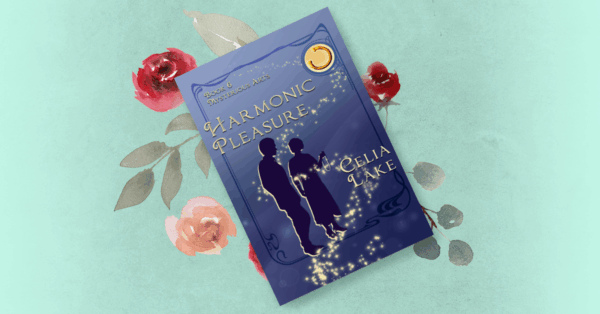
Hello, and thank you for joining me on this trip through London with Vega and Farran. My deepest thanks as always to my editor, Kiya Nicoll, and to my early readers. In particular, Elise Matthesen had an excellent suggestion that improved the end of the book.
A note on naming: Kevin Stafford is named thanks to his wife supporting my Kickstarter in 2024 to create my first audiobook. One of the options I offered was the chance to name a minor character. Kevin chose both the name and — as a musician himself — what role that character had in the band.
Cadmus and Vivian have their romance in Seven Sisters, where Farran also appears as a secondary character. I couldn’t resist spending a little more time at Thebes or with a different line of the Cousins.
Robin (who Vega spots at the club) has his romance in Fool’s Gold. He’s from a different line of the Cousins, as Vega notes.

London is, in many ways, the city of my heart. It’s not a city I’ve ever lived in (though I’ve visited multiple times), but my father’s family lived and worked in London, including someone active in the Chartist movement in the 1830s. Getting a chance to explore London in a book is, of course, a delight – but I also wanted to do it justice.
London is notoriously a city of many layers and so many odd eddies of history. There are a number of great books that dive into the topic. For a general overview of London as a city, I loved London by Peter Ackroyd. It not only explores the history, but wanders into topics like what the city sounded like at various points – and where it was known to be unusually quiet. London Under (also by Peter Ackroyd) and Underground London by Stephen Smith are different takes on underground London.
I’m indebted to Elise Matthesen for reminding me about the various closed and abandoned Tube stations. And also for sending me a copy of London’s Disused Underground Stations by J.E. Connor. It’s excellent to have friends who can pinpoint that kind of resource! The book talks through all the Tube stations no longer in use with all sorts of dates, ticket stubs, and other details.
Finally, The Secret Lore of London (edited by Nigel Pennick) and London Lore by Steve Roud both have extremely useful gazetteer sections. These allowed me to build a map of potential locations and figure out which ones I wanted to explore through the plot.
I do hope to come back to London in a book in the not too distant future. The mention of the Keeper of London had all my early readers noting they wanted more about that! I’m currently looking to see how it might fit in the Mysterious Societies series, the next 1920s Albion series. Keep an eye on my newsletter and blog for more!
On to the specifics:
Chapter 6 : My inspiration for Vega’s approach here is thanks to my hearing Nadine Dubois sing a 1920s style version of “Bedlam Boys” at Lili’s Burlesque in Minneapolis in 2005. As you can guess by that date, it made a tremendous impression, even though I’ve been unable to track down a recording in the two decades since. The song has a number of verses and variations, but there’s also something compelling about the determination of the protagonist.
Chapter 9: The Guild Hall has so much history it’s tricky to get into it. Once I started digging into the figures, however, I was fascinated. Some version of Gog and Magog have stood in the Guild Hall for many centuries, and they were paraded through the streets in the reign of Henry V. Exactly who they represent is a good question, but some version of giants or mythical figures dating back to the arrival of Brutus and the last remnants of the survivors of Troy is a common story.
The current Magog’s shield has a phoenix rather than the eagle present when Vega and Farran see it in 1928. Some people think the phoenix was put on the shield after the Great Fire of London, but no! It turns out that the shield was changed after Gog and Magog were destroyed in the Blitz. They’ve been remade due to fire and disaster several times, but these current figures date from 1950.
Chapter 13: The London Stone has been somewhere near that spot (with brief intermissions) since 1100. No one is entirely sure why it’s important, but it keeps mattering. The Wikipedia page in this case covers the details well. When I was last in London in 2015, you could peek around the counter in a W.H. Smith’s bookshop to see it, but it is now on protected display on the street, much easier to visit.
Chapter 14: When I went looking for a particular kind of art that Farran might have thoughts about, I stumbled into the Huguenot silversmiths. A number of the Huguenots came to London (many of them were known for fine weaving), but others ended up in North America. The references here are based on summaries of collectible silver.
The changes in treasure and hoard law in the United Kingdom are complex! These days, they’re made even more complex by advances in metal detectors and other technology. This has been a boon for archaeologists when the finds are properly reported and can be studied in situ first. Farran and Philemon are discussing the standards as of the 1920s, of course.
Chapter 15 : Ceadda is known as a patron saint strongly associated with wells, and thus his saint’s day on March 2nd is a day to clean them out. And as I’ve been known to say, it’s hard to go terribly far in England or Wales (or a fair bit of Scotland) without coming across a holy well.
Chapter 18 : The story of St Alfege is historically a bit tricky to document, but he was in fact thought to have been killed on the site and the church was a key location for a number of Tudor events.
The cemetery in Greenwich Park was excavated in the 1780s. Some of the mounds were destroyed due to planned construction in the 1840s, but outcry from a number of people prevented that from happen. Other smaller excavations have taken place, finding items from the 5th or 6th century CE – just about the right time period for my plot!
Chapter 20: Jack Cade’s caves have a rich history. Fortunately for my purposes, they’re also surprisingly well described. During the 1920s they were not accessible to the public, particularly for safety reasons. But in the Victorian period, they’d been used for parties, drinking, and other activities, including some well-documented graffiti. All the comments about the appearance here are taken from period sources or later descriptions.
There was major flooding in London in January of 1928 along the Thames, and so I have made the reasonable assumption that the water table in the well is still quite high.
Chapter 22: The clock mentioned here was removed in 1828 but finally returned in 1935. As Farran notes, the statue of Queen Elizabeth (then the first and only) went back up on display at St Dunstan’s in June 1928, a few months after the scene takes place.
Chapter 26: If you’re familiar with the Tower of London, some aspects of this description might seem out of place. I had a lot of fun consulting the guide to the Tower published in 1927, and have drawn all the specifics from that guide. The Crown Jewels were in the Wakefield tower in the 1920s, and not moved to their current location until the 1960s. Visiting involved a number of stairs, and a number of areas (like the church) could only be seen by touring with one of the yeoman warders.
Chapter 33: As Farran mentions, the London Tube at this point was in fact several different companies, with whatever connections occurred being a matter of negotiation, chance, and other details. Wikipedia has an excellent history of the London Underground, which includes the stations. The connection between Monument and Bank stations doesn’t happen until 1933. Depths for the relevant stations were taken from various sources. My hearty thanks to people who have a passion for transportation!
Chapter 37 : If you know your underground London history, you might be aware that there’s a surviving Roman temple right near where Farran and Vega find the missing artefact. The extant temple was a Mithraeum (sacred to Mithras). I used its location as a reasonably proximity for where other underground spaces might have survived. (I also checked for plague pits and Tube lines.) Of course, those open spaces may not have survived long past Vega and Farran’s discovery.
Thank you again for joining me for this journey. The best way to get all my news is by signing up for my mailing list. Check out the contact page on my website at celialake.com for other places to find me and more about my Patreon and Discord.