
Curious about what’s behind Brave Truth? Explore my author notes about the historical details behind the book.
These notes do contain some plot spoilers! Otherwise, they’re as shared at the end of the book, with edits only to share the most useful links and cleaning up some formatting for the web. Posted August 2026.
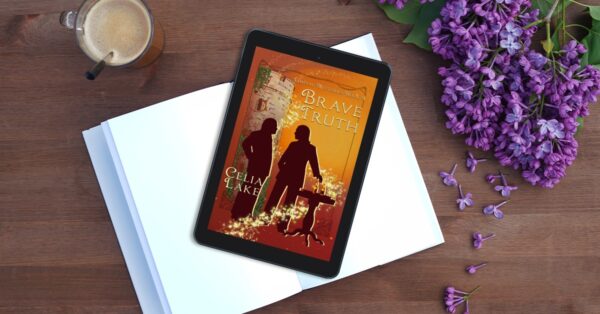
Thank you so much for joining me and Claudio and Matty for Brave Truth!
My thanks, as always, to Kiya Nicoll as my editor, helping with all manner of aspects of making this book stronger. Thanks this time to Annie, one of my early readers, who read Illusion of a Boar and dropped me a note wondering if Claudio was queer. That was not what I’d been thinking, but as soon as she asked, I nodded and went ‘yes’.”

I wanted Brave Truth to be a book that set Albion on a new course into the 1950s. I don’t intend to write past 1950 as a year for a number of reasons. Some of those have to do with the fact I’d need to have some beloved characters die of old age (Gil and Magni are head of the list). But also, more recent years present an entirely different range of research challenges in terms of looking for some kinds of details, and I’m just less interested in wrangling with some of the politics.
Because of this, readers of various of my other books might spot a number of cameos here. They’re described below in the relevant chapter. It was fun to get to revisit a few people and see what they were up to.
I do have plans for a few scattered things at other times in 1950, but from 1951 on, well, it’s up to you and your imagination! There are a few notes about some specific characters and their later lives on my website, too and I may add some additional notes over time. For now, let’s dive into Albion in 1950, and the folks in Brave Truth.
Other stories:
First, if you’d like to know more about how Claudio, Orion, Hypatia, and Cammie became close as a foursome (and Orion and Hypatia’s romance), Illusion of a Boar is your book. It takes place in 1944 in the run-up to the D-Day invasion, when the four are brought together to work on a secret project relating to misinformation. It includes more stoat goodness.
Claudio working out the theory of the Council seats can be found in As The Ground Shifts, a series of extras for Illusion of a Boar. You can find it (and other extras) on my website. As The Ground Shifts also includes Claudio and Orion meeting Magni and Gil for the first time and a great deal of Gabe being himself. Orion’s Challenge takes place at the end of Three Graces (though he’s not a point of view character there).
And if you’d like to see Claudio and Orion at school, Eclipse is Thesan and Isembard’s romance during the 1924-1925 school year, the second year Isembard is teaching at Schola. More character connections can be found on my wiki.
You can also find a range of other serialised extras on my Patreon. They include a few free episodes, including two prequels for this book.
History
For the background on the Nuremberg trials and Matty’s work there, I relied heavily on Ann Tusa and John Tusa’s The Nuremberg Trial, which does a fantastic job of talking about the pragmatic realities of the trial. At the time, there had never been any similar kind of international tribunal to deal with these sorts of crimes, and so the first job of the court was to figure out how to make things work, what law applied, and how to handle dozens of different aspects – starting with multiple languages. (The trials had the first simultaneous translators through audio headphones, for example). Behind the judges and visible key figures were a great many people doing administrative work.
Besides the main and most notable trials, various people continued with smaller focused trials until matters were turned over to local resources at the end of 1949. Matty’s references to specific people and their working style come from the Tusas’ book. At that point, well, he had to come back to Albion, really. He couldn’t stay where he was.
I also found the Criminal podcast episode, “Palace of Justice”, an interview with Benjamin Ferencz, one of the Nuremberg prosecutors. There’s a 2021 update episode that includes a followup with him at the age of 101.
One of the things I think about a lot is what we now call ‘moral injury’ – the challenges and often harm done to people who are exposed (especially as part of their work) to the horrible events and actions in the world. I’m most familiar with it from Trust and Safety work, the current term for people who support websites and social media sites (among others) by handling issues related to terms of service violations, but also issues like abuse, violence, harassment, and much more. I did some of that back in the day (2003-2004 on LiveJournal, to be specific), I’m still friends with people in the field, and I think a lot about how that kind of work shapes us for good and ill.
In Brave Truth, I wanted to write about someone who’s done difficult, damaging, critically important work that he can’t talk about (for all sorts of reasons). And whether it’s possible to find ways to come through on the other side less broken by it. (I hope yes!)
Finally, in 1950 the United Kingdom is still living under rationing. Some things are easier to get than during the war years. (Fishing is easier with less chance of U-Boats…) And flour came off rationing in the summer of 1948. However, other foods are still rationed, which always makes writing comfort food into a book a little trickier! And it explains why various households appreciate rabbit (which wasn’t rationed) besides giving Cammie a vent for her frustrations in life.
Homosexuality in this period is more or less as Matty describes. It was still quite common for men to face significant legal penalties if anyone accused them (significant time in gaol, usually with extremely hard labour and poor conditions). That accusation could come from something as small as a conversation. Matty’s also right when he says the average age of people in gaol for homosexual acts is just about his age.
How people dealt with this varied a great deal. I drew on Peter Ackroyd’s Queer City is an excellent historical look at London in particular (though the last chapter has some bits I hope he’d approach a little differently now). I also drew on various episodes of the podcast Bad Gays which looks at the biographies of a number of queer figures and puts them firmly in historical context (and that include a number of people active around this time). They mostly focus on people with complex histories (and a mix of genders and orientations, once you get past the first season or two).
On to comments about specific chapters!
Chapter 6 : Treeve Dixon was last seen in Carry On (set in 1915) as a friend of Roland Gospatrick. He’s still functionally doing the same job in 1950 as what we’d think of as a forensic accountant, just with a lot more experience behind it. He’s likely to retire sometime soon – he’s about 65 here.
Divorce in the United Kingdom in 1950 still required proof of cause (adultery, desertion, incurable insanity). The law wasn’t reformed until 1969 to allow a mutually agreed on (no-fault) divorce. Albion works a little differently: there are provisions in Albion for divorce due to a lack of children (as Claudio’s father did, twice), or for other mutually agreeable reasons. It’d raise some questions and gossip, but not be scandalous for too long.
Chapter 7 : The magical nature of Dinas Emrys and the dragons in the water is drawn from historical lore, specifically Geoffrey of Monmouth and other tales of two dragons battling each other in the pool of water below that keep. The castle has been rebuilt in Albion (it’s been a ruin since the mediaeval period for us…) but the traces of dragon scales remain. The other mineralogical content is drawn from the makeup of the local rock.
Chapter 8 : Charlus Edwards is a secondary character in Facets of the Bench. There, he’s apprenticing with Griffin Pelson, and by 1950 (as noted) he’s been named as Griffin’s Heir for the land magic of Trellech. Albion’s courts get much more time and space in that book, but of course people in Albion’s Courts were deeply interested in the legal implications of the Nuremberg trials.
The ATS is the Auxiliary Territorial Service (almost always known by the initials informally), with the women serving generally called ‘ATS girls’ (though they were adult women). Cammie and Hypatia are serving in the ATS in Illusion of a Boar, but it brought many women together in new ways for national service in a wide range of tasks and roles. Many were administrative, but some involved machinery support, anti-aircraft guns, or despatch work.
Chapter 12 : Robin Aelfdane can be found in Seven Sisters (in 1922) and his romance, Fool’s Gold (in 1925). At the end of that book, he settles down. When I needed an antique shop here, I couldn’t resist giving him a chance to show up. Yes, some of the landscapes on the walls are his work.
The lamps Matty looks at are drawn from period sources, including the one Matty gets, which is similar to the Tiffany “Feather” lamp (bronze and leaded glass) with a glorious range of colours.
Chapter 13 : For Giles and Cammie fun related to his current apprentice, Apt to be Suspicious has more about what they’re up to.
Chapter 15 : When I was drafting this book, I kept counting up awkward conversations. This is one of my favourites on the list, because it brings in the questions of what we do and don’t talk about – even with people we love and trust and who want the best for us. Thesan has long had some clear lines about what she shares (and with whom) and what she doesn’t. You can see them in Eclipse (her romance with Isembard) and through a number of sources.
She’s also got long experience with walling off the bits that can’t be visible at a particular time. So I’ve known she was bisexual (and had past romances with men and women) since writing Eclipse but also why she wasn’t talking about it (and, as Isembard says, why he wasn’t pressing her about the details).
You can find Seth and Golshan’s romance (and how the two of them and Dilly become a family and household) in Casting Nasturtiums, a novella found in Winter’s Charm. Claudio’s first meeting with Gil and Magni is in As The Ground Shifts, the extra that includes a number of events in 1945.
Minority or marginalised groups have a number of ways to signal membership that those in the know will spot while sliding under the notice of others. This has risks, of course. (It’s one of the ways people were sometimes entrapped and accused of homosexuality in this period.) Shared references are common.
We also have a custom of pubs picking up certain types of people, often based on proximity to the pub, shared interests, or both. Urania’s Apples is near the Ministry (and so is a reasonable location for folks working there), but it’s also quietly picked up people who want a space friendly to their interests. The public spaces never go beyond conversation, obviously, but there are private rooms (as Gil and Magni use later in the book) and some upstairs.
The name is as explained in the text. References to Sappho were a longstanding indicator of possible sapphic or lesbian interest: this also turns up in Seven Sisters. But Urania as the muse of astronomy also means that the name amuses Thesan rather a lot.
Chapter 16 : The floods that Claudio and Matty discuss took place on October 28th, 1927 with massive flooding and storm surges along the Irish Sea and Cardigan Bay (where Schola Island is located).
Chapter 17: The Penelopes are up on the southwest side of Kielder Forest, which was planted on scrubland to increase timber reserves. Kielder Water, the massive reservoir that’s there now was created in the 1960s.
As for the red squirrels, I have been wanting to get this fact into a book for years. Leprosy shows up in pelts of red squirrels from the medieval period forward (their fur was often used for robes and other expensive clothing, so there are a number of preserved samples). Current research isn’t sure whether it started with the squirrels or with humans, but the same strain is involved for both species. As Gabe and Claudio say, you generally do need extended exposure (and some very bad luck) to catch leprosy.
Chapter 19: Getting to write Matty’s observations of May Day in Trellech was great fun. Facets of a Bench also has a look at this particular celebration from a bit closer to the main action (that’s Griffin Pelson’s romance).
Chapter 23: Philemon Hollington’s work is something he’s involved with (much earlier in his life, c. 1890) in the Mysterious Fields trilogy. Vitus Deschamps, hero of that trilogy, is the person Cyrus is thinking of talking to. Hereswith Rowan appears in those books, but she’s also a main character in the Council Mysteries series, coming out in 2026 and 2027. The third of those will include more of Metaia and Owain once they join the Council in the late 1870s.
Chapter 25 : Cammie and Claudio discuss broom closets (in the literal sense, including banging your elbow on a broom) in Illusion of a Boar. Once I wrote that scene, I knew that if I wrote Claudio’s romance, it had to include something in a broom closet.
Chapter 28 : Gil and Magni’s romance is in Four Walls and a Heart.
Chapter 37 : Matty has picked up quite a few languages by this point. Just so you have the list, it includes English, French, and German, plus he picked up Russian and some Polish while working in Nuremberg. All five of those languages were very much in play for various parties involved.
Chapter 41 : Hesperidon Warren remains very much himself, alas. As Claudio says here, he does have occasional moments where he’s actually correct. His approaches to pollution and factories are one. His take on how you keep nosy journalists away from your home is another. The fact that almost everyone who ever knew him would like to shout at him a lot is still true. (That does actually include Silvia.)
And again, if you want a few scenes from other perspectives, A New Landscape is an extra of 25,000 words. It includes the Council meeting with the gossip, Matty and Mary watching Claudio and Orion duel the day after, the conversation Silvia has with Thesan and Isembard, and Orion and Claudio discussing their respective Challenges.
If you enjoyed Brave Truth and would like to read more about Albion, please sign up for my mailing list to get all the latest news and fun extras.
Thank you for joining me for this chapter of Albion’s adventures and events (and romance!) and happy reading wherever your reading takes you.