When I was writing In The Cards, I spent some time exploring the implications of the Tarot in Albion. That book both has a Tarot reading (in the opening chapter) and then discussion of various cards during the book, as relevant to specific people and events.
While the modern Rider-Waite-Smith Tarot is quite new in the 1920s (it was originally published in 1909), Tarot decks have a long and storied history in Albion. The primary deck used in Albion itself is the Howard Tarot, based on a deck commissioned in the 1700s by Alethea Howard. As with other features in Albion, it decentres Christianity (leading to some changes in symbology), and draws on figures from Albion’s history as well as British myth, along with significant plant references.
And then later in the chronology, Claudio (and Gabe) come up with a theory about the Council seats where the Major Arcana is an interesting tool for understanding some of the patterns. You can find their initial discussion in As The Ground Shifts (an extra) with additional discussion in Brave Truth and A New Landscape (another extra).
The Art
In 2026, I worked with a wonderful artist, mahasu4u, to come up with images for all of the Major Arcana, the 22 cards that represent archetypal concepts. Some of these are extremely specific to Albion, others have a lot in common with extant decks of the period, especially the Marseilles and the Visconti-Sforza.
I shared briefs with mahasu4u who then came back with often pages of notes (it’s so great to work with someone else who has a MLIS degree!). And of course, these are all (digitally) hand-drawn, no AI use.
When we started out, we did a bit of conversation about approaches. mahasu4u is the one who suggested exploring a dark silhouette (with some outlining) to echo the silhouettes on my covers. We both loved the effect, especially for something like a Tarot deck that is reflecting different aspects to the person looking at the card. And while digital art isn’t what my characters know, the stylised approach is evocative of art styles they were familiar with.
I’m sharing the cards in my newsletter first through 2026, and will post them here once they’ve been seen there. You can click to get more notes about the card and design elements on the toggle below each card.
The cards
The Fool
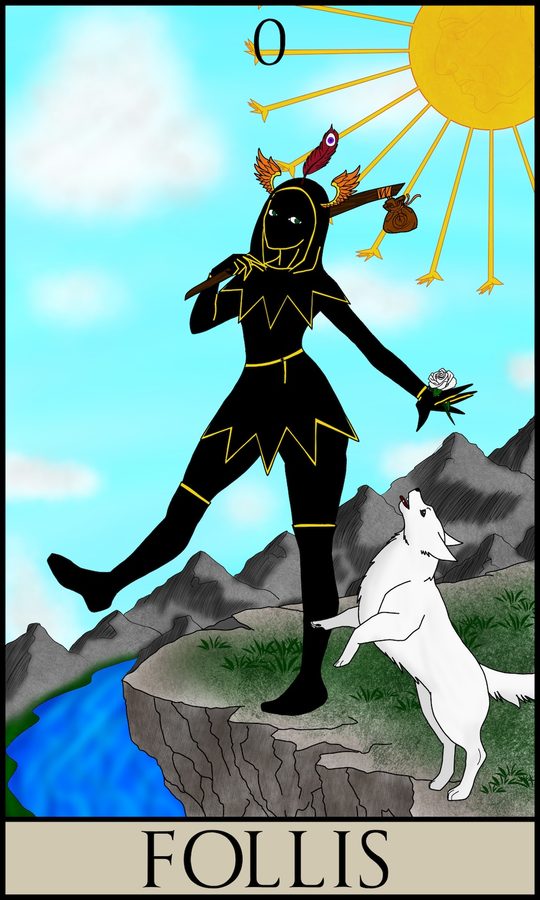
We wanted to have an androgynous and ambiguous figure here – the Major Arcana is partly the viewer’s trip through the cards, so a card where people might see themselves (or at least have an easier time) is great.
Several other elements call back to classical Greece and Rome – the name here (Follis) is also used for Odysseus’ bag of winds in the Odyssey, and the wings on the hat also call back to that.
And in Jacobean paintings (around the time the original Howard deck was created), the sun was often shown as having a face.
Finally, of course there’s a white rose for the white rose of York (and Richard III). You’ll be seeing more of those! (And in fact, a lot of the symbols, landscape, and other elements here carry through from card to card in specific ways.)
The Magician
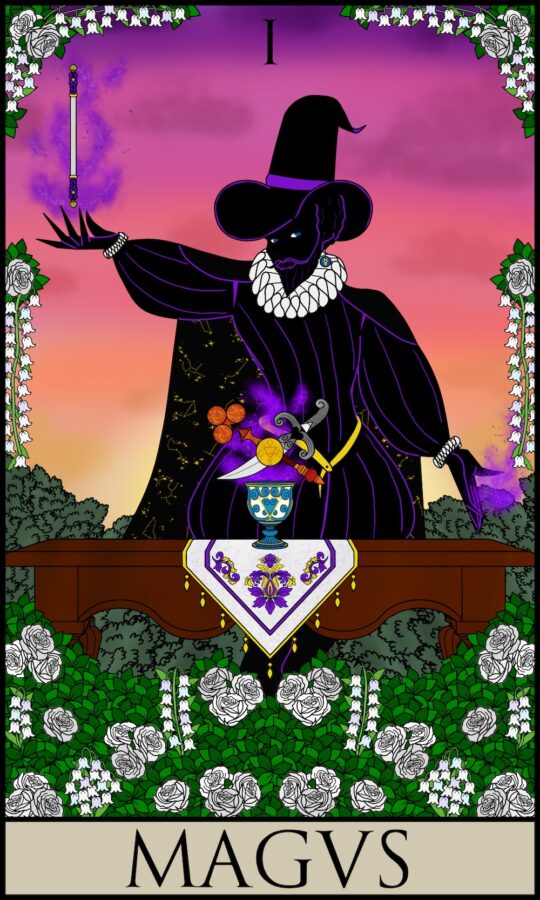
It’s a card associated as much with illusion as with functional magic – diverting the eye so you can do other things.
mahasu4u, my amazing artist, came up with so many added details here! That glorious sky and sunset, the addition of the lilies of the valley and the white roses of York, plus the purple details that link it to the Council’s particular strand of magic, or at least attempts to appear to! And of course I love the constellations lining his cloak.
The High Priestess
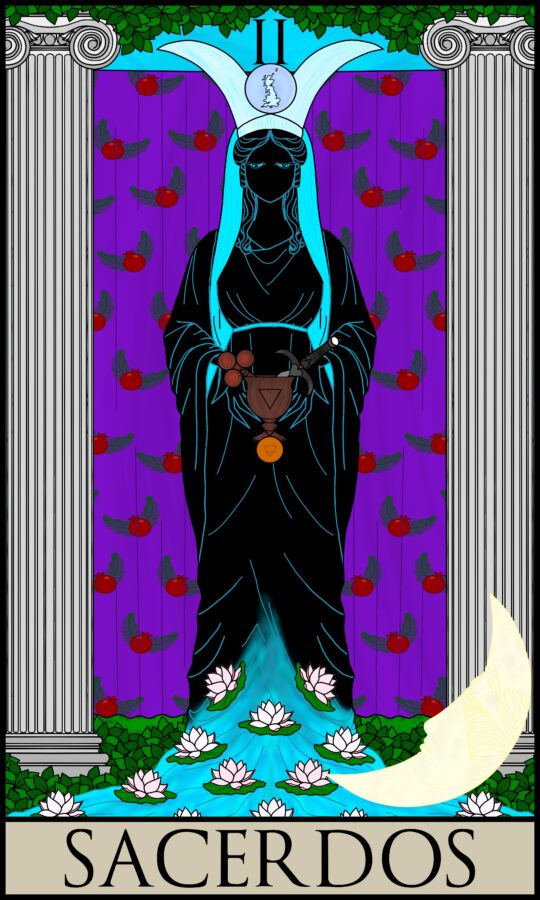
She is drawn in the mode of a Roman priestess, framed by two Ionic columns. The curtain behind her has pomegranates for the divine feminine, palm leaves for the divine masculine, and the Council purple for the relationship to divine kingship. (Keep an eye out for this cloth in future cards.)
Finally, her crown is drawn from some depictions of Hathor. If you can’t quite see the symbol, that would be Albion (as always, Ireland continues to do its own thing and is not on this map of what’s covered by the Pact.)
The Empress
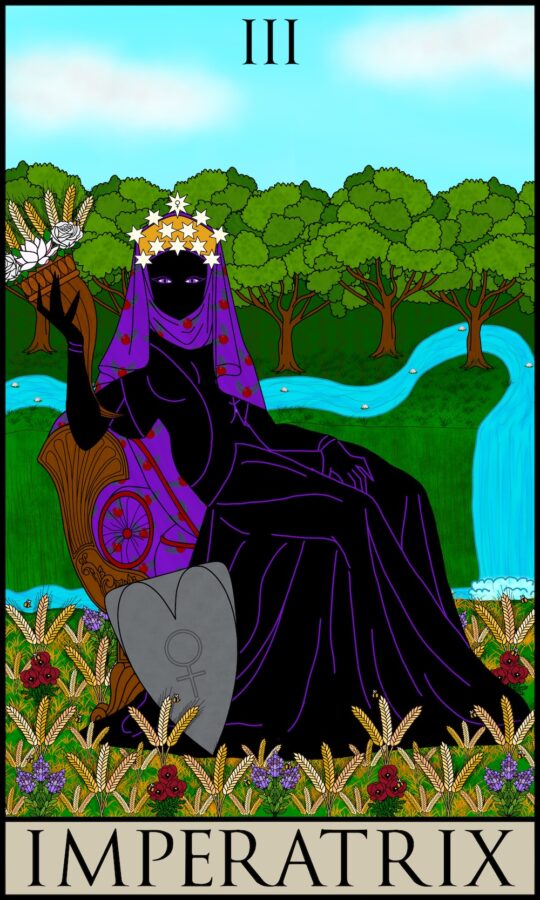
Those of you who love the Brother Cadfael mysteries will be familiar with this bit of history, the Anarchy. But she also had a strong love of England, in particular, and I wanted to bring that forward. She’s the mother of Henry II, and through him, the Plantagenets.
The Empress is associated with fertility, abundance, and in general. She’s often depicted as pregnant. Here, she’s holding a cornucopia, to reflect those things, as well as being surrounded by wheat.
She’s dressed in clothing from the late 11th century, including the veiling – and the crown is even based on crowns in illustrations. The shield is similar in shape to one her husband (Geoffrey, Count of Anjou) used.
In a number of Tarot decks, the gown from the Empress is the same as the curtain for the High Priestess to echo the connections. T, with the pomegranate pattern. Along with the wheat, we also have mint and poppy here, all sacred plants of Demeter/Ceres.
Her crown has 11 five-pointed stars and one larger 8-pointed star, representing the connection with Venus. And the trees are specifically ash trees, for longevity, fertility, and ties to ancient roots in the United Kingdom.