
Curious about what’s behind Ancient Trust? Explore my author notes about the historical details behind the book. (You can get this one for free!)
These notes do contain some plot spoilers! Otherwise, they’re as shared at the end of the book, with edits only to share the most useful links and cleaning up some formatting for the web. Posted April 2026.
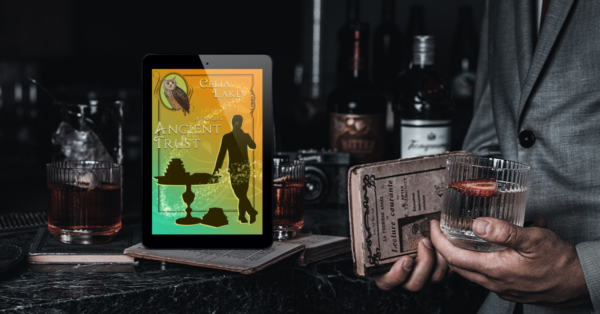
Hello! Thank you so much for joining me in this peek into a particular moment in Albion. As always, I owe a great deal of thanks to my editor, Kiya Nicoll, and to my early readers.

The world of Albion, the magical parallel to our own British Isles, is ever expanding. The best place to make all the connections is my public authorial wiki. That site has pages for each book and point of view character, timelines, maps, and other tools to help you make connections between characters and books. Check there for all the most recently updated information! My website has key information including links for all of my books, content notes, and frequently asked questions, as well as links to the wiki.
If you’ve read this, you’re on my newsletter! Thank you so much for that too. I share extras, research tidbits, and more just with my newsletter subscribers, but you can also keep an eye out on my blog and social media for more about what’s coming out soon.
Want more about these characters? Here’s a quick guide:
Geoffrey Carillon finds his romance in Goblin Fruit (set in 1924), and there is more to come in Best Foot Forward in 1935 (and the other books in the Land Mysteries series), including what happened with Carillon’s brother Temple. Thomas Benton is right beside him the whole way, with his own romance inOn The Bias (in 1926).
Richard and Alysoun Edgarton have an arranged marriage to love match romance in Pastiche (1906) and appear in a number of other books as secondary characters. Their son, Gabe has his romance inThe Fossil Door, which overlaps with the later part of the events of Ancient Trust (as hinted at in chapter 11). All of the Edgartons appear in the Land Mysteries series as well.
Giles Lefton met his wife Kate in Wards of the Roses (1920). The Country Manners novella in the Winter’s Charms collection takes place a few months before Ancient Trust, when they visit Giles’ family.
Rufus Pride and Ferry Wright appear in Outcrossing (1922) which has the meeting between Rufus and Carillon from Rufus’s point of view. You also get a bit more of Star, the pony who made herself at home in a stall at Ytene. It takes place during the same period as Ancient Trust.
Pross Gates has her romance in Magician’s Hoard, and also appears in Chasing Legends, a novella in the Winter’s Charms collection.
Captain FitzRanulf investigates a murder as a secondary character in In The Cards, and it was a delight to figure out how she and Carillon came to a solid working relationship with each other.
More about Temple Carillon’s death (and Delphina’s) is explored in other books, including Bound for Perdition (set during the Great War, but the precursor to what leads to his death) and Three Graces, which investigates what happens some decades later.
Many of my books deal with people who have had varied experiences of the world. It’s worth noting here that Carillon has some ongoing trauma from his War experiences as well as his shoulder injury. Benton is autistic, and Giles was blinded by gas. Alysoun lives with what we’d call fibromyalgia these days, and Gabe has what we’d call ADHD (though neither of those terms were in use at the time, of course).
If you’re looking for more books from particular perspectives, the content notes on my website or the “books that feature X” page on the wiki will help you out.
If you haven’t read anything else from me, you might want a little more context for the magical community. Albion encompasses England, Wales, and Scotland. (Ireland is not part of Albion, for excellent reasons, though the relationship between the magical communities of both places is generally at least civil at this point.) The magical community of Albion split from the non-magical community thanks to the Pact, made by Richard III in 1484.
Magical folk can – and often do – live side by side with non-magical ones, but are bound from revealing magic thanks to oaths made to the Silence. There is a magical city, Trellech (the seat of government), the Temple of Healing, and also five schools of magic, including Schola. However, there are also sizeable magical communities in a number of other places, including London.
Part of the Pact was settling responsibility for the land magics from the monarchy to individual lords and ladies. Lord or Lady is a title, with implications, and it attaches to the holder’s last name (as Captain, Healer, or other earned rank titles do) rather than the common British standard of the title and surname being different. The holders of the land magic have specific obligations, both to the land itself (or herself, as many of them prefer) and to the people living on that land. These days, however, that’s more complex than feudal obligations.
The Council – a group of men and women selected via magical challenge – are responsible for managing the agreements of the Pact, and for overseeing the land magic for Albion. They are also often mistrusted. You can read more about them in a number of my other books.
Ytene is the ancient demesne estate (i.e. the one associated with the land magic). It has been in the Carillon family for centuries. Lord Carillon is responsible for roughly the magic of the northern half of the New Forest, and the estate is in the northwest of the forest.
As Carillon mentions, there are ancient forest rights. In our world, there are seven, having to do with the right to graze various animals, take clay or firewood, and so on. Albion recognises an eighth, the yewbote, a right to harvest yew (for archery bows or magical use). The family also has several other properties, including Hawk’s Breath in Cumbria, but they’re not relevant for the land magic obligations. (Hawk’s Breath gets more time on the page in On The Bias.)
What the land magic rites involve varies from estate to estate and family to family, though there are some customary dates and types of observances. Geoffrey Carillon is a trained ritualist, and far more skilled than his brother was – or for that matter, their father.
In Ancient Trust, Carillon draws both on family tradition and on his own instincts and knowledge to strengthen the land magic after a period of neglect. The ritual of tending the healing well and tossing in a coin is based on rites related to Ceadda, honoured on March 2nd. (Diocletian was a Roman emperor, and coins minted during his reign have been found in coin hoards near Ytene.)
The May Day rites of the nearby magical village, True Eyeworth, are also described in Outcrossing. Again, there’s a lot of variation from place to place, but a community celebration of dance, song, bonfires, and shared feasting are common in many places.
The white hart is a deeply symbolic animal in England, and is often seen as a sign of a more mystical or numinous connection. Seeing one is a good omen for people in Albion.
Now that we’ve covered all the general background, on to the specifics of this book.
Carillon has spent time before the Great War and since travelling in many remote places. The Muthaiga Club was one of the notable spots for the British in Kenya. In 1922, we’re before its heyday as a central point for the Happy Valley crowd, but Carillon’s comments about the purposes of the club are on the nose.
I spend a remarkable amount of time staring into the abyss of time zones sometimes. Kenya was in fact exactly 2 hours, 27 minutes, and 16 seconds ahead of the UK at this point in history. (You can find maps with comparisons if you search on something like “time zone nairobi 1921” – 1921 is one of the notable years for changes.)
While there are a magical transportation option (portals), both geopolitical alliances and large bodies of water complicate using them. Hence, why Carillon and Benton need a train to Port Said, on the Mediterranean, to get a ship from there as the most rapid and reliable route.
Ovaltine of course, is the classic British bedtime comfort drink, made with milk. Of course Benton carries some, to be dosed with brandy as needed.
The S.S. Sussex was a Channel passenger ferry travelling between the United Kingdom and France when it was torpedoed in March 1916. There is no reliable count of how many people died, though Carillon correctly gives the estimate as 50 to 100. Those killed included a number of notable individuals.
Falconry is one of Carillon’s long-standing interests. He trained Theodora, the eagle-owl, before the Great War, but eagle-owls are tremendously large birds (about eight pounds). Merlins, his new choice, are about half a pound, and much easier to manage given the ongoing damage to his shoulder. However, tradition considers them a lady’s bird.
Pheasant can indeed become poisonous if they eat the wrong plants. Most of the stories about this have to do with laurel, but other plants have been implicated in illnesses or deaths after eating pheasant.
Carillon references an embroidered map he’d discussed with Giles. There have been many experiments in creating tactile maps for use either by someone who’s blind or for use in situations where vision is limited (such as at night). Embroidery is one of my favourite approaches here, with stitches and knots to represent particular locations or features.
I also make a nod to the issue of death duties. If you know much about the period, you’ll know that this was a tremendous burden for many of the older estates to bear – especially if they had multiple deaths within a short period of time. As Carillon mentions, the Carillon holdings don’t get the full brunt, partly due to how his father left the unentailed property, and partly due to the fact that three of the properties are firmly magical. (Ytene and the two townhouses in Trellech, the magical city.)
Albion’s government is not fully independent from the United Kingdom – it’s complicated – but they do have control over their tax structure in most cases and have decidedly different priorities in a number of areas.
The Naples Scourge was an alternate name for the Spanish Flu or the Influenza Epidemic of 1918. It’s discussed briefly as well in Outcrossing.
Lap Manse, Carillon’s intelligence handler, is part of MI6, based in Whitehall. They’ve been friends since their Oxford days, and Lap has some upcoming appearances.
Thank you again for joining me for this trip through a particular bit of Carillon and Benton’s history. If this has whetted your appetite for more, I recommend Goblin Fruit (for Carillon), On The Bias (for Benton), Pastiche (for Alysoun and Richard), or The Fossil Door (for Gabe). But my books can be read in any order, so dive in wherever you like!
Mostly, though, I wish you the happiest of reading, no matter what book (or who it’s by)!