
Curious about what’s behind Upon A Summer’s Day? Explore my author notes about the historical details behind the book.
These notes do contain some plot spoilers! Otherwise, they’re as shared at the end of the book, with edits only to share the most useful links and cleaning up some formatting for the web. Posted April 2026.
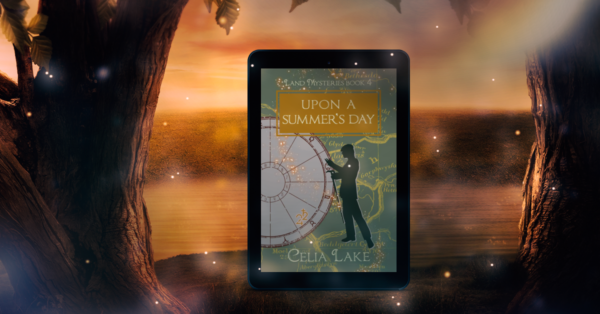
Welcome to the author’s notes for Upon A Summer’s Day! Thank you for joining me on this journey with Gabe and with Rathna, Alexander, Geoffrey, Richard, and Alysoun. I hope you’ve enjoyed it as much as I have. As always, my great thanks to my editor, Kiya Nicoll, for all their help brainstorming as well as editing, and to my early readers for their comments.
The title for this book – and the structure – have something to do with each other. The title comes from a Playford dance, “Upon A Summer’s Day”. The name for this type of dance comes from John Playford’s collection of dances published in 1651, The English Dancing Master. Various further editions came out into the 1700s, along with other similar books.
The book was an attempt to collect the various social dances for dancing masters in various locations around Great Britain. A number of historical re-enactment or re-creationist groups use them as appropriate. They were the dances of educated or well-off society, on the more decorous side, though some of them can get rather vigorous. Many of the dances are done in sets of paired couples, repeating various patterns to music. You can find examples of many dances if you search on YouTube, as well as music and descriptions of the dances themselves.
“Upon A Summer’s Day” is a dance based on groups of three couples, each of them progressing through a series of steps in sequence. Now, here’s where I have to confess that when I was first working out which dance to use, I swear I found a variation where the couples changed places in the sequence. There’s space for it in the music, where the first couple travels back up to their original position.
Can I find that now? No. Let’s call it Albion’s variation on the dance. At any rate, that also gives us the structure, with three couples, progressing through each portion, with a new couple ending up at the head of the line.
Partly, this sequencing amused me. More usefully, it allowed me to put Gabe’s challenge where I wanted it to fall in the pacing of the book, with time to work through the aftermath rather than ending abruptly. I wanted to tell this part of the Gabe’s life – and the larger arc of the land magic implications of the Land Mysteries – from multiple perspectives.
Having both people who know Gabe very well, and two who are amiably inclined but more distant, did just the trick. If you saw me talk about this on my newsletter, you may remember me saying this was supposed to be a novella. It decidedly outgrew that in the writing, and I think taking the space for that was the right choice as well.
Let’s get into the discussion of the book itself.
Both Old As The Hills and Upon A Summer’s Day deal with relatively early stages of the Second World War. As we get into the summer of 1940, various spies have been caught in Great Britain (from all historical accounts, very successfully. There will be a touch more about that in the upcoming Illusion of a Boar, but the history of those efforts is full of stories, some of them hilarious or almost unbelievable). As the book begins, we are also just about to enter the beginning of the Blitz, with more on that when we get to chapter 6.

Chapter 1 : We open with Gabe out on the family’s lands in Kent. Gabe’s mare is named Meliora, a Latin word that means either ‘better’ or ‘honey’, while Rathna’s Madhup gets her name from the Hindu for “honeybee”.
Chapter 3 : Winston Churchill made a number of notable speeches during the war. In this case, Gabe and Alexander are discussing his speech of August 20, 1940, where he’s particularly praising the fighter pilots and air crews. “The gratitude of every home in our Island, in our Empire, and indeed throughout the world, except in the abodes of the guilty, goes out to the British airmen who, undaunted by odds, unwearied in their constant challenge and mortal danger, are turning the tide of the World War by their prowess and by their devotion. Never in the field of human conflict was so much owed by so many to so few.”
The letter about the snake and apricot is taken from a real letter sent to the London Times by Eric Parker, a noted naturalist (as Gabe mentions). My thanks to my cover designer, Augusta Scarlett, for helping me track down an actual letter when I was casting about going “I can assume there’s some weird letter that they can investigate in the Times, there always is…” and fighting with my desire to dive into a rabbit hole of research for something that would only be relevant for a sentence or three.
On the other hand, finding something that’s real and historical is always a joy. This particular letter hit all the notes I’d been hoping for and them some. Of course there was a great deal of suspicion at the time about secret messages or unexpected communications meaning something dire. Thus, both the Council’s caution and the results of the investigation are quite reasonable in context.
Chapter 4 : There was in fact a bombing test range just west of Ytene during the Second World War. It was being built during this period and not heavily used until later in the War, but it was used to test the damage from various bombs as well as other investigations. Not exactly the sort of thing you want close to your magical estate or your horses, but Geoffrey (and Lizzie) will muddle through. It does explain some of why Geoffrey is spending so much time with the Home Guard.
The Home Guard was formed May 14, 1940 after the invasion of the Netherlands, Belgium, and France. Originally known as the Local Defence Volunteers (but using the name “Home Guard” by July), they were uniformed but not officially military. While their role changed quite a bit over time, Geoffrey (as someone too old to enlist, but with highly relevant experience in the Great War and a thorough knowledge of the area) is an excellent candidate for an officer’s role. Geoffrey’s fifty-seven at this point. They were meant to help maintain order at home, respond to emergencies, and, in event of an invasion, to carry out plans to slow the enemy in a number of ways. The men involved were those who couldn’t – for reasons of age, disability, or need to be in Britain for other employment reasons – enlist, but who still had useful skills or who were willing to learn them.
Chapter 5: While there had been fairly regular bombing raids in the United Kingdom from early in the war, they begin to pick up substantially in mid-August 1940. Generally, the UK considers the Battle of Britain to have run from July 10th, 1940 to October 31st, 1940, overlapping the Blitz running from September 7th, 1940 through May 11th, 1941. Originally, many of the targets were of a military focus, like airfields and harbours with significant shipping or shipbuilding. Over time, however (as we move into the Blitz), many more civilian targets took the brunt of the bombing.
Chapter 6 : One of my key research questions for much of this book was about where that bombing took place. Some I knew about, of course, like Coventry in chapter 9, and about the overall focus on southern England. My father was a schoolboy in Ipswich during the Second World War (and took some of his key exams in air raid shelters). My mother was enough younger and much further away (in Northern Ireland) that while they had many air raid warnings, almost no bombing occurred near her. She learned after the war ended that that was because the planes up to nearly the end of the war only had enough fuel to make it one way from the Continent if they ventured that far north.
Information about bombing in some areas was much easier to come by than in others. I kept finding fairly detailed information for London, or I’d stumble across a village history that had all sorts of specifics about that particular place. (Sometimes, this was down to which trees were destroyed.) This was helpful, but not everything I wanted, given that I had characters living in two different areas of southern England and responding to bombing in many other places (as both Richard and Gabe do in particular).
As I looked for answers, I kept finding references to a project published in 2019 called “Bombing Britain”. Frustratingly, I couldn’t get at the maps or data for a good while, just news reports about this exciting project that was now behind a paywall I couldn’t get access to. Then I had a moment of brilliance and realised that if I dug through the Wayback Machine, I could get the spreadsheet file of the original data they’d used.
A bit of downloading and crowing about my delight at all this data later, I split things up into the groupings I needed. In this case, that includes the duration of this book for southern and southeastern England (the regions I cared about most). I also made separate tabs for a few other places. I then spent quality time with Google Maps vastly improving my knowledge of minor English placenames, to figure out which locations were key for my characters.
Thus, all of the mentions of specific bombs or air raids in this book are as accurate as I could make them, given the thousands of rows of the original spreadsheet. I was delighted to be able to do that, both because I think it’s a part of history we don’t think enough about, and because so many of my characters are deeply connected with the land.
London of course was a major target, and is the place with the greatest number of overall deaths by quite a lot. If you’ve seen photos of the Blitz, you’ve probably seen how some houses are entirely demolished, and a house next door might still be standing. Magically, of course, this can also cause all manner of problems, especially when you think of disruption to alchemical labs or to the energetic lines of the portals.
There were, however, also a number of bombs dropped in Kent in specific, and thus highly relevant to the Edgartons. Basically, there would be a raid with targets in or near London, and if there were bombs remaining when they turned back to Germany (or wherever they originated), the Luftwaffe would often drop the remaining bombs over Kent on the way out.
This means there are quite a few random sites in Kent and along the southern coastline that are not near any military target at all. So far as I can tell, the closest ones to Veritas proper are the ones Gabe discusses in chapters 12 and 13. I did not in fact edit history at all, though it is always possible I missed something in all those lines of spreadsheet.
In chapter 6, Alysoun and Lizzie also go in for a spot of tasseography or tea leaf reading. The meanings they use are me drawing from a book called Tea-Cup Reading and Fortune-Telling by Tea-Leaves by “A Highland Seer”, published in 1920 and available from various sources including Project Gutenberg, since it’s now in the public domain. As Alysoun notes, snakes are generally considered bad luck, but Gabe has an unusual relationship with them by this point in his life.
Chapter 8 : Here, Geoffrey asks for Gabe’s help with a question that has bothered him since 1922 and the death of his brother, Temple. You can trace this story from Bound for Perdition (where Temple and Delphina appear), into Ancient Trust (a novella, available by signing up for my newsletter, that takes place immediately after their deaths) through Goblin Fruit and On The Bias, and into Best Foot Forward. The resolution of this mystery is coming in Three Graces, a novella where Lizzie, Thesan, and Alysoun tackle the problem and finally learn what happened. It will be out in December 2023.
Chapter 9 : I realised early in my outline for this book that I couldn’t ignore the utter destruction of Coventry, but I also wanted to handle it in a way that both fit the book’s focus and the characters.
If you do not know this bit of history, Coventry was the target of a massive bombing raid on November 14th. It was aimed at destroying the factories in the area. Many incendiary bombs were dropped from the evening of the 14th through to nearly sunrise the next day. As they dropped, they started many fires through the town, including destroying the mediaeval cathedral. The water lines failed fairly early in the evening, making it even harder to fight the fires or buy more time for people to get away. By the morning, much of the centre of the city had been destroyed. Over 500 people were killed, over 1000 were injured.
Richard, as one of the senior Guard, would of course have been in the middle of trying to help however he could. While magic (even the kind of not-obvious magic available under the Pact when people who haven’t made the Pact are around) could do quite a lot, it isn’t something anyone can maintain indefinitely. And as Richard says, it is tricky for the Guard to come and go to the same place, when they’ve clearly been elsewhere to recover their magic.
It’s also here that we see a bit more mention of rationing. Rationing began in stages in Great Britain. First, butter, sugar, ham or bacon were all rationed in January 1940. In March, meat (by price) was added, initially allowing about a pound of meat a week a person. Tea was added to rationing in July, allowing for two to three cups per person per day at this point (the amounts allowed changed a bit during the war). As Richard and Alysoun are talking in this chapter, cheese is not yet rationed, that only comes in May 1941.
It was expected that these rations would be supplemented by meals at schools (for students) or canteens (for workers, including people involved in war work). People could also supplement from their own farms and gardens. In general, vegetables were not rationed, though a number of them became very hard to get. For example, most onions at that point were imports, and so onions became very expensive and scarce to buy.
Veritas has a home farm to draw on and therefore they are not limited to the one egg a week per person ration. Magical farming techniques allow them to continue the farm with somewhat less labour, while magical transportation via the portals allows people to be doing some kinds of war work and still return to Veritas to sleep (and handle the farm chores…).
We are handwaving some of the logistics here – they just don’t fit in the flow of the story. Suffice it to say that they have some supplementation of the rations, but are using their resources carefully and sending their extra food to places like the Five Schools and the Temple of Healing. And of course, those things Veritas can’t produce itself – like tea – remain rationed.
It’s also worth noting that there was a significant restaurant scheme, and restaurant meals were not rationed the same way. People couldn’t have meat with every course, or have significant amounts of jam or sugar or what have you. But you could have a full meal, with items that were rationed, without using up your ration card. Within Albion, rationing for the schools and those drawing heavily on their magic as part of the war effort is also handled a little differently in most cases, due to the extra demands magic makes on a person’s body.
Chapter 10 : The sinking of The Patria is a tragedy in a war full of them. It sank on November 25th, 1940 while leaving Haifa harbour carrying Jewish refugees who had been turned away from Palestine due to not having immigration papers. The bombing was actually done by a Jewish paramilitary agency, seeking to disable the ship (though this was not known at the time Alysoun is mentioning it). 267 of the people on board were killed.
Chapter 11 : This chapter draws on a great deal of lore around sovereignty magic, particularly in some of the Welsh tales. In a number of tales in the Mabinogion, the collection of Welsh tales made in the 12th and 13th centuries and originally translated into English by Lady Charlotte Guest in the mid 1800s, there is a repeated scene. A young man – the hero, the one seeking sovereignty or kingship – comes to somewhere new. There, he finds a man sitting at a gwyddbwyll board, with a beautiful woman sitting nearby, and sometimes some other younger men who are likely her brothers. The hero must play a game and win in order to win the hand of the lady, who grants sovereignty over the lands through her gifts in marriage.
Gabe, of course, is both happily married and has no desire to be Arthur in this play. He knows better.
There have been some attempts at recreating gwyddbwyll as a game. We know it was a little like chess with pieces moving on a checkered board, but it’s not entirely clear how many pieces or all the ways they move. The game does keep showing up in lore, however, and Gabe is obviously familiar with it in that context.
The rest of his challenge is largely explained in the text either here or in later chapters. If you’d like more of his original encounter with the snake, he explains his fall to Rathna in The Fossil Door. The extra (available through my newsletter) Three Tales of Gabe and Rathna includes “Three Times Told”, where Gabe works through telling his family about that bit of experience. It also includes a series of scenes just after his fall from Gil Oxley’s point of view. I will add that you’ll be seeing a little more of one of the challengers in Illusion of a Boar.
Chapter 17 : The scene with Thesan pointing out the details of her article is in another extra, With All Due Speed.
I do hope you’ve enjoyed these author’s notes as well! You can find more connections and information about different characters, places, and topics on my authorial wiki. My newsletter is the best place to hear about all my forthcoming books, current research, and other amusements. It’s also the way to get access to those extras!
The next book in this series will be Illusion of a Boar, taking place in the run up to D-Day in June of 1944. It features four people we last saw as students in the 1920s, now all in their 30s: Claudio Warren (Silvia and Hesperidon’s son), Orion Sisley (his long-time friend), Hypatia Ward, and Cammie Gates (both skilled magical specialists). It also has an appearance by Gabe, along with a few other people with an interest in the project. It’ll be out in November 2023.
Again, please do join me on my newsletter to hear all my latest news, and for more about what’s going on in my other online spaces. You can also get more information about all of these people and their other connections on my wiki. My website at celialake.com has links to all of these things as well.