
Curious about what’s behind Bound for Perdition? Explore my author notes about the historical details behind the book.
These notes do contain some plot spoilers! Otherwise, they’re as shared at the end of the book, with edits only to share the most useful links and cleaning up some formatting for the web. Posted April 2026.
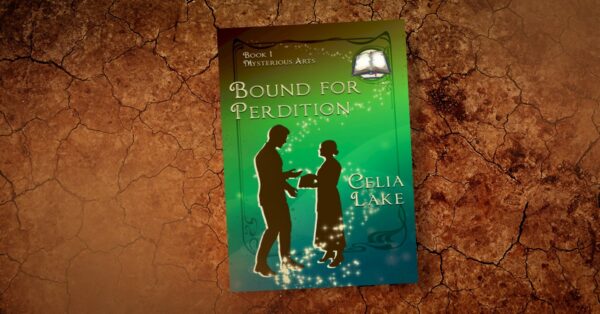
Welcome to Bound for Perdition! Thank you for taking this journey with me into the origins of the magical journals, a glimpse into more of what happened with Temple Carillon, and a great deal of pleasure rolling around in the beauty of bookbinding.
My thanks as always to Kiya Nicoll, both for editing and for helping me sort out the different aspects of Temple’s arc in particular. And as always, so much gratitude to early readers for making sure everything made sense.
The question of what Temple is up to – and what happens to him in 1922 – is a long arc through my books. This is only one piece of the puzzle! More will be revealed (including a reappearance of Margot Williams) in Three Graces, set in early 1945 and coming out in early 2024.
If you’d like more of the Carillon arc, in chronological order, they are: Bound for Perdition (1917), Ancient Trust (1922, available free), Goblin Fruit (Geoffrey’s romance with Lizzie in 1924), On The Bias (1925), Best Foot Forward (1935), and Nocturnal Quarry (1938), with some additional relevant references to Temple and his fate in Upon A Summer’s Day (1940).
That’s rather a lot, but I do love Geoffrey and the nest of people and experts he collects around him. You can learn more on my public wiki.
Onward to the notes about this book. Bookbinding notes in general first, and then we’ll get into the other details.

Bookbinding is, of course, an incredibly complex art. I have done my best here to present the sort of choices that would be practical for the goal – something sturdy, that could be packed into kit bags, carried around, be taken out and put away dozens of times a day. As Lynet explains, case binding (where the book is mounted onto book boards, a protective spine, and so on) is the optimal choice here.
As part of the research for this book, I tried my hand at a bookbinding kit, and discovered I enjoyed sewing the signatures rather a lot, but I was not nearly as good at the glue parts. (I am not the most dexterous human on the planet…) Figuring out how to take something from a stack of pages and parts to a real book was delightful, however, and I can see just how Reggie came to the same conclusion.
The journals themselves, of course, have a number of magical aspects. Some of this, as Lynet mentions, has to do with numbers in the design features. After some consideration, I decided that a “Council octavo” (a designation that doesn’t exist in our world) is a 6×9″ book. Octavo means that you get 8 pages to the sheet.
To make the magic work smoothly, and keep in lines with Albion’s commitment to the number 7, they use groups of 7 cut sheets to the signature, or 14 pages. This comes out to 196 pages, total (though you will lose a few of those pages to the end pages, securing the book to the bookboards, and to things like an index or owner’s information.)
As noted in the text, each page is a separate conversation, and the magic allows you to more or less scroll (as you would on a scroll of parchment, or these days on our phones) where you can see comments back and forth. At this point in time, you can only do single person conversations. By the mid-1920s, the journals will work with established shared contact points, and by the Second World War, there are options for information transmission to a large group of people with permission to read that information.
My 1920s books make the point that journals are not inexpensive. For much of the early 1920s, they’re about the cost of a car. Certainly something people might well own – but in that period, not a thing a lot of people owned. The cost comes down slowly in the middle of the decade, so by the late 20s it’s more like the cost of a higher end computer. (Still out of reach of many people, or a cost they might not chose to make, but within the realm that employers might provide one to certain staff, and where many people might consider the cost worthwhile.)
The actual magic of the journal is in multiple parts.
The paper relies on a chain of astrological magical and alchemical relationships, a sort of circle of planets. You move from Mistletoe (associated with Sun in Leo) to Quartz (Moon in Cancer) to Sardonyx (Mercury in Virgo), to Rose (Venus in Taurus), to Nettle (Mars in Aries), to Amethyst (Jupiter in Sagittarius), ending with Solomon’s Seal (Saturn in Capricorn). Each of these brings its own properties to the paper, from being a magical amplifier (the mistletoe) to providing clarity (the amethyst), to anchoring and making something lasting (Solomon’s Seal).
Then the book is bound with slivers of three woods in the spine. Apple for connection and many other aspects of lore, hazel for conducting the magical energies cleanly, and oak for stability and managing high levels of magic. Sigils are drawn with ink made from cedar (attainment of magical power), lodestone (connecting natural realms and pointing in a direction), and with an owl quill – rather finicky – for clarity, insight, magic, and secrets.
Finally, the paste plays a part: this is where Dill (clarity of thought), Iris (a fixative, protection as well), Rue (finding a mark, making that connection to another journal), Mandrake, and Vervain (both magical amplifiers) play a role. As you can see, having one ingredient missing might involve reworking the entire process, because it’s building a complex net of interlocking magical tendencies that all need to work together. Not unlike a computer, indeed! (You can also see why I didn’t try to explain all the mechanics in the text of the book: it’s unwieldy to lay out!)
Onto the rest of the notes, in order as we go through the book.
Trench foot was, in fact, about as Reggie describes it: unpleasant, vaguely shameful, and not talked about much. There’s still some question about what exactly caused it, but it ran rampant in cold wet environs like the trenches. It can come on quite quickly, causes swelling and damage due to poor blood supply, and can lead to decay, infections, and other related harm. As Reggie implies, his case is worse than most: beside the amputation of three toes, he also has some ongoing infection damage to his foot, and will be susceptible to similar conditions for the rest of his life.
The Wain mentioned is Orcus Wain, Seth and Thesan’s oldest brother and second oldest sibling. (He’s mentioned briefly elsewhere as having worked for some rather secretive position during the War for the Ministry, and he’s quite obviously exactly the sort the second floor swots are made of.)
There were a series of mutinies among the French army from April through June 1917, involving ultimately almost half the French infantry divisions on the Western Front. The soldiers remained in the trenches and were willing to defend the line but not attack. They were protesting – not unreasonably – the massive shock and loss of life from the Nivelle Offensive, the non-arrival of American troops, and enflamed by a growing movement toward pacifism. The French army leadership responded with mass arrests and mass trials, but also took steps (like longer leaves, and a promise to end grand offensives “until the arrival of tanks and Americans on the front.”)
The reference in chapter 11 to “they know a brother or a sister or a cousin or an aunt” is the Gilbert and Sullivan reference you might expect, from H.M.S. Pinafore.
An oggie is the Welsh version of “let us wrap some filling in some dough and eat it with our hands” (similar to a Cornish pasty). Traditionally, they’re larger than a pasty, sometimes called a giant oggie, and most often feature lamb and leeks (both common and widely used Welsh foods).
If you’re trying to place the name Medea Aylett, you’ve read On The Bias (she’s also referred to briefly in Best Foot Forward). A resolution to the question of what happens to her can be found in Nocturnal Quarry, set in 1938 (out in March 2023). Margot will be making an appearance in the future, too, as part of the tale in Three Graces, book 6 in the Land Mysteries series (out in early 2024).
Reggie refers to both Marathon and Charles Barbier as methods of rapid communication in battle conditions. Marathon, of course, is the famous battle where a soldier ran 26 miles to bring a message without stopping (leading to the modern sport). Charles Barbier was working on a method of passing messages that could be read by touch (without needing a light that might give away information to a nearby enemy), which led to Louis Braille developing his method of reading and writing for the blind.
The Decameron is a series of Italian tales, where the framing story is a group of nobles shutting themselves up in remote country estate to avoid the plague sweeping through Italy in 1348. Because of the setting and period, there’s a certain underlying ‘everything is going to be all right, yes?’ driving through the stories.
The first Pulitzer Prizes were awarded in 1917, established in the will of Joseph Pulitizer as an award for achievements in various kinds of writing and musical composition. The first award for literature went to three daughters of Julia Ward Howe, a Boston suffragette, poet, and author, for a biography of their mother.
Latin has a number of ways to ask questions. The enclitic nonne is the form used if you’re asking a question that assumes a ‘yes’ answer, as described in the text. There are other places Geoffrey Carillon could have gone, but if he’d wanted to stay in the Trellech townhouses, he’d likely not have come out to Cumbria in the first place.
Ravenser Odd was a port built on the sandbanks of the river Humber in Yorkshire. The sandbank and the buildings on it were destroyed in a massive storm in the 1350s, similar to the storm that destroyed the village of Dunwich the previous century.
That’s it for our author’s notes! We have a lot more to come in this series, exploring the various arts and magics of Albion. The next book in the series will be out in August 2023, Shoemaker’s Wife. It’s set in 1920, with a “we got married quickly during the War, and now we have to figure out what it means to be married” romance with a lot of theatre and holiday pantomime fun, a theatre ghost, and a mystery to solve.
Again, if you’d like more about the arc of what happens with Temple and Geoffrey, all the books dealing with them are listed on the Carillon arc family page on my authorial wiki. (You can also find it under Series and Arcs in the sidebar.)
You can get Ancient Trust, a novella in 1922, for free and learn a little more about Temple’s (tragic) outcome and about what happens with his brother Geoffrey. I hope you’ll come join us there – or on my Discord or Patreon – to hear more about my books, get access to extras, and other delightful things.