
Curious about what’s behind Forged in Combat? Explore my author notes about the historical details behind the book.
These notes do contain some plot spoilers! Otherwise, they’re as shared at the end of the book, with edits only to share the most useful links and cleaning up some formatting for the web. Posted March 2026.
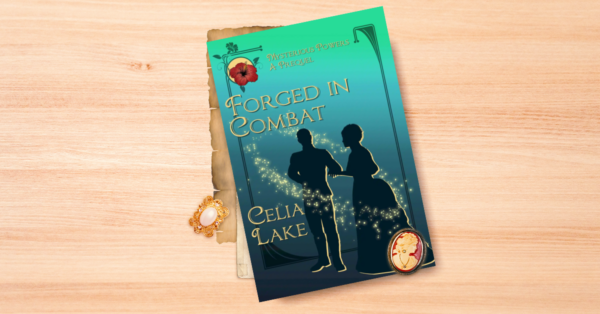
Thank you as always for joining me on a trip through Forged in Combat. I’ve been intrigued by Arthur and Melusina since Melusina showed up, perched on the end of Roland’s bed in Carry On. It was a delight to see how they fell in love, and the particular dynamic they bring.
My thanks as always to Kiya Nicoll, my editor, and to my early readers. And to my cover designer, Augusta Scarlett, who did a lot to make sure both the uniform and the bustle suit the correct period, even in silhouette.

Let me begin this note with comment on the time and setting. Writing about Britain’s Imperial excesses is always tricky. I deliberately trod lightly on them in this book. That’s not only because there’s only so much history you can fit into a novella, but also because of where the focus of the plot ended up.
That said, 1882 in India is a rather fascinating time period. Lord Ripon, as Viceroy, was more on the progressive side of things (comparatively speaking). Certainly far more so than his predecessor! He was actively working at this point on several projects to undo some of what his predecessor put in place.
It’s also an interesting point in comparison with British wars in Afghanistan, the first Boer War in South Africa, and the Mahdist War in the Sudan. It made figuring out Arthur’s military career something of challenge.
I am considering a few more books in the 1880s (mostly the later part of the decade) down the road, in Albion itself, and I’m looking forward to spending a bit more time in this period of history.
That said, let’s move chronologically through the book!
We begin, of course, with a moustache. Facial hair – specifically a moustache – was in fact mandatory for men serving in the British Army between 1860 and 1916. It apparently came over from the French, who saw moustaches as a sign of strength and virility. They were phased out in 1916 because of the difficulty of fitting a gas mask over facial hair.
Men in Albion are more likely to be clean shaven, both because they have somewhat better shaving resources (potions for shaving cream, magical methods of keeping blades sharp and undamaged), and because, as Melusina notes, hair can trap things if not carefully maintained.
Arthur mentions Frederick Sleigh Roberts, also known as “Bobs” to his men. He was an extremely successful Victorian-era general, born in India to an Anglo-Irish family. By the time Arthur serves under him, he’s in Afghanistan, fighting in the second Anglo-Afghan War. He’s most notable for taking 10,000 troops across rough ground to relieve the siege at Kandahar.
But that’s not why I got interested in him, really. Bobs is also known for his horse. Volonel was an Arab charger, bought in 1877 when Volonel was four. Along with the human generals, the valiant horse was awarded a medal by Queen Victoria herself for service in the expedition in Kandahar. He died in 1899 at the age of 29 (quite old for a horse) in retirement in Ireland, and he has a grave in the grounds of the Royal Hospital in Kilmainham.
George Robinson, Lord Ripon became Viceroy of India in June of 1880, as part of a tremendously long career in British politics. So long, in fact, that it began at his birth! He was born in 10 Downing Street while his father was Prime Minister F.J. Robinson.
I got intrigued with him when I read his bio on Wikipedia while I was trying to figure out the exact time and place for this novella, and got to the part where it says “He was educated privately, attending neither school nor college.” Which in my book – and worldbuilding – is a lovely time for someone to have had a magical education. Though, while various characters opine about this at points in this book, no one has an actual answer. (Well, Michaelton probably does, but he’s not talking.)
Lord Ripon served in every Liberal cabinet between 1861 and 1908 (and he died in 1909). By the time he becomes Viceroy, he’s been a member of Parliament, a member of the House of Lords, Secretary of State for War, for India, and Lord President of the Council. While Viceroy, he introduced a bill (that unfortunately failed) that would have given Indians more legal rights (backed by Florence Nightingale). By 1882, he was working on repealing the Vernacular Press Act, which had been put in place by his predecessor to suppress papers in native languages due to fears of sedition. Lord Ripon was working on establishing an Indian legal system, along with a number of other acts. He had a longstanding interest in improving labour conditions, and supported Home Rule in Ireland. Altogether an interesting figure!
At this point in history, the Viceroy’s Palace is in Calcutta (now Kolkata), as it was until 1911 when the capital moved to Delhi. It sits just north of Fort William, a major fort of the period. (And now in the hands of the Indian Army, who continue to use it as the headquarters for the Eastern Command.) I have taken some liberties with the layout in generalities, because getting maps of active military bases is a touch hard.
The government would retreat to the mountains around Shimla in the heat of the summer, then return to Calcutta when the weather cooled down in the autumn.
Various people refer to the Fishing Fleet, the ships full of young women interested in marriage who would come out to India and other far-flung points of the Empire to find husbands among the colonial service and military men. I found Anne de Courcy’s The Fishing Fleet: Husband-Hunting in the Raj very useful for this part. She leans heavily on a number of sources, and topics are grouped thematically rather than chronologically. There are lots of great tidbits in here, though.
Arthur refers several times to bad strategy in the Boer War. Bluntly put, it’s another time when the British Army underestimated the skills of the people who lived there. (I grew up next town over from Lexington, Massachusetts, and the battle of Lexington and Concord looms large, among others.) The Boer fighters were excellent shots, used to spending the day in the saddle, and living by what they could hunt. It was very easy for them to snipe the red-coated British Army, and to be far more nimble in many situations.
As noted later, I’ve put Arthur at the battle of Laing’s Neck, which was a rout, killing almost a third of the troops who made the charges, as well as killing or wounding many of the senior officers. I’ve taken liberties with how a magical specialist might interface with non-magical military, but as Arthur said, he never had a chance to set up a number of his more magical skills. (Martial magics, as he notes, often do things like improving accuracy, providing some degree of shielding or help in difficult conditions, and so on.)
The Darjeeling Himalayan Railroad (or Toy Train) ran between Siliguri (at the base of the Himalayas) and Darjeeling in July of 1881, at a sharp gradient. As you might guess from the name, the carriages are quite small, built on metre gauge track. You’d guess right if you thought that meant that was a narrow-gauge track, one metre apart. It’s still a popular tourist attraction, and of course a significant source for tea. Besides the scenic nature, it also made travel up to Darjeeling much easier than a previously arduous climb by carriage, needing to change out the horses at regular intervals.
Allan Octavian Hume is a fascinating figure who unfortunately does not appear in this book. I couldn’t figure out how to get more than a brief mention without him taking over. (And Melusina had dibs on that kind of thing.) He was a British civil servant who more or less resigned in a slow-moving huff in 1879 after being demoted (the press claimed it was because he was too honest and too independent). He was a devoted ornithologist for many years, and in this period was writing an extensive book on the game birds of India. He’s also, as noted, a Theosophist for a while, following Helena Blavatsky. (If you dive at all into esoteric and occult groups of the period, you can’t miss her.)
One running thread through the book are the tensions between the British establishment in contrast with both Indian self-rule and some of Lord Ripon’s actions. This was a period where building up a network of Indian civil service judges was coming into being, and Arthur is obviously taking a lot of messages related to this.
Diwali migrates somewhat across the Gregorian calendar, but as Melusina notes, she just missed it that year.
Which of course made me do some maths, to figure out how old she was during the Indian Rebellion of 1857 (or as called by the British at this point, the Mutiny). I knew she was based in Bombay (across the continent, now Mumbai), which had somewhat less in the way of direct action and violence. It was quite common for women at the time to make the long trip home to give birth nearer family (though with some risks on several fronts, including quite a long separation from their husbands).
Arsenic greens refer to the brilliant greens that came in during the mid-19th century. Of course, there’s just a small problem with them; they’re made with arsenic. Sensible people might avoid that near their skin.
The Royal Military College, Sandhurst was founded in 1801, and was a military academy for training infantry and cavalry officers in the British and Indian armies. (These days, just the British army.)
I found the concept of the kalajuggah fascinating – I learned about it thanks to the Fishing Fleet book. Of course, proper young women couldn’t spend time in private with men. At the same time, a certain amount of more intimate conversation encouraged a marriage. (This was of interest to the Army officers for career reasons as well as personal ones: there’s the old saying that a lieutenant may not marry, a captain can marry, and a major must marry. So at a certain point, being married often determined your promotion options.)
The kalajuggah were a creative solution to the problem. Men would set them up in little alcoves in the building, shielding the entrance a bit with tall plants, curtains and drapes, or anything else that might reasonably conceal the people within from direct line of sight. It wasn’t the done thing to disappear there for too long – the length of a single dance, for example, or a brief intermission. But it did give opportunities to get to know one’s conversational partner a little better and for a touch of romance (or at least pragmatism).
Grass widow is a term for a woman whose husband is away for a long time, in this context. That was quite common in the more remote forts of the period, where the military might be in a number of places and not at home where their wives were.
Finally, Arthur very accurately points out that the dangers of military life weren’t just about battle. Far more injuries and deaths came about because of disease, bad food, or local wildlife dangers. (Hippos are exceedingly dangerous, for one. And then there are crocodiles, snakes, spiders, and more…)
If you want to see more of Arthur and Melusina, they both appear as secondary characters in Carry On, which is the romance of their son Roland in 1915. And I might just have a few other things up my sleeve – keep an eye on my newsletter for the latest news.