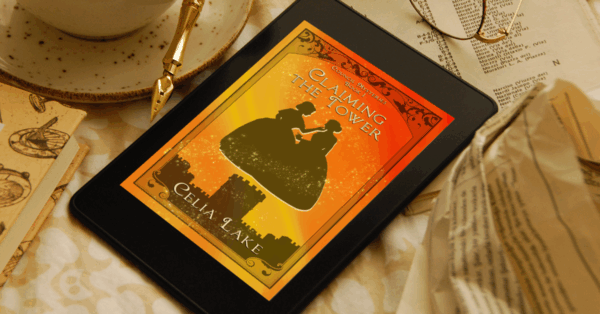
Curious about what’s behind Claiming the Tower? Explore my author notes about the historical details behind the book.
These notes do contain some plot spoilers! Otherwise, they’re as shared at the end of the book, with edits only to share the most useful links and cleaning up some formatting for the web. Posted May 2026.
Hello, and thank you for joining me on this journey through the 1850s with Hereswith and Bess. My deepest thanks as always to my editor, Kiya Nicoll, and to my early readers.
I plan for two more books in this series about Albion’s Council during the Victorian period. Those who’ve read the Mysterious Fields trilogy will have seen Hereswith (and Bess) later in their lives, along with Hereswith’s husband. The story of how Hereswith and Galahad will be next in the series, taking place in the 1860s. I plan to follow it with a book including cousins Metaia and Owain Powell and the Council in the 1870s. Sign up for my mailing list for more details as they happen!
Onward to the historical notes…

The Crimean War has rather fallen out of history. When I was talking about doing the background reading for this book, people kept looking at me blankly when I mentioned it. Even people with a pretty solid British and European history background often know only two things about it: Florence Nightingale and the Charge of the Light Brigade.
In many ways, it can be seen as the first modern war: the first war fought with fairly modern artillery, the first one that turned into a grinding stalemate. It’s the first one where news about what was happening in the war got back to people at home fairly quickly (a matter of a week or three, rather than months). The various events referenced and comments in the paper are taken from the Times of London, on the relevant dates.
As Hereswith notes, the British handled so many logistical parts of the war terribly badly. Where the French army had dedicated resources for cooking (and also for medical care), the British troops were more or less left to fend for themselves. They’d be given rations and maybe be able to cook them over a small campfire. The medical care was even worse, with thousands of soldiers dying from infection, dysentery, and infectious illness that could have been prevented or reduced.
If you’d like to learn more, Orlando Figes’ The Crimean War: A History, is a good overview, including going into the people and places. That includes the utter misery that led to the Charge of the Light Brigade. That one was basically caused by the fact that two officers, who were brothers-in-law, hated each other and refused to communicate clearly.
Of course, we have a number of specific details.
Hereswith is a trained diplomat. I found Capricia Penavic Marshall’s book, Protocol: The Power of Diplomacy and How to Make It Work for You very useful in figuring out how Hereswith thought about situations. Marshall was Chief of Protocol for President Obama from 2009 to 2013, as well as number of other related roles. The book includes a number of stories about different situations, essential planning considerations, and how using protocol can change the feeling of a meeting.
Chapter 1: The play Hereswith references – “Two Loves and a Life” – was playing at the Adelphi Theatre that night. I had fun looking through theatre archives for what was playing.
Chapter 11 : The Crystal Palace was originally built in Hyde Park, London, for the Great Exhibition of 1851, that ran from May to October of that year and was an incredible feat of engineering. It had the greatest area of glass ever seen in a building, and it was built in just thirty-nine weeks.
In 1854, it was moved and rebuilt in South London. It opened in early June, not long before Hereswith and Bess visit it, until it burned down in 1936. The details about visiting – including the special trains and station – are drawn from the program for that year. The Crystal Palace Foundation has a lot of additional information. The saurians are as described (including the real antlers on the Irish elk!) and some of them have had recent restoration and conservation work.
The Ladies of Llangollen were two Irish women– Eleanor Butler and Sarah Ponsonby– who lived together as a couple in Llangollen in North Wales. They both came from upper-class families, and while they lived quietly initially, they eventually became well known with visits from a number of distinguished writers and public figures. They lived together for fifty years, signed their letters jointly, used their joined initials on items, and a lot of other indicators of a committed relationship, though surviving sources aren’t clear on the precise details of whether it was a sexual relationship, a romantic one, or what these days we’d call queer platonic. They died in 1829 and 1831, so were well known to people in the 1850s.
Chapter 12: As I do whenever possible, I checked the weather before writing the outdoor scenes. The Times noted the weather on the summer solstice as “fine sunshine” and about 68F.
Chapter 16: Faddish in this context dates to 1855 in the dictionary, so I am using it here on the principle that words exist in common speech before they get documented in the dictionary.
Chapter 20: The history of opium and the British Empire is a particularly complex topic. Exactly how China responded or handled the opium trade, what the British and other European traders did, and everything in between varies a lot depending on precisely when we’re talking about. Between the First Opium War from 1839 to 1842 and the Second Opium War beginning in 1856, there’s a period when trade occurs in a very limited form. Since it’s 1854 during this book, we’re there.
Two good books about this aspect of history that I read include Julia Lovell’s The Opium War and Amitav Ghosh’s Smoke and Ashes: Opium’s Hidden Histories. The latter gets into American trade in opium, and also the impact opium had in other parts of Asia, specifically India.
Chapter 29: Hereswith references Nathaniel Hawthorn’s “P.’s Correspondence”, collected in 1845, considered now to be the first complete alternate history in English. It talks about tales from someone with different perceptions of 1845 and many dead figures in our timeline still being alive (including Napoleon Bonaparte, Lord Byron, and others).
Chapter 37: Bess is referencing the Peter Paul Rubens painting Hygeia, Goddess of Health painted c. 1615.
Chapter 40: Melbourne Hall was owned by the Lambs. If you’ve heard the name, it may be because of Lady Caroline Lamb (she had a notable affair with Lord Byron and later is the one who described him as “mad, bad, and dangerous to know”. She died in 1828, and her husband, William Lamb, later became the 2nd Viscount Melbourne and British prime minister. He died in 1848 and was succeeded by his brother, Frederick. When Frederick died in 1853, Melbourne Hall passed to their sister, Emily. This is all still somewhat nebulous when discussions are taking place in 1854.
The references to the well and the poetry inscription are taken from historical sources. Lord Palmerston and his wife (born Emily Lamb, then Lady Cowper, now Lady Palmerston) are their historical selves, briefly referenced.
Chapter 42: The extensive habits of Victorian mourning come into play with the death of Prince Albert in 1861. In 1854, the custom of wearing black clothing and other markers of mourning were in use, but not so formalised. The citations Hereswith makes are from a lightly humorous piece published in Town and Country Magazine in 1769, but give an idea of the divides based on gender and class.
Thank you again for joining me for this journey. The best way to get all my news is by signing up for my mailing list. Check out the contact page on my website for other places to find me and more about my Patreon and Discord.