
Curious about what’s behind Grown Wise? Explore my author notes about the historical details behind the book.
These notes do contain some plot spoilers! Otherwise, they’re as shared at the end of the book, with edits only to share the most useful links and cleaning up some formatting for the web. Posted May 2026.
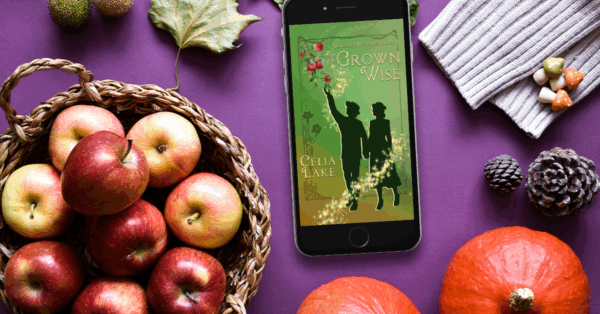
Thank you for joining me in the terrifying delight that is Ursula Fortier! (I also love Jim, but he’s a lot less hectic.) As always, my thanks to Kiya Nicoll, my editor and other half of my brain, for various improvements to this.
Grown Wise is the first in a four book series of post-war (Second World War) romances set between 1947 and 1950. The other three books in the Liminal Mysteries series will focus on romances for Edmund Carillon (seen here), Rowena Edgarton, and Claudio Warren. While there’s no overarching plot, the four books are about how to navigate the needs and wants of the land magic in the aftermath of the war, the Blitz, and the massive changes to agriculture in the late 1940s. My newsletter is the best place to find out all about what’s coming next.
Grown Wise also picks up threads of the Mysterious Fields trilogy, which takes place in 1889 and 1890 (beginning with Enchanted Net). When I wrote that trilogy, I knew there were parts of that story that Thessaly and Vitus (the main characters) just would never see or know about. Certainly not then. Ursula was a chance to return to the consequences of the trilogy for the Fortier family, nearly 60 years later.
Ursula is absolutely the best of both her parents in several ways, and she was able to bring several tools to the problem that no one had previously tried. You can find Thesan and Isembard’s romance in Eclipse, and various details relating to Garin can be found throughout various books. My authorial wiki has more details about where to find stories dealing with specific characters (including Garin).
Onwards to the specific notes!

Rationing continued in Britain until 1954. In 1947, basically everything that had been rationed was still rationed. That included flour, dairy (butter, cream, milk), meat, eggs, clothing, sugar, tea – the list goes on and on. Meals in restaurants had some limits on what could be served, but did not draw on individual ration cards.
People with their own gardens or other access could supplement the ration cards. In Albion, estates with home farms (like Arundel) could also supplement their food from their farms, but contributed most of what they grew to Albion’s institutions. Beekeeping for honey – as Ursula explores for multiple reasons – was actively encouraged.
There had been awful flooding in the spring of 1947, leading to the loss of a huge percentage of the grain crops. That’s the big reason flour was so hard to come by. (It hadn’t been rationed until 1946, after the war.)
The question of agriculture is a complicated one in this period. Britain was desperate – had been since the beginning of the war – to produce more food. A great deal of land had been turned over to agriculture (including cutting down forests and otherwise disrupting various habitats and growth). This is when we start to see the beginning of much more mechanisation in farming as well. The Agriculture Act discussed in the first chapter was intended to help stabilise food supplies and encouraging people to continue farming.
Wilding: The Return of Nature to a British Farm by Isabella Tree follows the work of the author and her husband to return their estate (in his family for some time) to older agricultural practices. Many of the things they do are in fact how Garin (and the staff at Arundel) are managing their estates, with less overt governmental interference. A fair bit of the Fortier-held lands are magically protected and hidden, though not all of them.
Chapter 3: Jim served in the 70th Infantry Brigade, and I am deeply grateful to a history site of the brigade that outlined exactly where they were when. I’ve kept Jim’s experience in line with that. (Except for his illness at the end, which is his.)
One of the more interesting questions in the research for this book involved figuring out whether the various West Sussex farms had electricity. There are still places in West Sussex where access to electricity is quite limited.
The Bignor Roman villa site, which Ursula mentions in passing (walking distance from Arundel), is still not on the electric mains. They don’t have enough electricity access for heat and light to allow visitors in the winter. Anyway, I decided that doing the sheep shearing with magic was more fun.
The sheep shearing customs come out of The Folklore of Sussex by Jacqueline Simpson, including the customs about the drinks at the end. The various nicknames are my own invention.
Chapter 6: The article referenced here is a callback to an article that Thesan (Ursula’s mother) published in 1924. She and Garin have a conversation about it in Eclipse, Thesan and Isembard’s romance. He gets details about it wrong, without realising she’s one of the authors.
The 1924 article is called “Esse quam videri: An evaluation of astronomical implications for Materia preparation”. Garin titles his “Prodesse quam videri” with a different subtitle, as a nod of apology. Esse quam videri translates as “to be, rather than to seem” (it appears in various classical texts). “Prodesse quam videri” might be translated as to benefit or to accomplish rather than to seem.
Chapter 12: My research suggests that cask is preferable to barrel for beer in this period, but there’s some variation and I had to pick something. (Keg is not widely in use yet.)
Chapter 20: Basically everything I know about knuckers came out of The Folklore of Sussex. There are also some excellent retellings and snippets online if you do some searches. The locations mentioned are accurate to the folklore.
Chapter 22: We were not getting out of this book without rather a lot more about apples. (For previous apples in particular, see Mistress of Birds.) Frederic Streeter is an actual historical figure with a fascinating background. Jim touches on this, but Streeter began as a gardener, working his way up to the head gardener. He became a radio presenter, first with a show about gardening, and then one of the leading voices encouraging people to grow vegetables and other foods during the Second World War. For much of his life, he was based at Petworth House, Sussex.
The Petworth Non Pareil is an apple variety developed at Petworth. It disappeared in the 1970s, and there are no currently known trees. (I managed to track down a reference to it in a town newsletter in the 90s, to get that date. Clearly some of the trees might survive on the warded Fortier estates.)
The National Fruit Trials had the goal of documenting varieties of fruit with an eye to improving the range of options, resistance to various problems, and use for different needs. They also help with identifying unknown varieties. These days, the relevant orchards are in Kent, but during the Second World War, they were in Surrey. Individuals would submit examples and scions (for grafting) or other options (for planting) depending on the kind of fruit.
Chapter 23: Harrow Hill’s lore is as Ursula describes – in some sources it’s mentioned as the last location of the Good Folk in England. There are ancient mines in the base of the hill.
The song Ursula picks to sign is “The Brisk Young Ploughboy”, collected on page 10 of John Broadwood’s “Songs of the Peasantry of the Weald of Sussex”, and with various sources to listen to it. That book was published anonymously in 1843.
Chapter 35: The charm Ursula references is an ancient Anglo-Saxon charm in praise of the earth. It’s known as the Æcerbot, and dates (in the written form) to the 10th or 11th century CE. It’s part of a larger ritual for the good of the land.
Thank you again for coming along on this story! We’ll have three more romances in the post-war years. The next, Apt To Be Suspicious features Edmund Carillon during his time at Oxford in 1947-1948.
If you want to know more about what’s coming, the best way is to sign up for my mailing list. You can also find me other places online – check out my contact page for more details.
Happy reading!