Curious about what’s behind Enchanted Net? Explore my author notes about the historical details behind the book.
These notes do contain some plot spoilers! Otherwise, they’re as shared at the end of the book, with edits only to share the most useful links and cleaning up some formatting for the web. Posted May 2026.
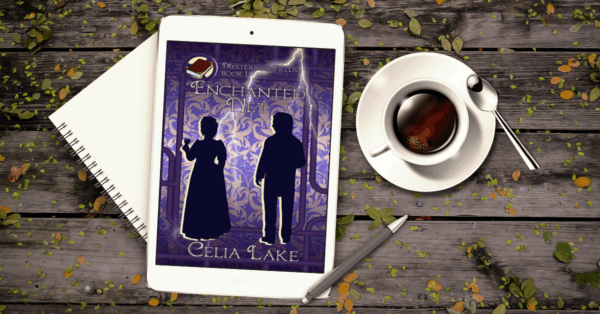
Thank you so much for joining me for the first book of the Mysterious Fields trilogy. I promise Thessaly and Vitus will have their happily ever after by the end of Book 3, Elemental Truth. It’s just going to take them a minute to get there.
My thanks as always to Kiya Nicoll, my editor, who has done everything from editing to consulting on Egyptian funeral rites as done by the Landry family, to helping me make sure the through lines on the plot did what we wanted. My other early readers all made excellent comments to help tie the trilogy together. Particular thanks to Elise Matthesen, as well, for not only a great deal of plot discussion but for making certain my mentions of gemstones and other mineralogical delights were accurate.

This trilogy is the earliest point at which we’ve seen the Fortier and Landry families, but it’s certainly not my first set of books dealing with them. You can find a complete list on my website.
Eclipse is set in 1924-1925, and includes Isembard (Laudine and Dagobert’s younger son) along with Alexander (in his 50s). Alexander is the focus of Best Foot Forward in 1935, as well as Nocturnal Quarry in 1938. The Magic of Four includes Isembard’s son Leo as one of the main characters. And then, as I noted, Grown Wise is focusing on events in 1947, and features rather a lot of Ursula (Isembard and Thesan’s daughter) and her Uncle Garin.
The attentive reader who is familiar with some of my other books will also notice some familiar faces and names. Niobe Hall, Vitus’s apprentice mistress, appears in Facets of the Bench in 1927, much later in her life. Those who read about Margot Williams from Bound for Perdition (1917) and Three Graces (1945) might remember her maiden name was Lytton. She’s mentioned as still being in the nursery during the discussion with Thessaly’s uncles here.
Gems, talismans, and stones
Obviously, there are quite a few references to gemstones and talismanic magic in this book (and that’s going to continue through the trilogy, given Vitus’s profession). There is a tremendously long history of using stones (of various kinds) for magical purposes. For a starting place, I drew heavily A Lapidary of Sacred Stones: Their Magical and Medicinal Powers Based on the Earliest Sources, Includes More than 800 Gems and Stones by Claude Leconteux as well as Stars and Stones: An Astro-Magical Lapidary by Peter Stockinger. The former – as you might guess by the title – is extensive. The latter is more focused, but goes into more detail in some places.
The way that stones are used varies across time, but talismanic stones in Albion in this period draw from different approaches. Part of it is the innate tendency of the stone (as determined over centuries and via experimentation). Each stone usually has a handful of related attributes, many of which overlap with other stones (such as the selection that Vitus considers for better sleep).
Lore also associates specific kinds of inscriptions for particular purposes. For example, to pick something not at all relevant to the trilogy, there’s this description (taken from the Laconteaux book): “etched with the moon and sun and hung about the neck with hairs from a synocephalus and feathers from a swallow, it protects one from evil spells. Magical properties are increased if set in gold or silver and if a man on horseback holding a sceptre is carved on it.” If that seems like a lot to put on a gemstone, yes, I thought that too. (A synocephalus has the head of a canid.)
Vitus and Niobe are mostly using something between those two extremes: designs that align the specific focus of the stone to a particular purpose, which are then enchanted with appropriate ritual. There’s a reason talisman making is a long apprenticeship – people not only have to master gem cutting, but also the ritual and incantation magics relevant to the work.
On to the chapter notes – quite brief for this book!
Chapter notes
Chapter 1 : Many of the Fortier customs draw – as Thessaly notes – from their Merovingian and Norman ancestors. The Merovingians were an early Frankish dynasty, before the Carolingians. One line of lore has them descended from a sea monster (Merovech, where the name comes from), and they were known as the “long-haired kings”, for not cutting their hair. Very in keeping with Albion’s general preference for long hair as holding magic. Many of the social customs of the Fortiers are drawn as much from French as from British sources.
The mazurka is a common dance of the period – not quite as energetic as seen in the Addams Family movie, but more energetic than the waltz, and full of the little hops and kicks Thessaly describes.
Chapter 2: A word about the clothing might as well go here. Victorian clothing can sometimes be extremely specific as to silhouette (especially of the sleeves and bustle), changing year to year in this period. I now have a fairly vast collection of images stored for 1889 and 1890 so I could stare at them and figure out a description. If you’d like to learn more, Mimi Matthews (also a romance author) has a fantastic series of blog posts talking about details on her website, and also has a non-fiction book discussing the period, especially clothing and customs.
Chapter 16 : The Weald is a geological and geographic feature that runs a little bit north of the magical Arundel. It was heavily used for sheep grazing and farming into the 20th century. It now has a number of vineyards. Arundel as a magical estate is a little north of Arundel Castle. The manor is about a mile directly north from Amberly. The estate is in the chalky downhill of the Weald.
Chapter 18 : When I was trying to figure out the state of electrical transmission in 1889 (for a passing reference in one of the lectures here), I got extremely confused by two references to the Willamette Falls transmitting electricity, one in 1889 and one in 1890. It turns out that the first one was direct current transmission and the second was alternating current.
Thank you so much for starting this journey with me! The second book of Thessaly and Vitus’s story (Silent Circuit) will be out on November 15th, 2024. Elemental Truth (the last book, with the happily-ever-after) will be out on December 13th, 2024.
There are some elements of the plot that Vitus and Thessaly never fully see: some of those will be explored more in Grown Wise, Ursula Fortier’s romance in 1947 (nearly 60 years later). That will be out in May of 2025.
My newsletter has all my updates and news, as well as additional information about where I am and what I’m doing online. Until next book, happy reading!