
Curious about what’s behind Facets of the Bench? Explore my author notes about the historical details behind the book.
These notes do contain some plot spoilers! Otherwise, they’re as shared at the end of the book, with edits only to share the most useful links and cleaning up some formatting for the web. Posted May 2026.
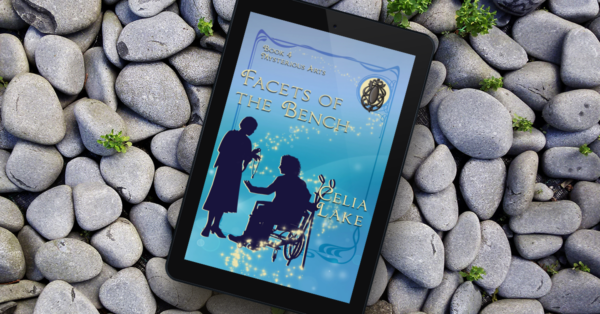
Thank you so much for joining me – and Griffin and Annice – for this story. I hope you’ve enjoyed both Whitby and Trellech! As always, tremendous thanks to Kiya Nicoll, my editor. Thanks too for this book go to my friend Elise Matthesen, who not only said “You should do something with Whitby jet.” but who shared many stories of her own visit there and samples of jet and coal. My early readers as always helped improve things as well, with special thanks to a reader who gave some great advice about Griffin’s mobility needs and approaches. Any remaining typos are my own fault.
If you’d like to see a bit more of Griffin earlier in his life, you can find him in Shoemaker’s Wife, when he’s newly back in the Courts and working with Captain Donovan and others to help deal with a legal problem. Griffin also appears in Point by Point, in 1926, where he’s the one overseeing the legal aspects of a situation along with Antimony Orland.
And if you like Niobe here, she’s a significant secondary character in the Mysterious Fields trilogy, out in late 2024. That takes place in 1889 and 1890, when Niobe’s in her mid-30s.
On to some general notes, and then a few chapter notes.
Griffin’s disability is similar to a number of autoimmune disorders. Sometimes triggered by an injury or shock of some kind, they can cause a wide range of symptoms and things to deal with. Griffin describes his pretty accurately: balance, some muscle weakness that affects his lower body more than his upper half. And if he exhausts himself or does too much, there are consequences to that. By the time we get to Facets of the Bench, he’s a lot better at managing that most of the time.

I’ve been asked where Trellech is, and my answer is that it’s on the map. There are a couple of alternate spellings in various sources: Trelech, Treleck, or Trelleck. Whichever spelling you’re using, it’s currently a tiny village in Monmouthshire in south-east Wales. Find the mouth of the Severn – or Tintern Abbey – and go just a bit north, and you should see it.
It’s a tiny village these days. That wasn’t always true. For several centuries, it was one of the major towns of mediaeval Wales. The most likely history, from what I’ve read, is that it was deliberately established by the de Clare family. It was conveniently placed to use iron ore from the Forest of Dean and charcoal from the woods in order to make munitions for their ongoing skirmishes and military activity. Some numbers suggest there were about 20,000 people living there at various points, at a time when London was about 80,000 people.
However, a lot of the city was destroyed in 1291, with further destruction due to the Black Death, and then further fighting and military campaigns in the area. By the middle of the 1400s – a few decades before Albion’s Pact – it was down to being basically a tiny village with a long history.
In Albion, the city picked up population after the Pact. It was still well-positioned for resources and trade, with a river and the coastline not too far away. There is in fact a healing spring in the area. (All right, this is Wales and England we’re talking about, if you look at maps of such things, there’s a healing spring of some sort every mile or three.) There are limestone caves not far away, used by the Trellech banks for their vaults and storage. (More about that is in Fool’s Gold.)
Trellech has grown up, been built and rebuilt, into its own city with its own customs. There are walls around the city, as much to contain the area that’s magically protected as for physical fortification. Outside the walls, a series of illusions and enchantments help keep people without magic away from the city, and the vast majority of traffic in and out comes by portal rather than road or river (so it’s not visible outside the city).
In my mind, the city is a vast and gloriously varied range of architectural styles. There are sections of the city built out at particular times, with particular architecture. The Temple of Healing is very much like a Gothic cathedral in design, although for at least four centuries it’s been explicitly open to people of all beliefs (or none) who seek healing and respite. I imagine other buildings in a range of styles – a row of Georgian townhomes here, a few Tudor buildings still in good order, others of varying styles and periods.
You can find a map of the different areas of the city on my authorial wiki . (Search on “Trellech” and you’ll find the map.)
I’m delighted we actually got to spend substantial time in Trellech in this book, and focused on the particular traditions, celebrations, and customs of the people who’ve made Trellech their home. I have some more in mind about that. Sign up for my newsletter for a treat in December 2024 that will include more, including a bit more of Griffin and Annice (and a few other people mentioned in this book).
Annice gives an excellent explanation of jet and jet simulants when she’s talking to various prospective customers. The more I read about jet and the simulants, the more fascinated I was.
Jet was a huge industry in Whitby, but for a surprisingly short period of time. Jet was worn as a mourning stone before Queen Victoria. It turns up in graves that are thousands of years old, and then it becomes used for jewellery in various forms. It’s easier to cut, somewhat more forgiving, and it allows for carving and decorative designs and patterns in a way that harder gemstones refuse. But it exploded in popularity and demand when Prince Albert died in 1861. Queen Victoria wore mourning for the rest of her life, and jet was one of the few types of jewellery permitted for women wearing mourning throughout the Victorian and into the Edwardian periods.
Workshops opened up all through Whitby, training up generations of carvers, and needing all sorts of related services and skills. If you explore the history, you’ll find workshops like Annice’s tucked into rooms all over the city. At the height of the trade, there were over two hundred in the town.
Jet is also tricky to find. Whitby jet comes from a stretch of shoreline that’s seven and a half miles in length, starting more or less at Whitby and running south along the coast. As Annice explains, a lot of what washes up is coal or tar-like substances from the ocean. Sometimes larger pieces erode out of the coastline. And at the height of the jet industry, there were also mines in the hills near Whitby.
However, in the wake of the Great War, demand for jet fell off. The explanation I’ve seen in multiple sources is that people didn’t want to be faced with the visible signs of grief at that point. Jet made mourning visible, and when the entire country was mourning so much loss, it became overwhelming. Almost overnight – certainly over a few years – the workshops shut down, with just a few hanging on.
The jet industry in Whitby has kept going, and these days, there are several jewellers working in jet. In one case, they’ve even discovered and opened up a Victorian workshop that had been walled off for decades. It’s possible again to buy beautiful pieces of Whitby jet (and ammonites, if you like ammonites).
The modern era has also made identifying jet simulants easier to do. Those are materials that look rather like jet but aren’t. There’s currently research to better understand what jet actually is, but also how those simulants can be identified without destructive testing. Sometimes it’s fairly obvious – how a piece is mounted, if aged horn is flaking along the edges. Sometimes it’s a lot harder. Or sometimes as Annice discovers in this book, a material is jet, but not from Whitby.
We’ll cover some of the details about Whitby as I talk about specific chapters, for tidiness. But the city is as described – a long coastline, a lot of fishing trade, and homes and shops and other spaces built into the cliffs on either side of the river. It has some quite interesting history, ranging from the Abbey to Dracula’s arrival point in England, to Captain James Cook’s home for some years. (He was an apprentice in Whitby, learning the sailing trade.)
Chapter 4: The local pub and inn – there for centuries – on the east side of the river is in fact called the White Horse & Griffin. In that spelling. I couldn’t make this up if I tried.
Chapter 12: The history of mining in Yorkshire is unfortunately full of awful mine disasters. The explosion at Swaith in 1875 was particularly bad, and the worst mining disaster since the Oaks Colliery disaster in 1866. 143 men lost their lives. It’s the sort of event that people use as a marker, especially anyone who had family members working in the mines.
Chapter 15: I want to give all the thanks to the self-named “church nerds” on my authorial Discord, who were a tremendous help with figuring out what Anglican worship might look like in Albion in the 1920s.
They also all have very strong opinions about Saint Hild. And with good reason! She’s a fascinating figure who doesn’t get nearly as much attention as she ought. While working on this book in stages, I was reading (for other reasons) a lot of Anglo-Saxon and Northumbrian history, prior to the Norman Conquest.
St Hild gets more paragraphs here than she gets in most non-fiction works about the period, and I’ve done my best to do her history justice. The abbey is, as described, not the one she founded, but it is a beautiful architectural marvel. As Griffin notes, it was damaged by bombing from the coastline in the Great War, but mended by the time he sees it. Caedmon, the poet, is also a real person (or as probably as we can be, given the time), and a few fragments of his poetry survive, including the part Griffin quotes.
The 199 steps are a particular landmark of Whitby, rising from the east side of the river up the cliff to the abbey and cemetery. There are regular benches along the way, but the lore, at least, has it that they were designed not for people to sit on, but for pallbearers to rest coffins on, when carrying them up for burial. The stairs do have a road that runs alongside, but it’s very steep, so most wheeled traffic goes a little north, then comes at a shallower climb toward the abbey.
Chapter 33 : The local building stone around Trellech is a red sandstone known as the Old Red Sandstone. It would lend a warm reddish glow, especially at particular times of day or in certain kinds of light to the city. Certainly not everything is made of it, but enough buildings and civic structures are to give a consistency to the city. If you’d like to look at pictures, it was heavily used in the construction of Raglan Castle, Tintern Abbey, and Brecon Cathedral, also in Wales.
Chapter 36 : To begin, for various reasons, Christianity is no longer the most dominant religion in Albion. That’s due to a combination of factors following the Pact in 1484 that accelerated first with the formation of the Church of England, and then expanded even more with Cromwell’s Protectorate.
Long story short, some families and individuals continued as Christians, other families reconstructed family traditions, created some new ones, brought in a focus on local spirits of place, or embraced Roman or Celtic or other relevant traditions. There’s a lot of variation, and of course as new strands of Christianity emerged, those are present as well. (Kate, in Wards of the Roses and Country Manners is Welsh Chapel, for example.)
Both Annice and Griffin are Anglican, but their experiences are a bit different. We ended up doing quite a bit of discussion on the Discord as I was working on this section. At this time, the Book of Common Prayer (the liturgy and other worship materials for the Anglican church) were still in Latin, though readings might be given in the local language.
This brings up an interesting note. Trellech is a Welsh city, and has held onto Welsh language and customs more than some places in this period (in large part because there was less pressure to give up those things from the surrounding overculture). But many people who live in Trellech as adults grew up elsewhere – crafters and Ministry staff, for example – or people live elsewhere part of the year. As a result, Trellech mostly runs in English, but people who grew up there often would know Welsh. We don’t see Griffin use much of it here, because he’s with Annice or other people who don’t speak it, but he absolutely is fluent in it.
Thinking about what magic would change in a given service was also fascinating. The vigil service as described was done in the Anglican Church of the period, but not very often. It is, however, one of my favourite liturgies. It runs as described, with the kindling of a fire outside, a procession and then lit candles providing light in a dark church with nothing on the altar. The readings cover many of the most evocative Biblical texts, starting with the very opening of Genesis. And then, at a particular point, there’s a triumphant roar of music and sound, and the altar is filled again with all of the items for ritual and celebration.
It’s a long service, but it can absolutely be so moving you forget you’ve been there for an hour or three. Magic, of course, makes part of it far more showy, like being able to bring up all the lights, or using magic to bring all the altar items to the proper places. (Or make them visible.) I loved having the chance to see this through Annice’s eyes, and the mix of the known and unknown she experiences.
Working out the details also involved figuring out how many parishes are in Trellech. Three parishes, each with a different focus and core community, felt about right for a city of about 20,000. Many other people find their celebrations in other ways, or at the Temple of Healing, or through specific networks of community and family. Or they have private beliefs, and participate in the larger communal festivals like May Day processions or the solstices, just as many people do now.
One thing was clear, though. Saint Hildegard von Bingen would absolutely have been of interest to Albion. Getting her named as a saint took a long and complicated process, but she appears on lists of saints in the Roman Catholic church from the 16th century on. She pioneered a great deal of medical advice, as well as having detailed mystic visions, and many of her comments about materia (stones, herbs, and other items) made it into texts about those topics for centuries to come.
For the other two parishes, it also makes a great deal of sense to me to have one parish focusing on Saint Matthew, patron saints of civil servants and accountants (among other things) in the Ministry-focused city of Trellech. And Saint David, of course, as the patron saint of Wales, for the third. The balance is very much the way modern parishes often fall out, with parishes near each other developing something of a niche in the larger ecosystem.
Thank you again for joining me for this journey and a glimpse into Albion’s courts and the wonders of Trellech. The best way to get all my news is by signing up for my mailing list. Check out the contact page for other places to find me and more about my Patreon and Discord.
The next book in the Mysterious Arts series is Weaving Hope. Set later in 1927, it’s all about weaving, restoring some ancient tapestries, and tending a venerable old estate so it has a future. It’ll be out in February 2025.
Before that, we’ll be taking a step back into 1889 and 1890 with the Mysterious Fields trilogy where a series of bad choices change lives forever. Vitus (one of the protagonists) is a talisman maker finishing his apprenticeship with Niobe Hall. Enchanted Net (book 1) will be out in September 2024. Silent Circuit (book 2) will follow in November and Elemental Truth (book 3) in December.