
Curious about what’s behind The Magic of Four? Explore my author notes about the historical details behind the book.
These notes do contain some plot spoilers! Otherwise, they’re as shared at the end of the book, with edits only to share the most useful links and cleaning up some formatting for the web. Posted May 2026.
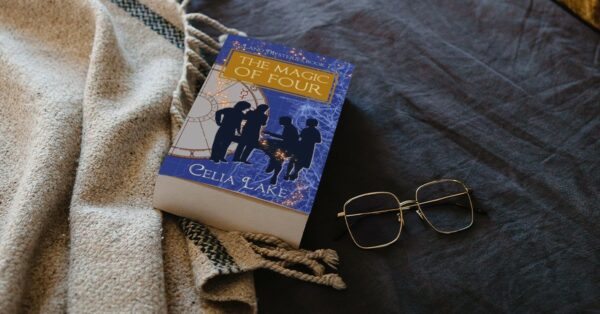
Thank you so much for joining me for The Magic of Four, the last book in the Land Mysteries series. I hope you’ve enjoyed a bit of Schola and the lives of these four.
As always, thanks to my friend and editor, Kiya Nicoll. And to my early readers, who among other things also made sure my (very responsible) teenagers still acted like teenagers.
Of course, all four sets of parents here have their own romances. Jasper’s parents met and fell in love in Outcrossing. Lizzie and Geoffrey Carillon fall in love in Goblin Fruit (and Alexander Landry becomes part of their family thanks to the events of Best Foot Forward). And Avigail’s parents met in The Fossil Door, with Old As The Hills and Upon A Summer’s Day picking up with the family in 1940.
Finally, when it comes to Schola, Leo’s parents fell in love during Eclipse, and have adventures in the caves below Schola during Chasing Legends (found in the Winter’s Charms collection).
You can also find extras for many of these folks via my website.
If you’d like more of these four and their families, I do have some future plans. I do not intend to write past 1950 for a variety of reasons (which means I have no plans to write any of these four and their romances). But I do have a few books in the writing stack that will definitely include them.
I have plans for Ursula Fortier’s romance (Leo’s older sister) in 1947, coming out in May 1925. Edmund Carillon’s romance (Ros’s older brother) will be out that November, set around 1948 while he’s at Oxford. Claudio Warren’s romance will take place in 1950, and will almost certainly involve a bit of Avigail and her family. That’ll be out in May of 2026. [Edited to ad: And we have Rowena Edgarton’s romance, Avigail’s older sister.]

Before I get into a few author notes for this book, I wanted a moment for school stories. I grew up reading Enid Blyton and the Chalet School at a time when they were nearly impossible to get in the United States. My father would often go to London once a year in December (he was a theatre professor, so this was partly to see productions in the West End). I’d send him with lists of which specific books I wanted. During the two trips we made as a family when I was little, we also picked up a number of titles.
One of the things I’ve given a lot of thought to was how a magical school should actually work, as well as how it worked in the British schooling systems of the period. On the practical level, besides going to (American) boarding school myself, I also worked in an independent day school for a decade.
Schola presents the challenge of being a magical school with a priority for magical education, but also having some students who will integrate with non-magical society. Thinking through how that works took a lot of time.
One thing that was true in the period was that people specialised very early. My parents were educated in the 40s and early 50s. They took basically no maths or science after the age of about 13, because they both went into history and languages. I wanted a system that would be flexible enough for overlapping magical needs, but that would also keep that specialisation.
A number of drafts of class schedules later, I had a system that worked. Those rare students (like Avigail and Peter) who would like to take all the classes ever can do so. Those who want to specialise more (like Jasper) take fewer. Others are somewhere in the middle, or supplementing structured classes with additional tutoring (as both Leo and Ros do). Schola – with 350 students – is small enough to allow flexibility a lot of the time.
Then we come to the magical aspects, like the house magics and the secret societies. A book allows only so much space, alas, so while we get glimpses of several of the house magics, it’s by no means a complete picture. The societies, though, were a delight to dive into. I have books to come that will spend more time with the Four Metals and the Society of the White Horse, and ideas beyond that for the others. (If you want more of the Dwellers, In The Cards and Point By Point both focus on them, including more of Martin and Galen and Ros’s Aunt Laura.)
On to a few specific historical notes
The aftermath of the Second World War is threaded through all of this book. I do have a series of prequel extras (currently available through my Patreon for patrons, I’ll be releasing the whole set as an extra in due course). Those posts cover the first year of our characters here, the 1945-1946 school year. It includes their sorting into houses, settling in, and a few other key events around the end of the Second World War.
The various points around rationing are historical. It’s sometimes a shock to realise that some of the most restrictive rationing actually happens in 1945 and 1946 (flooding in 1946 and 1947 did serious damage to grain crops in the British Isles). While Schola is mostly spared the worst of that, and they have a lot of resources to support their own food, it’s a constant balancing act. Rationing didn’t end until 1954 in the United Kingdom.
It’s worth mentioning here that rationing was managed differently for schools than for individual households, and that places with resources to supply some or most of their own needs also had greater options. Schola – and estates with a home farm, such as Ros and Avigail’s families – could supplement rationed food from their own gardens and livestock within reason. (In all three cases, they’re sending surplus to the Temple of Healing in Trellech and other institutional uses within Albion.)
Similarly, magic does draw on the body’s natural vitality. I’ve fiated that rationing for people actively engaging in war work (or education) that draws strongly on their magic have additional rations, similar to some other professions during the war. That covers basically anyone at Schola proper. But we’re talking more like 4 or 8 ounces of cheese a week (instead of the usual ration of 2) than “all the cheese you like”.
On to the specific notes!
Chapter 6: Pavo as a game is based on some of the mediaeval training exercises used by mounted knights. As noted, it has a played-on-foot equivalent in bohort. Both involve doing specific tasks using a combination of skills (including magic) to win points.
Dot, Jasper’s mare, is an authorial insertion of my pony Dorothy, who was the joy of my teenage years. She’s as described in the text, both in terms of her appearance and her brains.
Chapter 10: I love a bit of grammar. Here, Ros is getting deep into a bit of nuance. Latin – like other declined languages – has different cases for nouns that indicate different things. You commonly use the ablative for concepts like from, with, by, or in and at. The ablative of attendant circumstances can be thought of as being about the surrounding situation, the way something happens. Why this one and not one of the many other cases? I love the name.
Chapter 25 : The weather in the spring of 1947 was truly awful. The year began with a lot more snow and ice than usual for the British Isles. It was the coldest February since 1895. In the spring that turned into severe flooding in many locations, and substantial damage to crops and fields. The floods were in many places the most severe that had been recorded, including flooding of the Thames that rivalled the earlier 1927 flood.
Chapter 33: The tea strike is entirely historical. It did mean the reduction in tea rations for the UK in the following months. Avigail’s sympathies are naturally with her mother’s extended family.
Chapter 39: The tapestry maths are drawn from calculations from the Metropolitan Museum of Art. How long tapestries take to create varies quite a bit based both on the design and structure and what period of time we’re talking about. However, Jasper is very aware of what time is involved, thanks to his mother.
Chapter 44: Regular readers will know I am continuously baffled by historical time zones. That’s for good reason. During the Second World War, the UK had gone on what is known as “British Double Summer Time” in order to make use of the later light for factories. (This put clocks two hours ahead of GMT for the summer, and one hour ahead in the winter). They went back to GMT at the end of the summer in 1945 with the end of the war. However, the fuel shortages from the harsh winter of 1946-7 meant the country went on Double Summer Time again during the summer of 1947.
Thank you again for joining me for The Magic of Four and the lives of these students. Please sign up for my mailing list (or follow me in other spaces) to hear about new books as they come out. And as always, you can find more info about my books, characters, and plans at my website. Happy reading, wherever it takes you!