
Curious about what’s behind Unknown Depths? Explore my author notes about the historical details behind the book.
These notes do contain some plot spoilers! Otherwise, they’re as shared at the end of the book, with edits only to share the most useful links and cleaning up some formatting for the web. Posted April 2026.
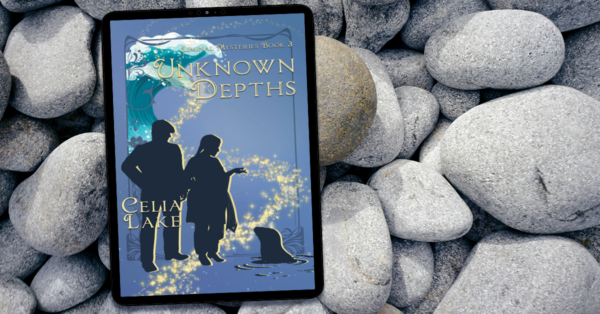
Welcome to the author’s notes for Unknown Depths! I hope you had as much fun as I did with finally having a selkie story! My thanks as always to my editor, Kiya Nicoll, for their immense help, and to my early readers for comments. I have two other thank yous for this one.

I’m the sort of author who wants things to be as accurate as I can make them. I’ll go digging for the historical weather information, all sorts of details. That turned into a challenge here, when I was trying to figure out the tides around Thurso and up into Orkney.
Getting them right mattered for two reasons. First, obviously, Rowena and Thom were going to be in the water, and both of them have excellent reason to be aware of and understand the flow of the tides. Second, the Pentland Firth has a particular characteristic: the currents along the firth (running roughly east-west east of Thurso at the northern tip of mainland Scotland) change directions depending on whether the tide is going in or out.
I tried to find tide charts for the period, and kept coming up short. In the end, I made plaintive noises about it in my newsletter. Thirty minutes later, I found an email in my inbox from a reader. Maren Richter is an oceanographer, and while her area of focus isn’t Scotland, she offered to use software that can do tidal calculations for whatever spots I wanted. This is the TPXO10-atlas prediction software.
This is a mechanical calculation— it doesn’t take unusually high or low tides from things like weather or the moon phase into account— but it was more than enough for what I needed. I gave her the locations I was interested in, and later that day I had a glorious spreadsheet of data. Thank you again, Maren!
Maren also let me know about the creators of the software, Dr Lana Erofeeva and Professor Gary Egbert. Neither of us was entirely sure how this application of the software fit into their terms of use, so as a precaution, I wrote an email. I got a delightful and prompt reply back from Dr Lana Erofeeva, who also let me know that the software is actually available for free at https://tpxows.azurewebsites.net. You can type in coordinates (as decimal degrees, with a minus sign for western and southern coordinates) and you’ll get a file of tidal predictions (elevations or velocities) by email.
I am deeply grateful for all the help making my selkies deal with the correct currents and directions!
My thanks also to a friend whose background in marine biology helped me figure out the state of orca populations in the relevant bits of ocean (more about those details when we get to the relevant chapter notes). And for checking a number of other bits of my marine ecology, magical and otherwise.
The comments about selkie eyesight come from research about the role of rods and cones in seal eyes. Current research (there’s some new information available since I wrote Sailor’s Jewel, where this also comes up) suggests that seals can see the blue-green shades, but that the differentiation is different than it is for humans. Seals do generally have very good eyesight, however, especially at distance.
If you’d like to read more about other members of the Edgarton Family, you can find the books about them on my website. Gabe and Rathna’s romance, The Fossil Door, takes place in the Scottish highlands around Glencoe in 1922. Other books cover Alysoun and Richard’s romance, and Gabe’s Challenge for the Council.
If you’re curious about some of Ursula’s background and priorities, her romance with Jim in 1947 is in Grown Wise. (And as I noted at the end of the book, there’s a bit more of her Uncle Garin and Domitilla as an extra! More details below.)
On to the chapter notes!
Chapter 4: When I started thinking about what was living in the relevant bits of ocean, I hit a complication. These days, we don’t know all the things we’d like about orcas (killer whales), but we know a lot more than we used to. There’s also some fascinating natural history here. I’ll also admit that orcas are a particular favourite of mine. I use ‘killer whale’ in the book because it was the more common term at the time. They were also known as “sea wolves” in various parts of Scotland.
For many years, there was a pod of orcas known as the West Coast Community, who travelled up and down from the top of the Hebrides, along the coast of Wales, and around Cornwall. People first started paying attention to tracking them in the early 1970s, and there’s not much data about them before that. (This is handy as an author because I could be general in useful ways).
We know that the pod then had more than twenty orcas, many of whom had likely been around in 1949. There’s an excellent book about this pod, The Last Sunset in the West by Natalie Sanders that talks about the history, the ecology, and the individuals.
I was going to say that unfortunately recent sightings have been few, in 2021 and early 2024. However, as I was writing this note, I discovered that the two brothers had been spotted just a few days earlier on April 2nd, 2026, off the coast of Cornwall. We do know that this pod are residential orcas, who both tend to keep to a geographic range, and who tend not to eat seals. (Highly relevant information here!) They’re also a distinct genetic population, compared to other orcas, as far as anyone can figure out.
However, the orcas that spend their time around Orkney are— as Thom and Rathna refer to— what we now refer to as transients, in this case coming down from near Iceland. They’re much more of a threat to seals.
While we’re talking about marine life, there’s actually no obvious reason that great white sharks (or a couple of the other larger and potentially seal-eating shark species) aren’t found in the ocean around Great Britain. But in fact, they aren’t. My current best answer for why is “Finfolk”. I did actually go down a massive rabbit hole on this topic while I was researching the book, including a number of the ‘is that a great white?’ possible sightings.
And when it comes to the seals, the seal population went down around the Scapa Flow (where a great many massive warships were sunk during and after the Great War, to protect the harbour). They make for amazing diving these days, but changed many of the patterns and habitats for wildlife, including seals. The seal population of the United Kingdom has significantly rebounded since the 1950s, thankfully!
Chapter 10: The information Rowena shares about diamonds is all straight out of history. The stones she mentions were given to a museum, tucked safely away, and only found again around 2000, when they turned out to indeed be colourless garnets.
Chapter 11 : The ferry running from Scrabster to Stromness has a fascinating and somewhat terrifying history. There was in fact a single ferry for many years. The St. Ola ran from 1892 to 1951. It was tiny for a ferry, and when it was fully loaded, the way you got automobiles onto it was to drive them on two planks onto the deck. The replacement was larger and steadier in the water.
Chapter 19 : Ross’s gull is as Rowena describes. The head and neck shift colour depending on the season and maturity.
Chapter 21: I do love when I can find a relevant historical sea monster sighting. The creature that attacks Thom is as Gabe describes it. That’s the Pentland Firth sea serpent, also called the Hoy sea serpent. It was spotted (at least reportedly) in 1919 by “lawyer John Mackintosh Bell” as the information I found gives it. Naturalists at the time thought it sounded more like a (very) long-necked seal than anything else.
Chapter 31: The phrase “From your mouth to God’s ears” appears in “Bandit”, a short story written in Yiddish by Sholem Aleichem (better known as the author behind Fiddler on the Roof), who lived from 1859 to 1916. Gabe has picked up a bit of Yiddish from Rathna (who knows rather more of it, thanks to her time living with Morah Avigail in Spitalfields.)
Chapter 33: Eynhallow is a real island in Orkney. However, the currents around it are especially treacherous, combined with few even plausible landing spots. People can generally land on it for a day or two every year if they’re lucky. Seals, however, could have an easier time.
The lore about the finfolk puts Hildaland in that vicinity, as much as any folklore location can be pinned down. As described, the finfolk have their own customs, including taking spouses from among humans from time to time. And they winter deep at the bottom of the ocean, up towards Iceland, and summer in a palace abounding with greenery, an island paradise.
On that front, reading through the Scottish folklore while doing research brought up a number of fascinating points. The Hebrides have plenty of stories of selkies, but also the Blue Men of the Minch. Orkney has not only finfolk (seen here) but merfolk (a distinct population). In the Shetland islands, finfolk and merfolk are the same community, more or less. The Sea Mither, Turan, and the Nuckelavee are as described in the text. I did not make any of that up.
Chapter 40: In point of fact, Stromness held its first ever Shopping Week in June of 1949, with events, music, and a parade. It was put together extremely quickly— three weeks— to attract attention to the island. That timing didn’t quite fit with the book, but you can imagine people having a good time with it shortly!
And in case you didn’t already get your copy, a reminder that there’s two extra scenes about Domitilla and what happens next in Returning to the World.
My newsletter is always best way to hear all about what I’m up to – new books, sales, and many fun and fascinating historical notes. You can find additional information about related books on my website and details about people, places, magic, and more on my wiki.