Curious about what’s behind The Hare and the Oak? Explore my author notes about the historical details behind the book.
These notes do contain some plot spoilers! Otherwise, they’re as shared at the end of the book, with edits only to share the most useful links and cleaning up some formatting for the web. Posted March 2026.
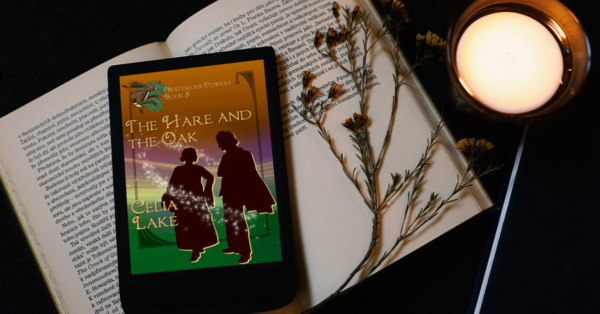
Thank you so much for joining me for The Hare and the Oak. My thanks as always to my most excellent editor, Kiya Nicoll, as well as to my early readers, all of whom made this book immeasurably better.
I’ve loved Cyrus since he first showed up – barely named – next to his sister in Carry On, and even more since his appearance in Sailor’s Jewel. (This is the one to read if you want more about the 1901 Atlantic voyage that is referenced several times.)
Mabyn appears briefly at the end of Eclipse but the mentions of her there made me want to know more about her life. It was a joy to see them find each other. If you’d like a bit more about Gabriel and Rathna Edgarton, The Fossil Door is the story of their romance.
I’ve known for some time that I wanted to write a book focusing on members of the Council, who took on responsibility for the larger land magics in 1484, at the time of the Pact. All of them are exceedingly competent, and even the kinder ones can be extremely ruthless and single minded in pursuit of their oaths. (Cyrus and Mabyn are both definitely on the kinder end.)
As this book makes clear, the 1920s are a rough time for the land magic. While Albion wasn’t a direct battleground during the Great War, plenty of men and women came back shaken and hurt in ways that affected their magic as well as their minds and bodies. The Council is only beginning to understand the range of impact that is having, and how to ensure the land magics continue appropriately.
The other big piece of this book is that one of my early readers has pointed out for a while now that we really needed a book that demonstrated what happened when someone pushed too hard on an oath. By design, oaths made to the Silence (i.e. those anchored by the Pact) are not meant to be fatal. The goal is always to make you so scared you can’t proceed with doing something that would break the oath. It’s very effective that way, if also unyielding.
However, many people only rarely swear on the Silence. Think of it like being in a courtroom or hospital operating room. For some people, that’s their day to day life, but for most people it’s something that happens only very occasionally (and you might prefer never.) As noted in a couple of my other books, the Guard and Penelopes make these oaths frequently, as part of their professional duties. So do judges and magistrates, the Council, and in some cases others.
In Eustacia Baddock’s case, she obviously pushed past both the oath to the Silence she made when she became Lady Baddock, and past the binding oath that Cyrus and Mabyn required of her, to avoid interference. It did not fully trigger (in terms of consequences for her long-term well-being) until she did something that could not be easily taken back, making sure the charmed stone was placed in Nora’s room. We don’t see her reactions in that span of time, but it was likely something akin to progressive debility, and the longer she didn’t reverse her course, the more terror pressed in on her, and the more she wasn’t able to react.
Let’s get into the specific notes for this book…
The brief mention of someone walking down the street and spotting their double has happened a number of times, but there was a news story about this in 1926, and of course I had to use it as a passing reference.
One of the joys of research is getting to poke around and look at actual census records and figure out what information would be available. As Cyrus notes, the 1901 census includes name, age, place of birth, but doesn’t include parents. People are listed by household, which means they could connect Nora to her aunt, but not necessarily know more about the relationships. Fortunately, Cyrus does have access to other records.
I also wanted to write a character who, while magical, had not lived in a magical community. There are magical folk throughout Albion, of course, with many living in the larger population centres (Trellech and London are the largest, but there are a number of other communities in other cities.) Manchester, though, doesn’t have a core community in the same way. My thought on that is that the neighbourhoods where that might have happened had rapid change due to the rise of factories and other industrial production, with some people moving elsewhere.
Plenty of people in Albion live alongside non-magical folks, with perhaps a few advantages (a more reliable kettle, they get slightly fewer infections, their milk stays good a few days longer, their chimneys are less smoky), but without being very noticeable. I’d wanted to write someone from this background for a while, and writing Nora was a fun chance to explore an outsider’s take on some things the magical community just takes for granted.
Nora and Mabyn talk about ghosts at one point. Ghosts definitely do exist in Albion, though they’re not nearly as widespread as ghost stories suggest. Most old houses do have stories, but they’re more often caused by lost troves of coins or other metal objects that have accumulated magic than by actual ghosts. One of these days, though, I’ll write about an actual ghost.
Cockfighting chairs are in fact a real thing. I stumbled across one in other research (figuring out the furniture that is something of a plot point in Fool’s Gold), and had to reference them somewhere.
They’re as described, a chair that you could sit astride (if you were wearing trousers, anyway), with a folding ledge for a book, betting slips, or other paper items. If you wanted to sit with your back supported, you turned the chair around and put the reading ledge down. Either way, there was a small compartment under the seat for pens, paper, and of course your betting slips, cards, or other amusements. As Mabyn notes, they fell out of favour when cockfighting became illegal, because it is very difficult to claim you weren’t watching an illegal match when you had purpose-made furniture handy.
I was delighted to set this book in Suffolk, for a personal reason and for an equestrian one. My father was born and grew up in Ipswich in Suffolk (a handful of miles south of Baddock Hall), and I’ve visited the city a couple of times (though not at all recently.) It’s a large port city, and while I didn’t want to focus on the city for this book, I had a delightful time exploring the fauna and flora of the area.
The Suffolk Punch is a local draught horse breed, always chesnut (in that spelling, as Lionel points out), and they are absolutely gorgeous to watch. (Check out YouTube or other sources for videos.) They’re considered an endangered breed, but they are smaller than other draught horses, hardy, and generally very good-tempered.
The rest of the notes for this book all have to do with magical theory, folklore, and related topics, so I’m going to group them somewhat thematically.
One thing I’m committed to in the depictions of magic in my books, is the idea that there are many different forms of magic. Some work better than others for certain situations, and some absolutely have more social support than others. But it’s a big and varied world out there.
Think of magic a bit like music: some kinds don’t fit well together, lots of people have their own personal preferences and tastes (especially about what they’re interested in spending a lot of time with). But there’s also room for different combinations, approaches, or for an individual to have skills in a number of different styles or techniques. Cyrus and Mabyn both have their own approaches, and so do other people. One thread through the book, of course, is trying to figure out what might work for Nora, well enough that she can pick up the land magic obligations.
Similarly, there are a variety of options for shapeshifting in Albion. Some people learn to shift (see Magician’s Hoard for more about this – one of my working chapter titles for that one was “shapeshifting 101”). Others have a family tendency, such as the berserker legends, while others are living with a curse or other external magical situation.
This leads to a variety of different approaches. The garden exploration that Cyrus sets up is a little more rooted in a formal ritual approach (though modified to be more flexible and free flowing, suitable for a ‘see what calls you’ goal.) The ritual they do in the workroom is an older form, one anchored in elemental attunement. I imagine it as having origins in the grimoire traditions of the Western magical community in the mediaeval period. The actual method he uses, though, has been revised and refined over the years for a variety of reasons.
On that note, there are many ways to maintain the land magic obligations. Every one of the landed holdings has their own particular rituals (most commonly around spring equinox, May Day, summer solstice, harvest, and often winter solstice), but the specific vary a great deal.
Each person has their own preferences – someone who is an expert in ritual magic is going to go at those rites differently than someone who prefers materia or incantation or who has a strongly elemental approach. There’s lots of ways to make a joyfully festive occasion, but some are going to be more to your taste or skills than others.
Which is, of course, why we get Cyrus riffing on Shakespeare’s “There are more things in heaven and earth than are dreamt of in your philosophy” which is from Hamlet. (I am not yet committing to what Shakespeare may or may not have known about magic, though being magical would explain some things about the obscurity of his background at various points in his life.)
As Mabyn notes, some fairly famous examples of magic aren’t their sort of magic, to say the least. Isobel Gowdie is a well-known tale from Scotland, talking about her turning into a hare. There are various song versions of this text. Two I love are on Maddy Prior’s Year album as “The Legendary Hare”, and Fay Hield’s “Hare Spell” on her Wrackline album.
Likewise, as Mabyn comments, the fairies at the end of the garden aren’t the Fatae at all. This is a reference to the Cottingley Fairies. They were much later confirmed to be a hoax, but were very compelling to Arthur Conan Doyle, author of the Sherlock Holmes stories, among other things. Mabyn does reference a few of the Fatae seen and referenced in other books, including the Belin (seen in Goblin Fruit) and the custos dragons (one of whom appears in Fool’s Gold).
Finally, there are a number of different personal approaches. Hag stones, a stone with a hole in it, have a number of different pieces of folklore attached, including the ones Mabyn mentioned. They’ve been seen as magical and special in a number of contexts, especially when made of particular stones like the flint one Mabyn has had.
Sign up for my newsletter to be the first to hear about future books and learn about fascinating bits of research. And I am hoping to spend some time with Gemma in a book of her own down the road.
Happy reading! The next book in the series is Point By Point, taking on journalism, a secret society, and the aftermath of previous justice.
Learn more about the world of Albion and future books at my website, celialake.com. Additional information linking characters, places, and timelines is available at my wiki.
Happy reading!