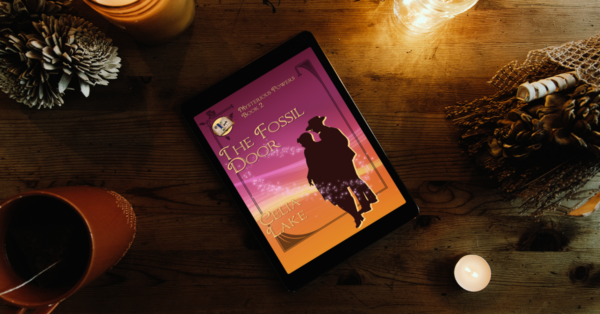
Curious about what’s behind The Fossil Door? Explore my author notes about the historical details behind the book.
These notes do contain some plot spoilers! Otherwise, they’re as shared at the end of the book, with edits only to share the most useful links and cleaning up some formatting for the web. Posted March 2026.
Welcome to the author’s notes for The Fossil Door. I started writing it in May of 2020, when we were still locked down, and it was a joy and a delight to spend a lot of time looking at completely gorgeous photos of the Scottish highlands, Highland Ponies, and various wildlife. As well as deeply enjoying both Gabe and Rathna, and their adventures together.
As always, my thanks to Kiya Nicoll, my excellent editor, and to my early readers. (Any remaining flaws are entirely mine, but they all helped make this book better.)

Before I get into the historical notes, a word about Gabe. He is the son and eldest child of Lord Richard and Lady Alysoun Edgarton, who I’ve come to adore over the course of multiple books. Pastiche, set mostly in 1906, is about the early years of their arranged marriage. After that, Richard is mentioned briefly in Outcrossing (at the end of the book). He is a significant secondary character in Wards of the Roses. Alysoun appears briefly at the end of the book, and they both have a part to play in the events at the end of On The Bias.
Originally, I hadn’t planned for the hero of this book to be their son. Then I needed a name that might be heard as feminine, out of context, and I looked at this small kid I’d named Gabriel, adjusted his birth year slightly (Pastiche was still in the editing stage) and here we are. I love Gabe for his curiosity, for his refusal to abuse the privilege he was born with, and his insistence on trying to put his gifts to good use. Most of all, I love him because he is so very much the product of his family, those he’s had since birth, and those who have become chosen family since.
If you’re curious about Gabe’s family, you can find the tale of Alysoun and Richard’s romance in Pastiche (along with more Mason, Gil, and Magni.) You can find the complete list of their appearances on my authorial wiki under the Series and Arcs section, “The Edgarton Family arc”
Which brings us to the beginning of this book. Spitalfields, in East London has long been a home to immigrant communities a bit unsure of their welcome. Originally home to Huguenot weavers, then to weavers from other places, it had declined into slums and tenements by the mid-1800s. An influx of Jewish refugees, mostly from Eastern Europe settled in. These days, there’s a sizeable Bangladeshi community. By the 1920s, the Jewish community had established customs, communities, and spaces. The magical community of the area is rightfully proud that one of the three London portals is there, brought in to aid the silk trade originally. (We’ll come back to the eruv.)
The Portal Keepers are, as you’ve gathered, an elite group of magical folk, who are responsible for a key piece of Albion’s infrastructure. Only it’s a bit more complicated than maintaining bridges and roads (a complicated enough problem), since the portals are to some extent living, breathing, vibrant magic with a mind of its own. Being able to make portals was part of the original agreement of the Pact, in 1484, and since then, portals have been established around Great Britain. More recently, there have been a few established across water, such as the one on the Isles of Scilly, in In The Cards.
The portals present several complications, however. First, as noted, the ability to tend them is quite rare, far more rare than the ability to become skilled at significant healing magic or some of the other complex magical needs of the community. Second, rapid transportation (even if it’s between known points) presents a number of practical challenges, if there is an outbreak of rebellion, a theft, a murder, or some other immediate need. (The fact Albion has portals is what led to the creation of the Guard in the early 1500s, long before any country had what we’d consider a police force.)
There are, as noted, portals in other countries, but where and how they were developed varies a great deal. In general, they do not do well crossing water – certainly not deep or stormy water – on a regular basis. Naturally, who gets a portal is also a politically charged question.
We’ve seen the Penelopes before. They’re another thing that Albion figured out was needed. Albion has all sorts of known magics, things people learn in school or apprenticeship, that work pretty much as expected. However, in any society you’re going to have people either experimenting (not always successfully) or using what they know to hurt other people. The Penelopes are Albion’s answer to both forensic science and to figuring out how to undo whatever dangerous magic someone has come up with this week. Highly skilled, the sort of people who absorb every bit of information in case it might be useful in ten years, they have their own particular ways of doing things.
While officially on the Ministry payroll as something like Analyst or Senior Analyst, everyone who works with them calls them Penelopes, after Penelope, wife of Odysseus. She used her wits to keep unwanted suitors at bay, unweaving the work of her loom every night to avoid an implied deadline, while juggling half a dozen other critical needs in her household.
As Gabe notes, many of the Penelopes are female, certainly many of the best of them. While Albion is much more open to both men and women in many professions (especially those that require stronger magical ability), the Penelopes decidedly skew toward women. Thus, people assuming an unnamed Penelope will be a woman, and why Gabe frankly expects that to happen much of the time.
Highland Ponies are a breed of pony much known for their sturdiness and sure-footedness. They’re often used to carry loads of materials around the Highlands, though these days, mostly for pleasure riding. I was a serious horseback rider in my teens, and Livet is based in personality (if not in colour or breed) on my beloved Dorothy, who was round like a barrel, 14.2 hands tall, and terrified of sheep, but otherwise a seriously clever sort of pony.
Glencoe is of course a real place, and to the best of my ability, the landscape and general layout is as described. (Except for Gormlaith and Eoin’s inn, of course, and the portal itself.) If you’ve not had a chance to see that landscape, many people have posted gorgeous photographs online. Ossian’s Cave is a real cave, narrow and difficult to reach, as described. For many years, including in the 1920s, there was indeed a battered tin with the names of everyone who had climbed up there. The climbing techniques are also accurate to the period, though many of the technical climbing tools used now did not yet exist, or only in a very rudimentary form.
The geology of Glencoe is fascinating and complicated. It’s a massive caldera of an ancient supervolcano, and it’s actually the place on the planet where people figured out what a caldera collapse looked like. It’s particularly interesting because sedimentary rocks (largely limestone) were laid down between volcanic cycles and in those bands of rock you do find fossilised plants. (This is also what led to the shale quarries, closer to the loch.) Withamite is an actual mineral, named for its discoverer, Henry Witham, who identified it in 1825. As Rathna identifies, it has a high manganese content, and comes in shades of pinkish-red and some greenish-yellow.
The wildlife other than the beithir are as described. Red deer are quite large and impressive. And Scottish wildcats are deeply endangered, but large, stocky, and very furry. (My editor’s eldest has been fascinated by them for some time, and I knew I had to let one appear somewhere in here.)
Beithirs are a dragon-like beast of Scottish folklore. (I did not make anything up about them, other than the fact there might or might not be one lurking in the mountains around Glencoe in the 1920s.) They were most commonly supposed to be active during summer lightning strikes, which must be spectacular in the mountains of the Highlands.
When it comes to Rathna’s background, there’s a lot of difficult history. I’ve done my best to keep to documented stories. First, it was not uncommon for ayahs – Indian women, employed as nursemaids – to be abandoned in London. British families (mostly returning from colonial posts) would bring the ayah back with them, and then leave her in London, without enough money for a ticket to get back home, or a way to support herself. There was a home established to help give them somewhere to live until they could find a new position or a way home, and there was a system in place to help make sure they got home – but usually after a stay of some weeks or months. (Some records say about 100 ayahs a year stayed at the home.) Gabe’s generous gesture at the end of the book is a little out of the ordinary, but not completely unheard of, at least for someone inclined toward philanthropy in that direction.
Of course, some of the women brought to England stayed. There were a sizeable number of men from India who had taken positions as servants or sailors (the word lascar is used for both during this period). While the Southeast Asian community was not as large in London in the early 1900s as it is now, it was certainly present and growing.
A couple of my early readers wanted a little more about Rathna being sent to the orphanage than she was willing to share in the text. Her mother had become nursemaid to a British couple, in the Civil Service. After her death, they continued to have Rathna live with them. But when Rathna was around ten, the husband was offered. a posting in India. Not knowing where Rathna’s family were, or how to reach them, and knowing it would be impossible to bring her to India as anything other than a servant, a decent orphanage was the best option available.
It was not a great option. Orphanages of the period were underfunded, often heavily institutional, with strict rules, little in the way of individual care, and the bare minimum of education. As Rathna says, hers was a bit better than some, but that didn’t mean it was a pleasant place to live. The fact she had magic – enough to get her into Schola, despite little understanding of what was going on – completely changed the arc of her life in ways she’s still sorting through.
I loved having a glimpse, however briefly in passing, at two of the great libraries of London at this point in time. What is now the British Library was then in the great central court of the British Museum (I got to see it there, once, when I was young, before it moved to its current location in the late 90s.) Access to the library was free, but getting a reader’s ticket involved an application process – especially if you were under 18. Gabe, being himself, has had a reader’s ticket since he was 16. The Natural History Museum also has its own library, as well as amazing collections, and is the natural place for someone to start some research about a particular mineral.
Aunt Mason is my second favourite Penelope (my favourite would be Gabe, but it’s close). I’m glad to answer a question here about why Richard Edgarton was so touchy about Kate and Giles not using a ladder in Wards of the Roses. Mason’s love of creating illuminated manuscripts, both entirely her own creation and copying existing works, comes up in Pastiche. It was delightful to get to describe a little of what she might produce when given absolutely free rein. (If you are reading this and have some relevant skills, get in touch, I’d love to discuss a commission or two… I know enough about the art form to know what Mason is doing, and not enough to create it myself.)
Mason’s background is as described in the book – a Malaysian grandmother and Dutch grandfather, whose daughter married an English man. There will be more coming about Mason’s work as a Penelope and education in a future novella. Mason and Witt are, by the 20s, two of the senior Penelopes, dear friends, and utter opposites in how they work. If you’re familiar with the idea of an Order Muppet versus Chaos Muppet as a form of describing characters (and people), Mason and Gabe are both Chaos Muppets, and Witt, and Lucy Doyle (Witt’s former apprentice, and Gabe’s apprentice mistress) are both very much Order Muppets.
Speaking of Gabe, it became clear the more I wrote this book that he likely has what we’d now call ADHD. He truly was all over the place as a kid, never quite on the same timeline as other kids his age, and with very little patience for doing the thing he was supposed to be doing if it were boring. As an adult, he’s got reasonably good coping mechanisms, so long as you let him climb out a window or throw himself off a horse or tackle a complicated problem on a regular basis.
Cousin Del is indeed the Lord Delwyn who is referenced at the end of Pastiche. It’s clear from Gabe’s comments that the Edgartons took him under their wing as, effectively, a fostered cousin, making sure he could establish himself, marry, and settle down. The head injury in the War, however, has changed some things for him.
The costume party costumes are described in the text – all real historical things except for the mirabiles. (The history of silphium is fascinating and horrifying at the same time.) The Babian bird does show up in some Arthurian legends. The one invention is my own, the mirabiles, seen briefly in Outcrossing, they appear as a darting and dancing cloud of light, rather like larger fireflies with better choreography. They are only rarely seen, even in the magical community’s protected lands. Gil and Magni are enjoying themselves dressed as the fable of the mouse removing a thorn from the lion’s paw.
One thread of this series of books is the implications of what the War did to Albion’s institutions, and the Council is one of those institutions (there will be more about this in two later books in the series.) Gabe is quite accurate in his analysis here (though like all people who are not actually on the Council, there are pieces of it he doesn’t know or understand.) And as he points out, the fact he didn’t serve in the Great War will affect his social interactions for the rest of his life.
A particular challenge of my books is that they are so tightly wound up in the perspectives of people who have grown up and been educated in Albion, and the ways that has shaped them. While many people believe that how Albion does things is the way magic works, that’s not actually true. It’s just that that’s how it works for Albion. The end of the book brought a delightful chance to point out some other ways to look at things.
An eruv is an ancient Jewish approach to dealing with prohibitions against carrying objects in public and semi-public spaces during Shabbat (sunset on Friday to sunset on Saturday.) The eruv is a way of creating a continuous line connecting outdoor spaces, making them effectively part of private space, like a series of interconnected courtyards. This allows people to do things like carry keys or other minor household objects, carry children outside, or bring food to neighbours. They need to be carefully maintained, since it is essential that there is an unbroken line that encompasses the eruv (usually wire).
Spitalfields did not historically have an eruv. They exist in a number of parts of modern Jerusalem, there’s one in Manhattan in New York City, there is one now in north London, and about 200 other communities around the world. But honestly, they really should have, so they get one here. The more mystical approach, the idea that it gathers people into a larger community, is not just my own thought – and of course, a culture familiar with magical warding (as Albion is) also has ways of thinking about something like an eruv.
Likewise, Rathna realising that her approach to some things – snakes, for a particular example – might offer a way out of the ways Gabe’s assumptions have tangled him up. The Naga Panchami festival is widely celebrated across India, with prayers, fasting, offerings, and festivities. Because the Hindu calendar is lunar, the precise date shifts a little between July and August. In 1922 it was July 28th. (So their departure in mid-June gives them time for the 3-4 week voyage, and a week or two to get to know Rathna’s family.)
Finally, as Rathna and Gabe discuss in the epilogue, not everywhere is bound by the Pact. The Pact and the Silence, the underlying magical constructs of Albion since 1484, bind the people who’ve made it. Where it exists outside Albion (the United States, Canada, the various colonies and territories of the British Empire) are a result of colonisation and imperial assumptions – not necessarily the underlying reality on the ground. Various countries elsewhere (such as continental Europe) have their own takes. One of these days, I’ll figure out a book that can talk more about this from a useful angle.
Again, thank you so much for reading. Please sign up for my mailing list to get all the latest news and fun extras, including a prequel novella that includes an appearance by Gabe.
The next book in the series is Eclipse. It’s set at Schola, the elite magical school of Albion, during the 1924-25 school year.