
Curious about what’s behind Point by Point? Explore my author notes about the historical details behind the book.
These notes do contain some plot spoilers! Otherwise, they’re as shared at the end of the book, with edits only to share the most useful links and cleaning up some formatting for the web. Posted March 2026.
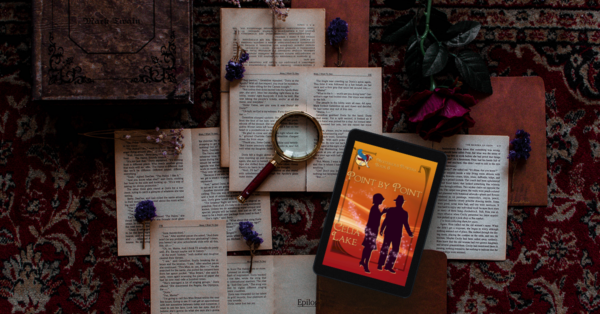
Thank you so much for joining me for Point by Point. My thanks as always to my most excellent editor, Kiya Nicoll, as well as to my early readers, all of whom made this book vastly better.
Galen, Martin, Laura, Julius, and Blythe also appear in In The Cards, along with Hippolyta FitzRanulf. (She also appears in Ancient Trust, a prequel novella available for free that you can get by signing up for my newsletter.)
In The Cards also introduces the Dwellers at the Forge in some additional detail. The events of that book get some brief references here, but I’ve been careful to avoid direct references who the murderer is in that book, to help avoid spoilers. (In The Cards is my locked room/remote island murder mystery, because you can’t write in the 1920s without one of those, really.)
The Dwellers at the Forge are one of the seven secret societies at Schola, taking in students in their second year with continuing membership into adulthood. I do intend to explore all seven properly eventually!
So far, I’ve had major characters who are members of Dius Fidius (Isembard and Alexander in Eclipse), Animus Mundi (Cyrus in Sailor’s Jewel and The Hare and the Oak), and Many Are The Waters (Rhoe in Sailor’s Jewel and Carry On, and Mabyn in The Hare and the Oak), but none of those books have particularly focused on the society aspects.
It was a delight to get to roll around in the details of the Dwellers. And of course, they’re very pragmatic about everything from the food to the pneumatic tubes to what they keep handy in their attics. Well-organised progressive action takes a lot of scaffolding, sometimes.

Lydia, of course, draws on the grand history of Nellie Bly and the “girl stunt reporters” of the 1880s and 1890s, about 30-40 years before this book takes place. Nellie Bly is the best known of them, but there were quite a few other women who would throw themselves into difficult situations, in order to report on key social issues, abuses of power – and of course those parts of life that made great headlines.
I found Sensational: The Hidden History of America’s “Girl Stunt Reporters” by Kim Toddvery helpful in exploring this bit of history.
(Did you know Nellie Bly also wrote a number of novels? They were reissued in 2021, and I read a few of them while researching for this book as well. They’re sensationalist novels of their times, but also an interesting way to dip a toe into how Nellie and her peers saw the world.)
As for Lydia, if you’re wondering about that reference to the talisman maker, it is indeed the same talisman maker referenced in Seven Sisters. (Farran Michaels is much happier where he is after that, thankfully.)
Horse racing is obviously a theme in the book, though more as a way into the core of the plot than the plot in itself. I’ll be honest and say I reread – gleefully and delightedly – a number of Dick Francis novels, for the feel of a racing stable. (Many of them aged far better than I was afraid they would have, and there’s a strong thread of kindness and justice through them that I had forgotten since I read them as a teenager madly in love with both horses and mysteries.)
However, if you want a great overview of the history of racing, I also found Mr. Darley’s Arabian: A History of Racing in 25 Horses by Chris McGrath absolutely fascinating. Through genetic testing, we now know that 95% of modern thoroughbreds in the world are descended from the Darley Arabian, a horse long considered one of the three foundational sires of the breed along with the Godolphin Arabian and the Byerly Turk. They were all brought to the British Isles in the late 1600s through the early 1700s.
This book tracks the history through specific horses, which was both a great way to illuminate a number of the stories, and to show how much breeding and lineage play a role in the sport. It also has some fantastic stories about scandals, gossip, and all the very human parts of the sport. (Though I’ll warn you in advance, the chapter on the Great War is heart-breaking, as you’d expect.)
Then, of course, there’s Crisparkle. He is an entirely fictional horse, who is related to a real one, Hurry On, who is somewhat older, and who had a good record and who was a leading sire in 1926. (He has a Wikipedia page, if you’d like to check out his details.) He is, however, chestnut, as are most of his relatives.
This is where we get into a bit of equine genetics. If you don’t know your horse colours, chestnut is the reddish brown coat, and the horse might have the same colour legs, or perhaps white markings on the legs or face. Bay is the term for a horse that has a reddish brown coat (anything from bright copper to mahogany brown or even darker), with black mane, tail, and legs. Genetically speaking, chestnut is the recessive coat colour, so it is very unlikely (read, impossible) for two chestnut horses to have a bay foal.
Many of the horses in this line are also named for minor Dickens characters, as Crisparkle is (for Reverend Crisparkle in The Mystery of Edwin Drood.) There’s no particular deep meaning in why that particular name, it just amused me.
This book also meant I got to roll around a bit in some of the Mesopotamian archaeology of the period. There were several significant British-run digs just after the Great War. Fairly clearly, Nico was part of them. (There were also some major battles near there during the War, though they don’t get nearly as much name recognition as sites elsewhere.) However, this is still a relatively early period for archaeology of the area, so it is easy to imagine digging up sites, finding something interesting, and not being entirely sure what it meant.
Or, if you’re Nico, coming up with grand theories about it, and about the expansionist aspects of the culture, and what that could mean. A great deal of our understanding of astronomical (and astrological) magic comes originally from various of the Mesopotamian civilisations, and so that’s a thread through everything else, roughly speaking.
Finally, there’s a thread in this book of secret society ritual in theory and practise. The ritual that Nico runs (and Galen is brought to) is intended to be rather poorly constructed. It’s the sort of thing that a skilled ritualist could do something with, but Nico is working with smaller numbers than he wants, and relying on his magical skills to make up the difference.
It would work a lot better on someone without Galen’s own experience in initiatory rituals, basically.
Secret societies abounded in Europe, Great Britain, the United States, and the Commonwealth countries throughout the 18th, 19th, and well into the 20th centuries. A number are still around these days, but there were many more, with societies focused on all kinds of particular interests and professions. Most folks have heard of the Freemasons (who have some of their roots in the guilds of stonemasons), but there were a huge variety of others. I riffed on a number of texts from different societies for Nico’s ritual.
That’s it for this set of author’s notes. I hope you’ve enjoyed these adventures with Lydia and Galen (and getting to see a bit more of Martin, Laura, Julius, and Blythe.)
Sign up for my newsletter on my website for all the latest about upcoming books, my current writing, and extras for various books. If you do, you’ll get a prequel novella that explains how Lord Geoffrey Carillon met Hippolyta FitzRanulf, Ancient Trust.
My public wiki has a lot more information on how to connect different characters and books.
The last book in this series is Mistress of Birds, a gothic mysterious house with a secret or three on the edge of Dartmoor.