
Curious about what’s behind Complementary? Explore my author notes about the historical details behind the book.
These notes do contain some plot spoilers! Otherwise, they’re as shared at the end of the book, with edits only to share the most useful links and cleaning up some formatting for the web. Posted March 2026.
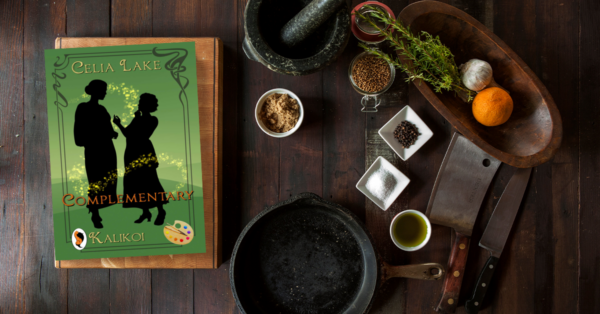
Thank you so much for reading Complementary! This was a joint project with Kalikoi Books, a publishing house focused on fiction about women who love women.
Obviously, Complementary features Elizabeth Mason, who has appeared in several of my other Albion books. I wanted to tell the story of how she met her partner Rosemary, and I’m delighted to have had this chance. You can learn about how Mason met the Edgartons in Pastiche (set in 1906) and see her later in life in The Fossil Door (set in 1922, and featuring Gabriel Edgarton). If you subscribe to my mailing list, one of the extras includes more of Mason and Witt after the events of The Fossil Door.
As always, I owe tremendous thanks to my editor, Kiya Nicoll, for taming my commas and telling me to put things more firmly on the page, not just in my head.

Mason works for the Guard, the law enforcement branch of Albion. Thanks to binding magical oaths, investigation and law enforcement work a little bit differently than in our world. The oaths both limit certain kinds of abuse of power, and make investigations more often about how to prove something or fix it, rather than who was responsible for a crime. If you think of the Penelopes as a mixture of forensic investigators, eccentric scientists, and perpetual-motion machines running on curiosity, you’ll be in the right place.
Elizabeth Mason and Agatha Witt are the same age, apprenticed in the same year, and complement each other very well, despite being such different people they sometimes have a hard time being in the same room. They’re also tremendously good friends. (And perhaps one of these days I’ll write something where they’re working together on a case.)
One of Mason’s particular pleasures is art, specifically figuring out how to forge historical documents so as to be better able to spot them in investigations. As she references in chapter 1, she and some of her friends have a habit of creating works and then showing them off. Strictly for educational purposes, of course. The notes she makes about the book she just finished are all accurate.
She comes by her interest in pigment thanks to her family. She mentions her grandfather and several other relatives were colourmen, responsible for processing and mixing pigments for paint, ink, and other use. While various chemical dyes were in use by the late 1800s, many people still relied on older pigments, which require specialist (and sometimes quite dangerous) processes to use.
This also explains a bit of Mason’s background. Her mother and grandmother were Malaysian, and married English and Dutch traders respectively. Mason grew up in Albion, but has (as you can see from the end of the novella) strong ties to Malaysia and that part of her family heritage.
Southwold, where most of this novella takes place, is a small seaside town on the Norfolk coast. Walberwick is a nearby village, and both are just a little north of Dunwich. All the tales about Dunwich sliding into the ocean are true, but the magical community set up a school nearby focusing on shipping, trade, and related magical skills after the village no longer functioned.
The ferryman, Wessy Cross, was the ferryman at the time. Things you discover while doing research, thanks to someone who had traced the history of the Southwold ferry back for a couple of centuries!
Speaking of the folklore, all of the references here come from ongoing legends of the area: King Onna, the barrow, the Black Shuck, the Devil beating on the church of the door. If you do a search on any of these and throw in the word “Southwold” or “Norfolk”, you should dig up several versions.
The Deadman’s Barrow is actually relatively close to Sutton Hoo, a famous Anglo-Saxon burial site of the 6th and 7th centuries that was first excavated in the 1930s. You may have seen the famous helmet or other items from the site.
Similarly, the references in the charades scene all come from artistic references (mostly the Pre-Raphaelites) and Shakespeare. The painting that Mason notes in Caro’s room is from the tale of Tristan and Iseult, a story that is part of the larger Arthurian legends, involving a love potion, adventure, separation, and death.
On the musical front, the Papageno/Papagena duet from Mozart’s Magic Flute is a particular earworm that sticks in my head on a regular basis. You can find a number of versions of it on various music and video services, including YouTube.
The opera itself is full of magical and ritual references, but the key piece for the duet is that Pagageno, a birdcatcher or birdman, has just come across Pagagena, a birdwoman, and they both find the hope for family and children they had thought was not an option for either of them. (Rosemary and Elizabeth have no desire for the children, but that doesn’t make it any less fun to sing.)
Likewise, Rosemary is humming “With Cat-Like Tread” from Gilbert and Sullivan about pirates sneaking around to avoid getting caught. (And of course, singing loudly about being sneaky is hilarious.)
Finally, Mason’s meal in the last chapter draws from a number of Malaysian dishes. The cuisine borrows from many different places and cultures in the area, leading to tasty combinations.
Thank you again for spending some time with Rosemary, Mason, and Complementary. You can learn more about my other books and upcoming projects on my website, celialake.com, and sign up for my newsletter there as well.
Absolutely check out the other books from Kalikoi, found on the next pages.