
Curious about what’s behind BOOK? Explore my author notes about the historical details behind the book.
These notes do contain some plot spoilers! Otherwise, they’re as shared at the end of the book, with edits only to share the most useful links and cleaning up some formatting for the web. Posted March 2026.

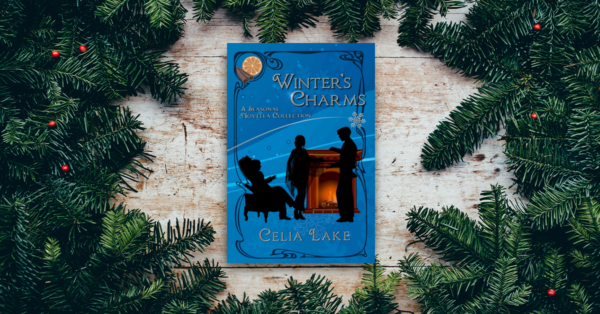
Hello, and welcome to the author’s notes for Winter’s Charms, my winter novella collection. Thank you for visiting with me and some of my much-loved characters in some new situations and spaces. As always, I owe a lot to my editor, Kiya Nicoll, and to my early readers, who all helped make these stories better.
Let’s take these notes in order, novella by novella.
Casting Nasturtiums
I need to start by explaining the title. I grew up with the phrase ‘casting nasturtiums‘ instead of ‘casting aspersions’ as a family saying. I come from a family of people who like puns and wordplay, so for a long time I thought it was just us that did that. And then I came across it in a Dorothy L. Sayers book, so not just us! The citations I could find for it go back to humour magazines in 1902, with several other cited sources around the time of the Great War.
As Seth notes, the actual flowers are edible, though a bit spicy or peppery, and they come in gloriously bright shades of gold and orange and red. Very suitable for any tale involving Golshan.
Seth refers to the demobbing process briefly several times. This was the way that people were cycled out of the Army and back into civilian life. It took quite a long time: Seth’s return in the summer of 1919 (more than six months after Armistice Day) is about in the middle of the process. People were demobbed based on a priority system depending on their civilian work (as well as exceptions for all sorts of reasons.)
The first step was being returned to a camp in England, where the soldiers would be processed through the system, paperwork would be sorted out, and so on. Once they could go home, they had to turn in their uniforms, and would get a suit of clothes or money to buy new ones, and they’d turn the great coat in at the train station near their final stop in exchange for some additional money. All rather convoluted.
As Golshan explains, his paralysis is primarily due to swelling and damage near his spinal cord – what we would call an incomplete T6 injury these days. The ‘incomplete’ means that not all of the nerves were damaged, and he does have some sensation, but this is an location of injury that can lead to a number of long-term health concerns around pneumonia, digestive health, and of course all the personal hygiene needs. Magic makes a number of those easier and more straightforward to manage, but it doesn’t solve them entirely.
The death rates for any kind of significant spinal injury at the time were about what Seth describes: eight out of ten people died in the first week or two, either from the initial injuries or infection. A number of the others died due to ongoing health issues, later pneumonia, etc.
Convalescent blues deserve a good rant. These were the uniforms assigned to soldiers in long-term hospital or care settings. As noted, they do not have pockets, they were not designed for independent activity of any kind. Similarly the Bath chairs, such as the one Golshan is first seen in, don’t allow for independent movement at all. They’re tall basket shaped chairs that require someone to push you. By design, that person is rather separate from the person in the chair – it’s difficult to even have a conversation.
Golshan comes from a Persian family who came to Albion just before he started school, due to political unrest. A number of the magical traditions in that region might reasonably focus on a knife as a key magical tool, rather than a wand. Golshan’s is a pesh-kabz, made with an ivory handle (from before ivory was restricted), and carved and set with suitable stones. An image search for pesh-kabz will turn up some gorgeous knives that are amazing pieces of art.
There are, of course, a number of other seasonal and ritual customs. The poetry and red fruits on the winter solstice in Golshan’s custom are about the dawn and glow of life. When Golshan thinks about cotton and blades, those are protection rituals for a new baby, done on the sixth day after birth to keep evil or dark spirits from hurting the mother and baby.
You can learn more about Roland Gospatrick and his now wife, Elen, in Carry On. The epilogue of that book finds them having established the care home, creating a place for people who need different kinds of help than the Temple of Healing can provide. (And to be honest, the Temple of Healing is rather overwhelmed into the 1920s dealing with urgent cases, surgeries, and all the ongoing needs of the magical community.)
The wheelchair Seth eventually arranges is based on some of the more unique extant models from the period, the sort that were put together by talented craftsmen, rather than made for general sale. Magic makes some aspects around comfort and balance a bit easier, of course.
Physiotherapy started being used as a term in the 1890s, though it goes in and out of fashion through the 20th century. It’s sometimes more used to refer to work with children who’ve had polio, but also at times with adults.
Country Manners
This novella takes place about 18 months after most of the events of Wards of the Roses. For those caring about the timeline, Kate was promoted in the spring of 1921, Giles proposed a year after they met, and they are arranging a wedding in February of 1922.
Giles doesn’t refer to it in detail here, but his blindness is due to being gassed in Flanders during the Great War. He does reference a few tools. There were several models of braillewriter at the time (though the models of the time had some quirks). He has a braille slate, designed for writing on the go, and special paper that takes the impressions needed for braille more clearly. He also uses small charmed tokens to help him orient himself in a room or find his way in an unfamiliar space. These are similar to some modern technology tools, but sympathetic magic does make that sort of thing easier!
As Kate notes, making offerings to the Fatae has worked out well for them before, and she uses the same offerings of honey cakes and cream that she used in Wards of the Roses.
Kate references a couple of Welsh holiday traditions. She is, as she notes, chapel (a nonconformist branch of Christianity, the predominant religion in Wales) rather than Church of England, like Giles and his family. The plygain services she describes are hours of singing and candlelight, and the Internet has some lovely examples if you do a search. Welsh music often involves glorious harmonies and resonance. The callenig rituals she describes for New Years are pretty much exactly as she says.
The parlour games they play are both common games of the time. Consequences is one of the many paper games, where you write down a series of phrases (in this case, using a consistent framework, rather like playing Mad Libs). The Parson’s Cat is also sometimes known as The Minister’s Cat, but since I grew up playing it as The Parson’s Cat, so do they.
The governess cart is as odd to drive as it sounds like, where you drive diagonally from the back of the cart. It does however allow a governess (presumably the driver) to keep her eyes on all of the children in the cart at all times, which seems entirely sensible. English Heritage has a good video of what it looks like. (Check out English Heritage Governess Cart or search on those words and it should turn up.)
Potter’s Museum of Curiosities was a real museum with taxidermy animals (don’t do a search on the name unless you’re all right seeing that!) There were a sizeable number of these museums in the late Victorian, Edwardian, and early 20th centuries. Schools for the blind also had their own tactile museum collections. (This is in fact how I have touched a swan. Do not try with a living swan.)
The Pleasing Token is something I’m delighted to have had a chance to explore. Kate showed up at the end of Outcrossing wearing one. I instantly knew that I’d need to write a book about her (as I have since).
I knew when Kate showed up with a Pleasing Token that they were rare and unusual (though Ferry clearly knows what one looks like.) Figuring out how Kate came by it was, as you can see, a whole new story. I expect to explore a bit more of this kind of magic down the road, since I find it entirely fascinating.
Chasing Legends
You can of course find how Pross and Ibis met in Magician’s Hoard, and the story of Thesan and Isembard’s romance is in Eclipse. As noted, this is a year and a half after the end of Eclipse (which ends in the spring of 1925) and a year after Thesan and Isembard got married (rather quickly) that December. It is also just after Ibis’s first term as a teacher.
(He interviews for the position in May of 1926, just after the events of Magician’s Hoard. If you are on my mailing list, there’s an extra called Tea and Meetings that includes his interview along with other scenes.)
As Pross and others note, there are a number of similarities to the mediaeval poem Gawain and the Green Knight.Written in a dialect of Middle English that didn’t survive, by someone usually referred to as the Pearl Poet (for the other major poetic work it’s thought they wrote), it’s been translated a number of times. (My favourite still is the one done by J.R.R. Tolkien.)
It tells the story of a mysterious green knight who turns up at Arthur’s court and who challenges Arthur’s most noble knight (Gawain, it turns out) to cut his head off in an exchange of blows. Gawain is hesitant, but does so, and the knight picks up his head, grins, and tells Gawain to come find him next year for the other half of the exchange. Gawain sets out, and ends up in a mysterious castle, with various attempts at temptation.
The question of who authored Shakespeare’s plays is a thorny one. Ibis notes a couple of the other notable playwrights of the era, both of whom have been contenders as the ‘real’ Shakespeare. Edward de Vere was the 17th Earl of Oxford, while Emilia Lanier was a poet (considered the first woman to be a professional poet in England), deeply connected to the artistic community around the Tudor court. Both wrote a number of other works.
Schola is set on the island of Cantre’r Gwaelod. There are tales about the land in Cardigan Bay disappearing, and some versions put that around 600 CE (at the point when teachers of magic settled on the island and didn’t want to be bothered, in my world.)
Of course, the geology and history is even more interesting than that, as are the stories of how it became flooded and lost to time. (The island of Schola is roughly five square miles, though the actual shape is something more of a longer narrow arch.)
Much like Doggerland, the primordial forest that lies under the North Sea (stretching between the east coast of Great Britain and the continent), there was once a great forest running from Brittany, covering Cornwall, and much of what is now ocean up through Cardigan Bay. That’s known as the Forest of Borth, and at certain times (depending on the tides, storms, and what’s been uncovered recently), you can see fossilised trees rise from ocean bed.
One challenge for any book that deals with calendar dates before 1752 is the change in calendar systems (and, as noted here, the change in when the beginning of the new year fell.) As this Novella notes, 1751 was right before the shift in the start of the year, and a year before the big shift in calendars. It seems a good time for chronological magics to have got skewed and tangled.
(This novella also touches on the fact that Scotland was eventually folded into the obligations of Albion’s Pact, but Ireland has not been: this is why Ireland is magically under a different system, has its own schools, and is mostly doing its own thing. One of these days, I hope to dig more into that.)
I worked out the astronomical details using my trusty copy of Star Walk (an excellent app both for locating current stars, constellations, comets, and celestial objects, but also for scrolling back historically), and a lot of references to figure out what reasonable timing markers might be. Supernovae to the rescue! There aren’t that many of them (few enough that an astronomer like Thesan would be able to place them quite accurately), and they’re obvious and easy to identify.
The music of the spheres refers to a theory tying the movements of the planets to magical workings, basically that you can create music or ritual that draws on the associations of the planets. Marsilio Ficino, a Renaissance philosopher, wrote a lot about it, among others. Thesan is not sure she approves of the theory here, but that’s why academic wrangling over beer exists.
Finally, a chance for Ibis and Alexander (both of whom have Egyptian parents, though rather different sorts of magical training from those parents) getting to wrangle over specific rituals. Thanks to Kiya and another friend for consulting not only on the Egyptology, but also what was known about various pieces in the 1920s. The idea of offerings being about restoration, and burials also being about rebirth are somewhat more modern discussions, but the underlying evidence for those theories is present in the archaeology.
Thank you again!
If you’d like more snippets and stories, my mailing list is the place to be. (And of course, for the latest news on upcoming books.) My website also has more about all my books, including content notes.
You can also find out more about the connections between all my books on my public wiki.
Finally, I appreciate reviews left on your preferred book buying platform or review site a great deal. They’re a tremendous help for other readers, helping people find books they’ll love.
Whatever season you read this in, I hope it’s a wonderful one.