
Curious about what’s behind Carry On? Explore my author notes about the historical details behind the book.
These notes do contain some plot spoilers! Otherwise, they’re as shared at the end of the book, with edits only to share the most useful links and cleaning up some formatting for the web. Posted March 2026.
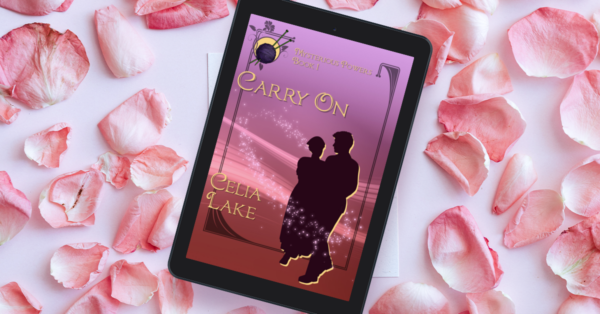
Thank you so much for reading Carry On. My thanks (as always) to Kiya Nicoll, my inestimable friend and editor. And I owe a lot to my early readers, including Erin and Anne Libby (along with half a dozen others) for making this book much better through their comments and suggestions. I particularly owe my knitting consultants a lot of thanks for this one!
You can find more about Arthur and Melusina, Roland’s parents, in Forged in Combat, a novella of their romance set mostly in 1882 in India.
Rhoe and her brother Cyrus (who makes a very brief appearance here) are key characters in Sailor’s Jewel, Rhoe’s romance, which takes place on an ocean liner in 1901.

This book has been a chance to dip into two new areas for me: the Temple of Healing (and more broadly how religion works for people in Albion), and a book set during the Great War itself.
The Temple of Healing is the main hospital in Albion, located in Trellech, in southern Wales. Devoted to healing in all its forms, it also has a variety of staff – Healers (functionally equivalent to our doctors, but with more magic), nurses (ditto), and orderlies, as well as the many other people making sure things keep running smoothly through cleaning, laundry, cooking, paperwork, and all the other tasks of any big institution. Each has their own supporting structures and hierarchy – and degree of formality.
Healers and nurses both make formal oaths to some power that they recognise as meaningful. It is possible for someone to swear on their magic, as everyone in the magical community does when they become an adult, but many Healers and nurses do have some sort of religious connection they choose to honour instead. (As you can see from Elen’s comments on her own oaths, there’s a variety, some more common than others.)
Albion itself is, in some ways, more fundamentally Roman influenced than our modern civilisation. When the fundamental shift in the country happened, at the time of the Pact in 1484, many people began to return to family traditions of magic that had been passed down, but not prominent. And in the Great Families, many of these had Roman roots, at least if you went back far enough.
That also affects religion, obviously. The various religious upheavals of the Tudors and Stuarts (and the English Civil War) meant that many families who were religious looked at their options, and chose what worked for them in private whatever public gestures they needed to make for political or legal reasons. (For a long time, church attendance was mandatory in the United Kingdom, with significant fines or penalties if you didn’t show up on Sunday.)
By the 18th century, things had settled into a wide range of religious practice, including people devoted to a wide range o different deities based on their interests, professions, families, or whatever else seemed relevant. Most of these are not true continuations of Roman practice, but they have kept the tendency of the Roman empire to include whatever interesting bits they found as the empire expanded.
In practice, much of how this works is similar to those groups reconstructing historical religions in the modern Pagan communities, in broad terms.
One of the things I’ve wanted to do in this series is show a diverse religious community, not just in terms of the types of religions, but the range of personal involvement. Roland is – until this book – not religious at all, nor is he particularly privately spiritual (as we’d put it these days.)
Elen, on the other hand, is actually devout, but not at all public about it, and she comes from a family that is equally religious, if in different ways.
(If you’re not familiar with the Welsh Chapel movement her father prefers, it’s a nonconformist Protestant movement, intertwined with labour and Welsh political concerns.)
Christianity is certainly in the mix here – Fidelius, in this book, as mentioned. I’m fairly sure several of my other characters in previous books are Christian, it just didn’t come up in text. (It may yet in some future shorter works I’m hoping to write.)
Now we come to the War and its battles. Figuring out where Roland was injured took a bit of research – especially since I was hoping for him to have been in more than one battle, so that he had a sense of the way the War was rapidly changing everything everyone knew about warfare. I was delighted when I stumbled on the fact that the 2nd Dragoon Guards fought both at the Battle of Mons, and at the first Battle of Ypres.
Also known as the King’s Bays (these days, the Queen’s Bays) because all of them ride bay horses, the 2nd Dragoon Guards have a long history dating back to 1746. Dragoons were highly mobile infantry who rode fast and nimble horses, and used firearms in battle, often dismounting to shoot and fight once they were in the midst.
The Battle of Mons has a mention in one of my other books (Outcrossing) because of folklore. It was, legitimately, a fight against overwhelming odds, and there were resonances with the Battle of Agincourt. (If you’ve watched the Kenneth Branagh Henry V, you know the battle).
Not long after the battle, there was a fictional piece in the papers, describing an angelic warrior or warriors, the ghostly archers who died at Agincourt, coming to save their countrymen with their arrows. It didn’t happen in our world, but in the world of Albion, there was definitely something magical going on.
After that, though, the Western Front turned into a long, muddy, awful slog. The First Battle of Ypres began in August 1914 and ran through the 22nd of November 1914. Roland was injured badly in early November, so he’d been at the Temple of Healing for about three and a half months when Elen arrives.
As Roland makes clear, this is a horrible way to fight for everyone, and particularly awful for cavalry. Over eight million horses and mules were killed during the War, many early on before everyone realised how futile and awful it was. (I found one statistic which said that Britain lost nearly 500,000 horses, one horse for every two men.)
Roland’s concerns about continuing to do the awful thing the worst possible way unfortunately came true. While many people in 1914 though the War would be over by Christmas, it turned into four years of misery, loss, and destruction.
Last in our War-related topics, before we turn to more cheerful subjects, shellshock was truly beginning to be recognised as a significant issue at about this point, though many of the necessary advances in supporting and treating people with what we now call post-traumatic stress syndrome were yet to come. Unfortunately, many people with lingering symptoms (like Roland’s depression and other issues) were accused of malingering, trying to get out of going back to the Front.
Healing baths and waters have, historically, been key to many places throughout the British Isles and continental Europe. The most famous of these, likely, is Bath itself, but Baden-Baden in Germany is also well known, as are other sites in Europe.
The Trellech in our world actually does have a healing spring associated with it, including that fascinating tidbit about the water bubbling in different ways to indicate a diagnosis.
There are some theories these days that the healing baths did actually help with physical healing. Not simply through getting people away from often unhealthily crowded cities and smoggy air, or eating too many rich foods – but because the mineral-rich waters helped with a number of circulation and deficiency issues in the diet.
The baths at Trellech have two parts, as Rhoe explains. The shared public baths, in the centre of the temple, but then the smaller bathing rooms, each dedicated to different deities, depending on need and interest.
This brings me to another thing I’ve wanted to explore. I’ve been writing a world where characters have agency, the ability to make their own choices. Just as people in Albion have a range of magical skills and abilities (and levels of raw power to work with), I want the range of religious experiences to vary. Because, after all, plenty of people have widely different views on religion and what it means for them in our world.
Sometimes what we need is a light in the dark, showing us the way forward, and that helps far more than a miracle would, in the long run.
There are prayers in this book, formal ones. There are also the informal needs, offered up in hope of some small gift. But there’s also the moments of going into the dark, and making space for a change, and finding some new path to explore. I wanted a book that has all of those, not in competition with them, but as part of a larger tapestry of what religion and belief might mean – but also what advocating for yourself or the ones you love can look like.
Of course, then we have things like the corsned, which is a historical form of ordeal. The term dates to before 1100, and it was originally done with barley and cheese, but it can be done with any food or drink. Other trials by ordeal include trial by combat, by fire, by water, by the cross, or by poison, among others. Many of those end up entirely fatal for the accused, even if they’re innocent.
The trick for Elen was figuring out something that would be meaningful proof, without being able to invoke the oaths and mechanisms of justice used by the legal courts (since she has done nothing legally wrong, those don’t apply.) Rhoe, of course, is both clever and well-read.
I was delighted when I read the Official Secrets Act of the time and realised it easily covered being told that magic existed. The version in this book is the 1911 Act, and basically, so long as you consider “magic exists and as real” as covered, then you can swear by the Official Secrets Act, be sufficiently bound by the Pact (the magical oath that allows the survival of magical society in Great Britain), and get on with the conversation.
Finally, we come to the knitting – and much thanks for my early readers who improved this. I am the sort of knitter who loves double-sided knitting, and does not have the patience for complicated lace work. (I’m also lousy at socks, though I can do a good scarf or non-lacework shawl.)
Knitting for the War effort was a huge focus of many women (and not a few men). Keep an eye on my blog for posts with some patterns and history (they’ll be in the Carry On tags.)
It was expected that you’d be busy working on practical items for men in the trenches any time your hands were idle. Besides the smaller more portable items Elen usually knits for this purpose, gloves designed to allow for shooting a gun or caps to be worn under helmets were both common, as well as larger items like warm vests.
By 1916 or 1917, there were a number of patterns released for knitting, and many women’s groups, invalids homes, or other organisations would run knitting gatherings, with the results boxed up and sent overseas as they were done.
They were much appreciated – but as Elen notes, for a skilled knitter, they don’t offer a lot of challenge or variety. Items always had to be in an approved colour that wouldn’t attract attention.
Her lacework shawl is indeed a Shetland pattern – these started to be published in the early 1900s. While they were traditionally pure white or cream, her love of colour got the better of her.
Many of our modern knitting techniques are, well, modern. Circular needles hadn’t been invented yet – and the terms ‘tink’ or ‘frog’ for undoing stitches are both much more recent. Figuring out exactly what Elen might reasonably know about knitting and how she’d describe it took a fair bit of research!
Thank you so much for reading Carry On. The next book in the series is The Fossil Door, exploring a misbehaving portal in the Scottish Highlands in 1922.