Curious about what’s behind Seven Sisters? Explore my author notes about the historical details behind the book.
These notes do contain some plot spoilers! Otherwise, they’re as shared at the end of the book, with edits only to share the most useful links and cleaning up some formatting for the web. Posted March 2026.
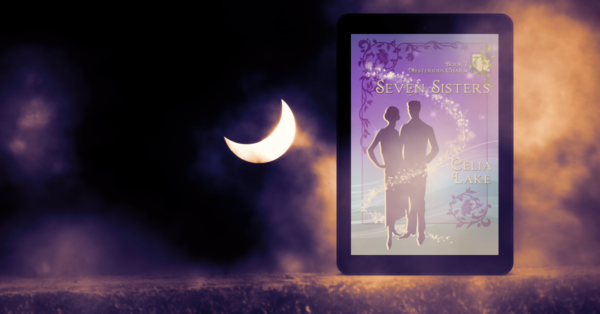
Hello, and welcome to my author’s notes for Seven Sisters.
First, this is the final book in the Mysterious Charm series. Don’t worry, there’s more charm and enchantment of the 1920s to come.
If you’d like more about these particular characters, Vivian also appears in Gobin Fruit, and there is also a brief appearance by Farran at the beginning of that book (which takes place after this one.) Robin’s story continues in Fool’s Gold where Vivian plays a small role.
My thanks as always to my most excellent editor, Kiya Nicoll, and to my early readers. Any remaining issues are of course, mine.
If you’ve been trying to place Farran Michaels, he appears briefly in both Goblin Fruit and The Magician’s Hoard after he’s sorted out his apprenticeship issues. I was intrigued by him and his knack for materia, and couldn’t resist bringing him back. He gets his own romance in Harmonic Pleasure.
Thebes is a fascinating city, historically. There are a lot of myths and legends about it, and unravelling some of them gets tricky because the Athenians (from whom we get a lot of our surviving written material) basically used Thebes as their target for “people who are not like us” when they weren’t doing that to Sparta. If you’d like to learn more about the history, the Thebes episode of the In Our Time podcast from the BBC was what got me started thinking about naming the estate Thebes, and why.
One of the most complex things about this book was making decisions about the Fatae. As you’ve likely realised at this point, while I’m drawing on a wide range of folklore traditions (mostly but not entirely British), the world of the Fatae is broad and varied. Elder bushes being guardians of portals to Faerie (or some other land not meant for humans) is one of the longstanding traditions in folklore, but most of our lore doesn’t mention them talking and walking around before they settle down…
Cadmus is, among other things, a chance to excuse my classicist background. My father was a professor with a Classics PhD turned theatre historian. I not only grew up on tales of the Greek myths and the various surviving plays, but I’ve taken Greek and Latin (more of the former than the latter).
In general, if there’s a passing reference to a classical name that I don’t explain in the following, a quick search at Wikipedia will find you a great summary. I’ve tried to give enough context that you don’t need to, however.
Herodotus is often referred to as the earliest historian, looking systematically at events and how they came to be rather than simply telling stories he’d heard about them. His Histories looked at the history of the Greco-Persian wars. It’s actually a little weird to read, because some of it is Herodotus talking about Persian customs of food, dress, and lifestyle, and the rest is mostly battles.
(When I was taking Ancient Greek in high school, my study partner and I decided and then proved that if Herodotus is talking about a battle, any verb you don’t know can be translated as “to attack” until you figure out the details. There’s a verb in his description of the battle of Thermopylae that can be quite reasonably translated as “to make pincushions out of one’s enemies with spears.”)
At the introduction of Mrs Cooper, we discover she is deaf. While many people these days identify with Deaf culture, Mrs Cooper would not identify herself that way, as she’s been largely cut off from other people who are deaf or hard of hearing since her school days.
She is, however, fluent at British Sign Language. I leaned heavily on various online BSL dictionaries to figure out the relevant signs, but found it was illuminating how people signed, and what that added to understanding their mood or character.
And of course, there are other situations in which sign is extremely helpful. Vivian is familiar with its uses in spaces where spoken language doesn’t work, such as with mermaids underwater. And she points out it’s useful in a noisy room or somewhere you don’t want to make noise.
One more linguistic note: sign language uses a different grammatical structure than English. I didn’t attempt to duplicate it here, other than a few bits of flavour, but what you’re reading of the signed conversations might best be considered their translation into English.
The use of name signs varies in different communities. In many places, it’s customary for them to be given to someone by other people, not decided by the person themselves, and people might have different name signs in different parts of their life. In this case, they’re all somewhat informative about the people they describe.
The Fauvists were a group of early 20th century artists known for their extremely strong and bright colour choices. Not the sort of thing you’d expect in a fairly traditional English manor house.
We get our first serious glimpse at some of the differences between Vivian and her cousins when she and Robin trade oaths. Clearly, while they’re related in particular ways, they also have some important differences.
The seven sisters of the title refer to the Pleiades, about whom there are a lot of myths and folklore. One of those pieces is that they became what humans would consider fae (or something between deities and mortals). As Vivian says later in the book, she prefers not to think about if they’re actually goddesses – grandmothers is terrifying enough! They clearly have magical powers far beyond what the mortal magics of Albion allow, and just as clearly, their human descendants who remained after the Pact of 1483 are not entirely sure what their scope or interests are.
The epithets used in the oaths are some of the traditional epithets applied to Celaeno and Electra. (And the word anthropoi at the end of Vivian’s oath is the Greek word for humankind.)
Cadmus reflecting on the lack of focus on women in classical translation is one of my favourite parts. If you’re at all inclined to read epic Greek poetry, I highly recommend Emily Wilson’s translation of The Odyssey (the first full translation published by a woman, ever.) The journey of Odysseus’s journey home after the Trojan War includes Circe (a sorceress who enchants his men) and Penelope, his exceedingly patient and clever wife. Medea is the focus of a number of myths, and specifically for escaping with Jason, who then betrays her.
The dinner conversation about Sappho was a chance to show the kinds of things that Cadmus, clever as he is, misses. Sappho is an ancient Greek woman poet who wrote compellingly about having a woman as a lover, among other things. Much of her work only survives in fragments, but the quotations here are all from public domain sources.
There were plenty of women in lesbian relationships at the time, but it was still more than a bit socially disapproved of, even if it was a fairly open secret in some social circles. The concerns Andie and Emma have, about needing to move, or that it might affect professional options, are fairly common (on the other hand, few people would have blinked much at older unmarried women setting up house together.)
The dance in the rose garden is an old idea of mine. The first time I saw Riverdance, the travelling production of Irish dancing, I had the thought of how those sharp and precise movements would work as a method of fighting (especially with a bit of magic in the mix.) Vivian is obviously quite skilled at using it here.
Spiritualism became quite common in the mid-1800s and remained popular through and after the Great War. While it could bring a great deal of comfort, it could also quickly lead to abuse of vulnerable people (often women who had lost husbands and children in quick succession).
Many of the tricks Vivian mentions that were used by spiritualists to fake sounds or events can actually be done perfectly well without magic. People would learn to crack their knuckles, use bent metal tins strapped to their knee, or insert strong wires hidden in their sleeves to make a table rock. (Miss Climpson, in the Dorothy L. Sayers novel Strong Poison has a lot to say about these and other tricks in the course of helping Lord Peter solve a mystery.)
There’s a tiny Easter egg bit of fun in this seance. If you’ve read Goblin Fruit, the portion that starts “a gentleman, falling over his own two feet” refers to Carillon falling over Lizzie outside the party that begins their investigation (and lives) together.
Vivian’s ritual takes place during the point when the Pleiades are the highest they get in the sky. One of the things I thought about a lot in this book was the sense of the numinous power, that is about being exposed to a mystery in the religious or spiritual sense. Cadmus has experiences of his own. He has the terrifying one of stumbling into something not meant for him in Afghanistan, but also his experiences of belonging to the Smith, a more approachable sort of mystery.
Cadmus never quite explains this directly, but he is part of a mystery cult focused on The Smith, who might be Hephaestus, or might be Weyland the Smith, or might be a number of other divine powers. It explains why he has such an interest in specific parts of the legends around Thebes.
Much of the rest of the book follows from the above, though you get a better sense of how Cadmus stewards his land. (Telling the bees is a folklore custom that insists that the bees must be told of deaths or other major events in the household, for example.)
The Belin appear and are further described in Goblin Fruit if you’re curious about them.
The historical settings that Cadmus and Vivian walk through are pretty much as described in the text – including a major fire in Oxford, and the near approach of Cromwell’s troops in the English Civil War.
Linear A is the name for one of the forms of writing and languages found at Knossos, on the island of Crete (and a few other places). Linear B, an early precursor of Greek used by the Mycenaeans among others, was deciphered in the 1950s, but no one has sorted out Linear A yet.
And that brings us to the conclusion of the book, and of this series. If you haven’t already signed up, my mailing list gets the latest news about new books and tidbits of research, among other things.
If you sign up for my newsletter, you’ll receive Ancient Trust, a prequel novella following Lord Geoffrey Carillon as he inherits the land magic in 1922. His story continues in Goblin Fruit, where Vivian plays a pivotal role in a romance.