
Curious about what’s behind Sailor’s Jewel? Explore my author notes about the historical details behind the book.
These notes do contain some plot spoilers! Otherwise, they’re as shared at the end of the book, with edits only to share the most useful links and cleaning up some formatting for the web. Posted March 2026.
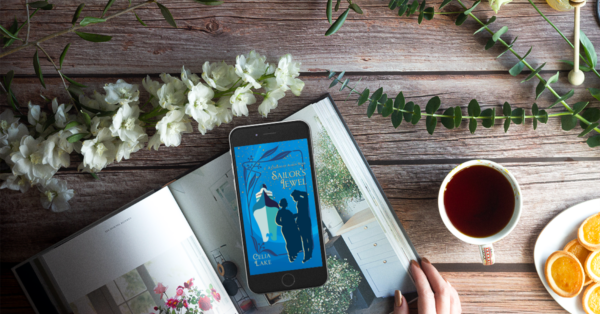
Thank you so much for joining Rhoe, Hugh (and all the others) for a week at sea. I’ve been joking for a while that anyone writing a series in my time period (the Edwardians through the 1920s) is sort of obligated to do an ocean liner book at some point, but the real reason for this book is it just seemed like so much fun (and it was). My original working tagline for it was “Taking a magical gem across the ocean. Alas, leviathan!”. You got a kraken instead, but I feel like the basic core is still there.
As always, I owe particular thanks to a few people. Kiya Nicoll remains my most excellent editor, and had a number of ideas that improved the book and parts of the worldbuilding.
A good friend from college who prefers to remain unnamed was an amazing consultant for many details here, ranging from the pelagic mermaids to the navigational implications of some choices. (It was very helpful to have a friend who has both marine biology experience and experience on the open ocean. All remaining errors are mine.)
For historical notes, let’s start with ocean travel since it’s so much a part of this book. There are some fantastic sites out there talking about the golden age of ocean liners, with many photographs, floor plans, and other details. I found the GG Archives particularly helpful for the wealth of details, but there are many other great resources out there.
The Moonstone is based on other ships made in the 1890s with a couple of magical considerations. I used other ships of the time for the time of the crossing, which varied due to weather, conditions, and any reason for interruption (as happens in the book). Most commonly it was a 5-7 day trip at this point. The cabins were as you see them here: extravagant and spacious for first class, modest but usually well-designed for second class, and larger cabins for third class. It was common to have unmarried men or women in larger cabins all together.
Magical ships have several advantages, many of which are referred to in the text. They are more pleasant to sail on as a passenger because charms and enchantments can help with comfort – items staying where you put them on a shelf, filtered water for bathing, easier and more efficient ways to heat water or cool a cabin. There are aspects not discussed here, such as making it easier and safer to clean and cook for a number of passengers.
But a key benefit, from the owner’s point of view, is that magic can make the massive coal furnaces that run the steam engines both more efficient (charms reduce the amount of heat lost) and safer for the crew. That’s true both in general due to better ventilation, less exposure to the furnaces, and so on. But a more efficient ship can carry less coal which is safer and leaves more room for other cargo – less expensive and greater profit, as well as probably a better safety record.
Clothing is obviously a major factor on ship, especially in first class. Rhoe, practical as she is, favours what’s known as both aesthetic and artistic dress. If you’ve seen images from the Pre-Raphaelite artists (or photographs of the women among that community), you’ve seen plenty of examples: they were designed for ease and comfort, and made of flowing and often richly coloured materials.
Oekology was indeed a field of study at the time, and as soon as I came across the name, I knew I had to include it. It’s such a great word. It is apparently coming back into discussion as a field again, since it looks at how communities function, especially when there is overlap to other spaces or systems.
There are few details from the chapter where Rhoe gets to show off her skills and bedside manner. Thermometers of the period took the five minutes shown to give a reading. This was better than the 1850s, when it took twenty minutes! Rhoe correctly diagnoses the problem as sun sensitivity brought on by contact with some plant that causes that (most likely, as she says, wild parsnip.) If you ever have an unexplained rash and you’ve been near plants or are taking medications that make you sensitive to sunlight, that might be your explanation.
The art songs sung at the first concert are a particular genre of song, popular in the 19th century and into the 20th for smaller performances. They were generally performed by a solo singer with a pianist accompanying, but they range through much of the Western European musical canon. You might hear a Schubert lied, a Dowland motet, something from an opera or operetta, and then something French.
As soon as I started thinking about this book, I knew I wanted pelagic mermaids to make an appearance. I have mentioned coastal mermaids in the past. (In Seven Sisters, they are where Vivian learned sign language. The coastal merfolk sign routinely with land dwellers in a form that takes two hands rather than a pod collaborating together. but some signs are adapted for water resistance.)
I think of the pelagic mermaids as rather like killer whales, especially the ocean-going species: matriarchal, forming close-knit groups and pods, passing along generational knowledge. Whales and humans actually have more anatomy in common than you’d think of at first glance, and I think they took a different evolutionary strand (quite possibly influenced by magic along the way, of course.)
Of course, it takes specific skills to be able to interpret between the pelagic merfolk and land dwelling humans, and that’s where Merope’s Speakers come in. I suspect I’ll be revisiting them in some future book. They negotiate between land and water in a variety of ways, and they are a peripatetic wandering lot, and fiercely independent.
Seals do indeed have interesting eyes that would result in what humans consider colour blindness – one that does otherwise occur in humans, tritanopia. It’s a blue-green colourblindness that makes it more difficult to see the difference between blue and green, red and purple, and yellow and pink. It also makes colours less bright. (I spent a rather long chunk of time reading about how the rods and cones work in seals, and then figuring out what the human equivalent was. I’d like to thank a presentation about the evolution of the eye in mammals I was at due to a work-related conference for knowing I wanted to do that.)
Gemstones feature heavily in this book. Aquamarine is as described at various times: it has been particularly associated with ocean deities, with scrying and visions as well as other more mystically-focused forms of divination, with curing poisons or purifying water, for clarity of thought, and for safety on the ocean. Maxixe, mentioned briefly, is a particular deep blue version.
I could not resist a reference to the famous blue stone of Galveston. If you recognised it, I’m guessing you’ve also seen that episode of Black Adder, a historical comedy from the 1980s starring Rowan Atkinson and Tony Robinson (now perhaps more famous as the host of Time Team). The series is set in four different historical time periods: Richard IV (yes, that’s fictional), Elizabeth I, the Prince Regent, and World War I. There are also a few specials. The history is surprisingly accurate when it’s accurate, though parts of it have not aged as well.
During the first series, there is a point where Percy (a somewhat dim nobleman) is comparing the eyes of the Infanta of Spain to the famous blue stone of Galveston. Asked if the people who told him this have ever seen either the Infanta’s eyes or the stone, he has to say no. Comparing one thing you’ve never seen to another thing you’ve never seen isn’s how that works. (You can find clips of this on YouTube by searching “blue stone of Galveston” if you’re really curious.)
One reason for Professor Merton to have the specialty he does was so I could have fun sharing a bit of sea monster lore. There’s quite a lot of it. The oceans are vast, and there are still so many things we don’t know about it.
We are fairly sure there are giant squid, much larger than we’ve ever seen alive, that may have given rise to the legends of the kraken. The leviathan is sometimes described like a giant primal serpent (in some lore it’s associated with Tiamat, a Mesopotamian goddess of chaos. It’s also named in multiple books of the Tanakh (the Hebrew scriptures). The aspidochelone is something else that shows up in lore, and is much as Professor Merton describes. It was so large sailors were thought to land on it and then drown when the creature submerged again.
Some of this lore is obviously an attempt to explain mysterious losses of ships at sea (besides storms). Some may well be an overlap with the natural world – squid, large whales, maybe icebergs that have made it unusually far into more equatorial oceans. And some of it, who knows, maybe we just haven’t discovered yet.
Port cities have a long and glorious (and complicated) history. Alexandria and Bombay (now Mumbai) are two of the more ancient, and Cyrus lays out the reasoning for some of the South American options. I chose Boston both because it is one of the oldest and busiest ports on the east coast of the United States, but also where I grew up and now live again. The chance to have some fun with Boston was something I couldn’t resist, even though there are a number of other good options.
In the vision from the aquamarine, they note that the temple they see is brightly painted. We know now (thanks to science advancing so we could find millennia-old flecks of paint) that the Greek and Roman temples were painted in all sorts of shockingly bright colours, rather than being plain marble. Cyrus and Rhoe don’t know that yet, however.
The Collect for Thanksgiving that Rhoe overhears is indeed taken from the Church of England Book of Common Prayer of the time (which was rather easy to find online). It has prayers for all sorts of things, but the other ocean one (as Rhoe says) is for storms. When I actually read the text, I couldn’t resist using a bit of it.
If you’ve read my other books – specifically Carry On – you’ll know that Christianity is one religion among many in Albion. Rhoe describes her coming more formal commitment to Belisama fairly clearly, but I had a lot of fun figuring out how Rhoe came to that decision and what experience she had early on that made her certain of her choices.
When it comes to the ship in distress, telegraphing between ships didn’t quite work yet (Though it would be famously a part of the Titanic story decade later, when it was still quite new.) And yet, ships had a strong code of assisting other ships having trouble at sea, in whatever way they could.
Rhoe points out that in the United Kingdom at this time, she would not have any vote or a number of other rights such as being able to have her own bank account. Albion is rather more progressive out of necessity (due to women with strong magic needing to have education training for the good of the community as well as themselves), but she’s very aware of how narrow that margin can be.
The William Weightman mentioned on the Memory is a real person. He was at one time arguably the largest landowner in the United States, and he made a synthetic quinine, much in demand for treating malaria. He died in 1904 at the age of 90, leaving all his property to his daughter, Anne, who also has an interesting history.
Finally, once we reach Boston, my thanks to the friend who consulted on best areas for the magical streets of the city. The plays mentioned in the Boston chapters were actually playing that week. Thank you to the Boston Public Library collections so I could figure out exactly what was on. I dithered about Iolanthe, a Gilbert and Sullivan operetta which is about fairies in a way that is utterly incompatible with the Fatae of my books. But it is, as Rhoe says, pretty much what you might get if you heard those stories tangled up, while drunk. The stars of this particular production were particularly respected, according to the reviews I could find.
More about these people:
If you’d like to see more of Rhoe later in her life, check out Carry On, set in 1915, where she is a secondary character. (Rhoe and Hugh also appear briefly in Eclipse, as does Cyrus.)
Cyrus finds a second romance of his life in 1926 in The Hare and the Oak. I also have plans for a romance for his daughter Gemma around 1928, coming out in early 2026. Cyrus also appears as a secondary character in a number of the Land Mysteries series books.
You can find out more about all of these on my authorial wiki (or get there from my website under the menu that says “more information”). And again, please do sign up for my newsletter to be the first to hear about future books and learn about fascinating bits of research. Happy reading!