
Curious about what’s behind Magician’s Hoard? Explore my author notes about the historical details behind the book.
These notes do contain some plot spoilers! Otherwise, they’re as shared at the end of the book, with edits only to share the most useful links and cleaning up some formatting for the web. Posted March 2026.
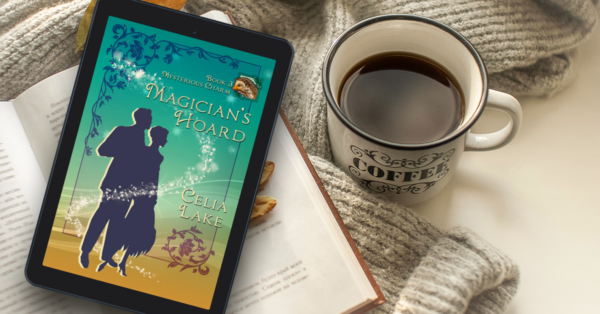

This was such a delightful book to write! The 1920s are a particularly rich period for Egyptology (even if some of it rather misguided).
Before we go any further, I want to thank Kiya Nicoll for the Egyptological consultation on this one, as well as being the best editor I could ever hope for. (Other services have included taming my commas, telling me when I need more ponies, and helping me sort out plot complexities. As well as telling me when I need to add another chapter.)
The Petrie collection of the time is much as Ibis describes it: William Matthew Flinders Petrie was still actively excavating in Egypt through around 1933. I had a chance to go to a lecture there in 2015 (on the Egyptology in the Classic Doctor Who episode Pyramids of Mars because I am entirely that sort of geek.) It’s an amazing teaching collection with stunningly important historical objects every time you turn around. If you’re at all interested in Egypt’s vast history, I recommend the Petrie Museum website and museum to you.
The Professor Murray Ibis mentions in passing is Dr Margaret Murray, known as a quite accomplished archaeologist and Egyptologist, but better known these days for rather less historically rigorous ideas about European witchcraft.
I loved having the chance in this book to show the kinds of religious practices that might have carried through in the magical community from ancient Egypt. Ibis is particularly devoted to Djehuty (more commonly known in English as Thoth). Commonly depicted with an ibis head (for the similarity to a scribe’s pen), he was also associated with the baboon, hence the items in Ibis’s office.
Hetheru, also known as Hathor, was traditionally depicted with the head of a cow, and Ibis makes reference to her horns. She was associated with lovemaking, beauty, music, dancing, and joy. The line Ibis recites in chapter 26 comes from one of the prayers to her found in a papyrus from the Middle Kingdom period.
Rudyard Kipling was still alive and actively writing in this period – more than once I had to go and double check that something I wanted to refer to had been published already! As Pross says, he can go from amazing to agonising in a matter of a sentence or two, if you’re aware of the underlying politics of empire and India in particular.
Acting Brigadier-General Reginald Dyer was in command of British Indian Army troops who shot into a crowd of Punjabi men, women, and children gathered in peaceful protest in April 1919. The troops ended up killing nearly 400 people in a crowd of 1,500 during what became known as the Jallianwala Bagh or Amritsar Massacre.
Michael O’Dwyer was the Lieutenant-Governor of Punjab at the time. He had approved Dyer’s actions and many believe him to have been the main planner. (O’Dwyer was killed by an activist who had been wounded in the massacre in 1940.)
Finally, there are so many variants of shapeshifting, and in the world of the Mysterious Charm, there is no need to pick just one. I knew Ibis was a shifter (and into a hedge‐ hog) from fairly early on, but I wanted to write about a magical ability that is often associated with curses, wrong- doing, and stigma in many mediaeval and other historical texts. However, Ibis is the most adorable hedgehog, and hedgehogs are found both in England and in Egypt.
The appearance of a snake cult half way through the book surprised me (and I suspect they still may be up to things in the larger world, despite being foiled here…). And the sirrush is a fascinating creature, also known as a mušḫuššu. You can, however, see why I went for sirrush for the book… But there you are. Sometimes a novel needs a snake cult.
(If you’d like to see more about the aftermath of the snake cult, Point By Point picks up that thread of the story.)
I hope you’ll join me for book four, Wards of the Roses, about a manor mysteriously reappearing in the Oxfordshire countryside after several hundred years. (It takes place in 1922, and explains how Captain Lefton, introduced at the end of Outcrossing, got her job.)
My authorial wiki (celialake.com/wiki) has pages, timelines, and maps that connect characters, places, and events in various ways. Please let me know if there’s additional information that would be helpful to you.
The newsletter (https://www.celialake.com/newsletter/) and my social media accounts will have all the details about new and upcoming releases, and I hope to see you one of those places! Until then, happiest of reading to you.
As always, reviews and comments on the books are always welcome!