
Curious about what’s behind Outcrossing? Explore my author notes about the historical details behind the book.
These notes do contain some plot spoilers! Otherwise, they’re as shared at the end of the book, with edits only to share the most useful links and cleaning up some formatting for the web. Posted March 2026.
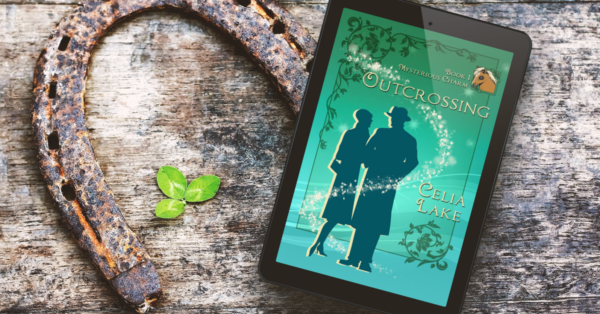

Thank you so much for joining me, Rufus, Ferry, and all the others of this book! Set in the 1920s in Great Britain, the Mysterious Charms series focuses on a magical community living and loving alongside the history we know.
These books come from my joined love for mystery, parallel world fantasy, and romances. (And a particular fondness for Dorothy L. Sayers and other Golden Age of mystery fiction and for rolling around in real-world history.)
You can read the books in any order (each one has a happy ending, with no cliffhangers) but the series does have some overlapping characters. As books are published, my website (celialake.com) and authorial wiki (celialake.com/wiki) will let you know which books have more of particular characters or settings.
Many of the details in the book are based on things from our world, so here’s a little more if you’d like to read further.
Outcrossing is set in the New Forest in southeast England, and I drew on a number of New Forest traditions when writing it. Six of the seven rights that Rufus and Ferry talk about in chapter 11 have been part of the New Forest for centuries. (Yewbote is the one I made up.)
True Eyeworth is a magical village in the Forest, hidden by some of the magics that characters refer to, about how non-magical folk just won’t go down that road or notice that thing.
Ytene is a landed estate whose name dates back to the Domesday Book, and as in medieval England, various lords and nobles have magical responsibilities to and for different areas of land.
The traditions of turning out the mares and stallions in the Forest are still practiced, much as described in the books. These days you can also find websites that will tell you about the lineage of different New Forest ponies.
Rufus refers to the Naples Scourge – one of the other names for the Spanish Flu. That epidemic in 1918 had a terrifying death toll, infecting 500 million people (about a third of the population), and killing 3-6% of people in the world. In English speaking countries, it’s often called the Spanish Flu because Spain was neutral in the War and did not have restrictions on publishing the real death counts or spread of the epidemic.
If you’d like to read more about this part of history, The Great Influenza: The Story of the Deadliest Pandemic in History by John M. Barry and Flu: The Story Of The Great Influenza Pandemic of 1918 and the Search for the Virus that Caused It by Gina Kolata are both good books (the first is more about the history, the second more about the virus itself.)
Rufus briefly mentions something that happened at Mons in chapter 24. The actual story of the Angel of Mons – a figure or figures of light standing between the British and German forces – comes out of a fictional story, but it became widely held to be true. Of course, if there were magical forces at play, any number of things might have been glimpsed in the War.
On the fictional side, many of the magical creatures come from my head, but many are inspired either by real animals or by medieval bestiaries or folklore. The ginsies mentioned as being particularly dangerous cause an allergic reaction in people with magic about half the time.
Pavo and bohort are based on real medieval training tools and games. Both involve small teams solving magical and practical puzzles (depending on the focus of the game and the challenges set), but pavo is played on horseback and bohort is played on foot. As a result, pavo is the sort of game played by people with money who can maintain a stable of horses with some specialised training and bohort is more accessible to anyone with useful skills. There’s more about both sports in future books.
If you have questions about anything mentioned in the books, check out my blog or please ask me a question through the blog contact form, both on my website at celialake.com.
The best way to find out my latest news is to subscribe to my mailing list (celialake.com/newsletter). You’ll get a copy of Ancient Trust, a prequel novella for the series focusing on Geoffrey Carillon inheriting his title that overlaps with Outcrossing. It has a look at Rufus and Carillon meeting from Carillon’s point of view.
Rufus makes a brief appearance in Goblin Fruit (Lord Carillon’s romance), and Ferry appears briefly in On The Bias, both later books in the series. (They also make appearances in other books, later on.) And there’s a great deal more about Ytene, Lord Carillon, his eventual wife, and his various plots in other books of mine.